Showing posts with label social studies skills. Show all posts

Wednesday, April 3, 2019

You Down With OPV?

You down with OPP (Yeah you know me)
Who's down with OPP? (Every last homie)

Large chunks of the “OPP” song (by Naughty by Nature, 1991)  are pretty inappropriate for me to send out through work email.    So, don’t think about those parts and we’re all good.

And don’t listen to it on your work computer or with students around. Just saying!

Instead of “OPP”, we’re going to talk about “OPV”
Like Naughty by Nature has said, “O is for Other, P is for People”
The last “V”, well, that’s not so simple.

I won't get into that, I'll do it...uh...sorta properly.

Ok, ok, enough silliness. This IS really a strategy and it IS really called OPV. O= Other; P= People; V=Views.

Our benchmarks ask us to look at multiple perspectives frequently -- particularly with historically underrepresented groups. We even have a benchmark about seeing history through the eyes of the people who lived it.

We also have a current societal problem where people live in echo chambers where they don’t actually experience opposing viewpoints in their social circles -- or if they do, the common response is to ridicule and mock the other side.

So how can we help kids learn to examine Other People’s View? I’m down with OPV (I know i sound old. I can live with that)

OPP, how can I explain it? I'll take you frame by frame it.
This is a hook activity that’s intended to be an introduction to a lesson and should take less than 10 minutes. Other People’s View (OPV) is from CoRT Thinking Tools , an exploration tool to broaden perception. It’s a very important part of thinking to be able to see the different points of view of other people -- not just your own. The OPV helps kids to broaden their (our?) overall thinking about a situation.. ​​​
Here’s how to do it:
•Step 1: Display a photograph (or painting or another visual stimulus)  without giving background information. Have students analyze the photograph. ​​​
•Step 2: In each of the thought bubbles have students individually write what they think the people/animals/objects in the image may be saying, thinking or representing. This step is intended to help students think about different points of view.​​​
•Step 3: Have students share and compare the comments they wrote in the thought bubbles with a partner or in groups. ​​​
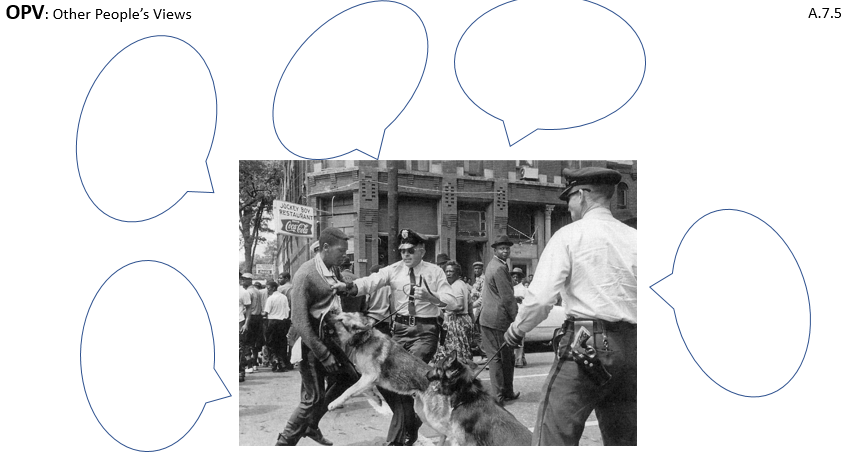
•Step 4: Debrief whole class making connections to related concepts and establishing historical context.​​​
The example here shows a famous photo of police dogs and a Civil Rights demonstrator in Birmingham in 1963.  How can students attempt to understand viewpoints of the the demonstrator, the bystanders, the police, --even the dog?  \

How can we get use this tool to get students to look at multiple viewpoints?

We can try this with photographs, of course. But political cartoons and paintings work, too. Here’s a Civil War cartoon about Lincoln. The caption (which may be too small here for you to read), says “Lincoln’s Last Warning: ‘Now, if you don’t come down, I’ll cut the Tree from under you’”.     

This is an easy strategy to set up! Just open a word document, paste the image you want in the center (leaving big margins) and insert the speech-bubbles.

If you don’t know where to find those, go into Word, under “insert” click “shapes”. At the bottom should be several versions of “callouts”. Choose one and resize and flip as needed.

That’s it.

Say OPV I like to say with pride
Now when you do it, do it well and make sure that it counts
You're not down with a discount

You’re down with OPV (Yeah, you know me!)

Don’t forget to have your kids share their thought bubbles together to encourage deeper conversation. It doesn’t have to take long and it encourages creative thinking and multiple viewpoints!

Well if you do, that's OPP and you're now down with it
But if you’re not, here's your membership

You’re down with OPV.

Yeah? You know me?

Email me! Tell me how OPV goes!

-Tracy

Tuesday, October 23, 2018

The Source

Imagine that you got a letter in the mail (with students, I pretend that they found a note in the  hall or in their lockers). Imagine that this letter or note said horrible things about you. Imagine that it accused you of doing terrible things and it called you awful names.

Now, think about who wrote it. You would deal with that letter or note differently if it was from a friend you had a disagreement with ... differently if it was from your ex ... differently if it was from your current significant other (and you thought everything was ok) ... differently if it was from your sibling ... differently if it was from a coworker  ... differently if it was from ANOTHER coworker... differently if it was from a complete stranger!


Sourcing matters.

It matters when you look to see what news outlet a Facebook link comes from. It matters which parent sent which email. It matters what author said which quote. It matters which individual made which comment on your social media. It matters what think tank funded which study. It matters which PAC paid for which ad. It matters which organization sponsors what website.


It also matters whether the document is from the Egyptian pharaoh or the Egyptian slave or the Kushite trader or the Israelite slave in Egypt or the British historian or the Greek enemy.

Sourcing matters.

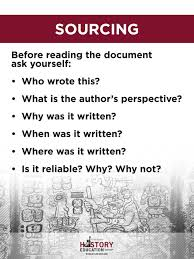
For every document, we always ask:
  • Who wrote this?
  • What is the author’s perspective?
  • Why was it written?
  • When was it written?
  • Where was it written?
  • Is it reliable? Why or why not?

The way we read and understand a document (or even a secondary source, really) depends on sourcing. Just as in the letter/note example, you would deal with that mean and nasty letter differently if it was your ex than you would if it was a coworker.

How would you react if it was your ex that wrote that letter (for some of us it might have been a long time ago and we might be surprised that they even remembered that we exist!)

How would you react if it was your sibling that wrote that letter? (it probably depends on how that relationship with your sibling is these days)

How would you react if it was your significant other wrote that letter? (assuming that things were generally good between you)

It depends on what you know about the author -- or about his time period or about her culture about his location or about her group/organization.

Sourcing matters.

It is the first step in our historical thinking skills AND it is a crucial piece in the civic literacy -- AND it is the a big part of the ELA/LAFS standards.

If I can challenge you this week to do one thing it’s this:

Have your kids dig into the sourcing information of EVERYTHING THEY READ.

They need to be in the habit of looking at the source for Social Studies, for ELA, and for Civic Life.

Teach them how to look at the source of current events, historical documents -- even textbooks!

Did  you read the article a few years ago about the Texas textbook that said that enslaved persons fought FOR the South in the Civil War?


Uhhhhh ....  No.

That textbook writer (OMG that was a textbook writer!!!) pulled info off a Sons of the Confederacy website that has no evidence to support its claim.

It can happen anywhere that people are not careful. If we don’t look at the sourcing information, we don’t understand the author’s point of view.

That doesn’t mean we’re sourcing documents to see if they’re RIGHT or not, TRUTHFUL or not. It means we’re sourcing them to see where the author is coming from.

If you have never seen the SHEG Lunchroom fight lesson on sourcing, it will make this sourcing stuff make MUCH more sense. https://sheg.stanford.edu/history-lessons/lunchroom-fight . You need a login, but it’s free and some of the highest quality Historical Thinking stuff out there!

Goal for the week: Be more intentional about sourcing everything with kids -- including secondary sources! If you make it a good habit, kids will get in that habit too!

Questions? Thoughts? Awesome ways you source documents? As always, email me. I want to hear all about it!! newmantr@pscb.org

Thursday, April 19, 2018

Multiple Perspectives

Do your kids look at history like, well, um, ... kids? Do they assume that everything in history  was inevitable? Do they assume that everything in history happened for a “logical, purposeful” reason?

Your kids aren’t alone. Plenty of adults also struggle with the idea that things in history were “meant to be”.

But not everything HAD to turn out the way it did and it’s useful for kids to put on their “Multiple Perspective Glasses” and see things through someone else’s eyes.

Here’s a strategy called “PMI” which is a way of looking at an issue from multiple viewpoints. It’s easy for us-in-2018 to look at history and see inevitability in how things turned out and think “of course things turned out that way! Was there ever a question?”


Yes.

There were hundreds of questions in history that had many very real possibilities of turning out differently.

Instead of students believing in the inevitability of history, it’s important to look at history through the eyes of  people at the time period and examining it the way they might have.

A great strategy for this is called “PMI”.

P= Plus (or positives)
M= Minus (or negatives)
I = Interesting

Pose an interesting question from history -- a “what if” or a “what would you do?” question like ...
  • Should Truman drop the atomic bomb?
  • What if Radical Republicans kept reconstruction going strong for another decade or two?
  • What if Texas had remained an independent nation?
  • What if the Founders had left slavery out of the Constitution entirely?
  • Should the Cold War get “hot” and the US and USSR fight directly?
  • What if Kenya had invested in infrastructure during decolonization?
  • Should LBJ sign the Civil Rights Act of 1968?
  • Should Lincoln free ALL the slaves with an Emancipation Proclamation?
  • Should the Supreme Court be the best place to decide the 2000 presidential election?

Once you have a good, debatable, multiple perspective question, then you can ask the kids to  tell you the positives of the situation, the negatives, and interesting points.

As with any new skill, I would model this the first time. Then, I would have students practice using it in groups. Finally, I would let them try it out on their own.

Download one from here https://lo.unisa.edu.au/mod/book/view.php?id=611321&chapterid=100451 and let me know how it goes!

Multiple perspectives isn’t just a “nice to know”. It’s crucial for our students as future voters, as internet users, and as participants in civic dialogue about everything from building new roads to gun control to race relations to balancing the budget. Every topic in the news requires the skill of multiple perspectives -- and so do our EOCs and Final Exams!

As always, try it and let me know how it goes!
-Tracy


Thursday, January 18, 2018

I Like to Move It, Move It

Happy New Year (still)!

When was the last time you sat in a long meeting, PLC, or training. Feel free to call me out on this one from some meeting or PD you were in with me (“Tracy! That's that one long meeting with YOU!”)

If I can ask a personal question, how do you FEEL after sitting for that long? Do your legs go numb? Does your foot bounce up and down? Do you change posture over and over again? Does your backside get too tired of those plastic molded chairs we find almost everywhere?


Uhhhhh, Trace? Pot? Kettle?

Yup. I’m not a superstar at incorporating movement in my instruction or my PD,  I admit it.

Sitting too long makes you tired. It makes your eyes glaze over. It makes you zone out. It makes your fitness tracker chirp at you. And if you sit there every day in 45-minute chunks (or longer!!) and rarely get to move ...

Your brain won’t work as well. You need oxygen to your brain, produced by body movement.

The average learner regardless of age (that means we- adults as well as our teens and tweens) needs to briefly move their bodies every 15-30 minutes If you’re in a 45 minute class, you need to have kids get up once in the middle. If you teach on block, you need to get them up multiple times a block.

Here are a couple of benefits of movement breaks:
  • Brain needs processing time for short term memory
  • As students return to content, their brains can refocus; movement re-energizes learning
  • If students are uncomfortable or stressed, the brain will not retain new information easily.
  • There is much less movement in today’s world of Ubereats, social media, and Shipt. Kids and grown ups need to move!
  • Our best ideas often come when we are taking a break.
  • Movement and collaboration heighten participation.
  • Movement can builds relationships, self-esteem and sense of belonging
  • Movement boosts listening skills and communication

  • Approximately 90% of the oxygen in our bodies are “stale” until we take a deep breath, yawn, or move.
  • Lack of oxygen results in confusion, lack of focus, and memory problems.

Yeah. It’s kind of a big deal.

“But Trace,” you say, “if I let my kids get up, they’ll go crazy!! (more likely in middle school) or “my kids will think it’s stupid and they won’t want to do it (more likely in high school)

If you’re worried your kids will get wacky, then set parameters, like you do with everyone else. Then don’t give them a “wiggle break” or a “stand and stretch” break. Instead, work it into your lesson.

Try things like
  • If you agree with x, stand up at your seat. Now sit down. If you think it’s y, stand up at your seat.
  • Please walk around the room to find someone who chose the same answer you did. See if you two (or three) can explain why you chose what you chose.
  • Please send one member of your group to me to check the answer.
  • Go post your response on a sticky note on the board/question when you’re done.
  • Do a gallery walk in small groups.
  • Graffiti challenge -- post prompts, misconceptions, or political cartoons on chart paper on the board. Have kids go respond to those question with graffiti. No chart paper? Have them write right on the whiteboard
  • Turn and talk -- but GET UP and find someone to talk to  ... (whose name starts with the same letter as yours, someone whose birthday is in the same month as yours, someone who as the same math teacher as you.. whatever)

One last note -- Movement is one of the 6 Ms of Culturally Responsible Instruction. When kids are up and moving, they are interacting with each other. When they speak and are heard by each other, they are being culturally responsive. And when they get up and move you-the-old-person-teacher (yes, even you, recent-college-grad. You’re old in their eyes), your Old Self is being responsive to their youth culture. And youth (children and teens) need to MOVE! It’s developmentally appropriate. So with movement, you are incorporating a small piece of CRI (Culturally Responsive Instruction)


And today, it might get the blood flowing through their frozen little limbs.

Try some movement. It doesn’t have to be a big thing. It doesn’t have to be elaborate. Put some rules/parameters on it and give it a purpose. You’ll be surprised at how much it improves student learning.

And then, get up and move it, move it. (You’re welcome for that Lin-Manuel Miranda "Moana" earworm!)

Let me know how it goes. Does your class implode? I hope not! Email me to tell me! newmantr@pcsb.org