Have you ever mis-heard
something and you had to listen to it again to better understand it? There are
books and websites dedicated to the hilarity of misheard lyrics. My all-time
best misheard song lyric is Jimi Hendrix’s “Purple Haze”. The misheard lyric is
“‘Scuse me while I kiss this guy”. The REAL lyric is “‘Scuse me while I kiss
THE SKY”.
I love misheard lyrics.
They usually make me giggle out loud like a kid. Partly because I mishear
lyrics all the time, partly because they’re so silly and funny, partly because
they make you listen to the song again. I sung “rock the cash box” instead of “rock
the casbah” until well into adulthood!
Here are some of my
other favorite misheard lyrics
Dancing Queen by Abba
Original: See that girl, watch that scene, dig in the dancing
queen
 Misheard:See that girl,
watch her scream, kicking the dancing queen
(Ouch!)
Tiny Dancer by Elton
John
Original: Hold me
closer, tiny dancer
Misheard: Hold me
closer, Tony Danza
(Right. Who’s the boss?)
Rock and Roll by KISS
Original: I want to rock
and roll all night and party every day
Misheard: I want to rock
and roll all day and part of every day
(So much more practical)
Bad Moon Rising by
Creedence Clearwater Revival
Original: There’s a bad
moon on the rise
Misheard: There’s a
bathroom on the right
(good to know!)
All this silliness is to
help us remember that sometimes, you just need to relisten and reread to get it
right. Sometimes, you need to listen to Elton John’s song a few bijillion
times. Sometimes, you need to sing along with the KISS song.
And sometimes, in class,
you need to read a text more than once. Sometimes you need to read it two or
three times.
Ugh.
I admit that even as the
literacy-in-social studies coach, I have pushed back a little against this
read-it-more-than-once trend. I rolled my eyes. I thought I didn’t have time. I
thought my kids “got it” the first time. I thought I had too much content to
teach to stop and reread something.
The eye-rolling was even
more recent than I would like to admit.
And then, I spent a half
of class period on a document from Industrial Revolution mill workers only to
be asked what the Industrial Revolution was and what a mill was immediately. My choice at that point was to either reteach it or grumble about ‘these
kids” and move on without them learning it.
I chose to have them
reread and I’m glad I did.
If you are having your
kids read primary source documents (or more challenging secondary sources), the
chances are pretty good that your kids will get tripped up at some point. It’s
natural. It’s normal. Kids don’t always have the vocabulary, background
knowledge, or reading level to deeply understand every primary source document
you put in front of them.
If they could do it by
themselves, you wouldn’t have to teach it!
 Common Core and the new
Florida Standards ask our kids to read complex text deeply. Nobody gets
it right the first time. That’s why they call it complex. And that’s
okay. That’s why second (and third) tries were invented!
First -- make sure your
document is manageable. If it’s super long, pull out a smaller excerpt. If the
vocab is way above them, annotate it a bit by defining a couple of words in the
margins that are necessary to the understanding of the document (ex.
industrial, mill)
Second -- come up with two
or three separate reasons to read your document. Here are some
examples, but JUST USE two or three
- Overview read -- read the
document silently or teacher read aloud to get the overall idea.
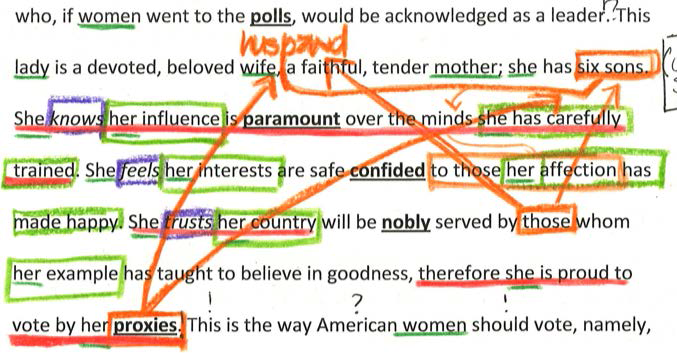
- Text Marking Read -- have kids
use a (?) for parts where they are confused, an (!) for an important piece
of info, an underline for patterns or things that come up
repeatedly, and an --> (arrow) for connecting one piece of text to
another.
- Vocabulary -- have kids read
specifically to find meaning for vocabulary terms (either ones selected by
you or by them)
- Reading Strategy -- have kids
read another time to use your reading strategy (Venn Diagram, for example)
- Essential Question -- have the
kids circle words or phrases that will help answer the Essential Question
of the day.
There are a ton of
different “types” of reads, or different purposes for reading. That’s okay.
PLEASE DON’T... have
kids read it five times (too much!). PLEASE DON’T have kids do these on a long
piece of text (it will take forever).
Instead, choose
two or three of the ones above and guide your kids through a close
reading in which they read the document more than once.
We all have to read
things more than once. It’s why millions of books or sermons are written on the
same pieces of holy writings. It’s why people can read Shakespeare (or even
their favorite novels) again and again. It’s why every time I look at a great
work of art, I see something I missed last time.
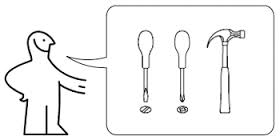 I recently got a piece
of furniture from IKEA. Even though the directions are pictorial and not
textual, I still had to “read” the directions multiple times to get it right.
And I’m a visual-learning, masters’ degree-holding, adult who has EXPERIENCE
and LIKES putting IKEA furniture together. If I needed to read the
directions more than once, why shouldn’t a kid who may or may not have
background knowledge or confidence reading documents?
There’s no shame in
rereading. It’s not just for lower-level kids. There’s honor and pride
and rigor in multiple reads -- or IKEA directions or song lyrics or (hopefully)
in primary and secondary documents.
It’s important to read
important or complex texts more than once. There are several ways to do that.
So, will you try it? Start with something complex but brief -- something like a
short letter or the Preamble or a paragraph from a historian.
Please drop me a line
and let me know how it goes. And, please, hold me closer, Tony Danza!
-Tracy
 Oh the testing in here is frightful
 Oh, tests don’t show signs of stopping
 Now the kids are really trying