Showing posts with label reteaching social studies. Show all posts

Wednesday, March 27, 2019

Three Rs

I still remember doing a WHOLE lesson on the difference between slavery and indentured servitude. And then, the long-answer question on the test asked the kids to explain the difference. And THEY ALL BOMBED THAT QUESTION!!!!

WHAT THE HECK??!?!? I TAUGHT MY BUTT OFF!!!!

It can’t be that they’re ALL stupid (although I might have said something along those lines, purely out of frustration!).

And then, the inevitable question of “what do I do now?” arises. Do I review the concept quickly and hope that sticks when the “real” lesson didn’t? Do I go back and reteach the whole thing? Do I say “oh well” and move on with pacing?


Well, first, let’s talk about the difference between Review, Reteaching, and Remediation.

Review is spending a shorter amount of time just looking at the content again (re-view). It’s that study guide before the test, the review packet before the exam. It’s a game where we get to look at content from a while back. It’s where you tackle 3 months of content in one class period. Everyone needs review.
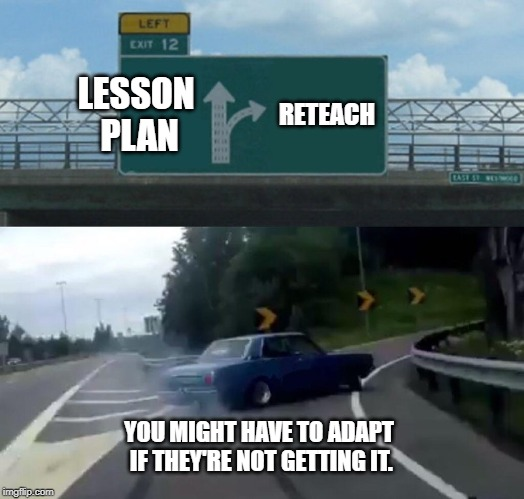
Reteaching is where the majority of kids didn’t get a concept and you need to try to teach it again, another way. Maybe you tried the first time with a reading and now you’re going to try a concept map. Maybe the first lesson was video-centered. This time, try a graphic organizer. Most kids probably need that lesson retaught.

*Note: Reteaching requires teachers to make pacing decisions. You WILL have to determine if you take less time on another topic to reteach this one.

Remediating is where you fix a problem, particularly student-by-student. To remediate is to try to address a problem -- like, if Student A didn’t get Concept B. Remediation is more student-specific and attempts to target a problem with a specific piece of content or a skill.. Remediation isn’t the same as reteaching, although they’re often mixed up together. Remediation is more targeted and more clearly defined.

Let’s look at the difference when we look at a one benchmark.

If I were going to REVIEW Civics Benchmark 2.4 (Bill of Rights), I would go back over the Bill of Rights, maybe including it in a review game or playing a video and asking kids to reflect after the video.

If I were going to RETEACH Civics benchmark 2.4, I might start with teaching the hand signals for each amendment (to engage tactile learners) and help the kids organize slips (with one amendment written per slip) into categories. I think I would finally give kids scenarios that had them applying the amendments to a particular topic.
If I were going to REMEDIATE Civics Benchmark 2.4, I would first check my data to see which kids struggled with that benchmark. Then, I would use formative assessment data from my class (I might need to make one) to see WHAT PART of the benchmark (or which benchmark clarification) the kids missed. Then, I would specifically create a lesson or a mini-lesson to address and fix that deficit. Maybe we would look at just the amendments they did NOT get -- maybe they got the 1st, 2nd, 3rd, 9th and 10th. So we will work on the others (4, 5, 6, 7, 8)  in a small group, using the hand signals and having the kids illustrate those particular amendments.

So what do we do after the main teaching?

It depends on IF kids bomb, how MANY kids bomb, and HOW they bomb.

We adjust from there.

There’s no silver bullet. But there are plenty of ways to adapt to moments where kids don’t learn what/as much as you want.

Think about using review, reteaching, and/or remediation to help your kids tackle stuf they need to tackle.

As always, let me know how it goes!
Email me at newmantr@pcsb.org
-Tracy


Tuesday, August 21, 2018

Big Data and Small Data

Congratulations!  It’s the second week of school. You are finally getting into content. You actually know some of your kids’ names. You are currently on top of things, since you haven’t given too much work that needs to be graded yet. You are feeling (a little) less exhausted than you did last week.

So, think way back to pre-service week (sometimes called pre-school). What did you hear the most?


Here is an unofficial list of the words you heard a billion times before school started:
  • New
  • Procedure
  • Protocol
  • Data
  • literacy
  • Differentiate
  • Active assailant
  • Text
  • Struggling
  • Relationship
  • Focused
  • Marzano

I didn’t get to spend pre-service week with you all, but it’s possible at at some schools, the #1 word on that list (in terms of usage) was data.

How to access your data, where does your data come from, how we’re going to move the data, what the data tells us, how to gather data .... That word seems to come up a LOT!


So, let’s think through some of that data and some of the questions that come up with it.

Where do I get data?

Everywhere, everywhere, everywhere!

No, seriously, you can get data from Portal and PM. You can get data from your gradebook. But, you can get data from every interaction with a kid, from every time you read his or her work, from every conversation with a parent, a guardian, a concurrent teacher or a former teacher. You can get data when you survey your kids about their learning styles and Data is everywhere.

What do I do with state and district testing data?
Read it, and try to form an overall picture of the kid. Has he or she been a consistent low reader for several years, or did he or she just have a lousy day or a rough year? Has he or she generally done better in math or in reading?

Remember, all that stuff is actually “autopsy data”. It’s all dead. It was taken months ago and is not longer a current picture of the kid. It’s important to lean what happened last year. But it is JUST AS important to collect more data now, and learn where the kid id now. Today!

How do I get new data?

You should be the prime data-collector for your course. You should get data through tests, quizzes, and projects, of course. But you also take informal data every time you do a formative assessment. You can get valuable, up-to-the-minute, in-the-middle-of-it data by reading quickwrites, listening to turn and talks, mentally noting where kids go during a “four corners” activity, or glancing at their text marking.

Formative Assessment should be taken all the time, ideally every day but at least a couple of times a week. It should only take a minute or two.

If you aren’t a formative assessment ninja, I highly suggest that you start intentionally planning for formatively assessing your kids every day.

Checking their classwork or homework is only useful if the work was intentionally planned as a formative assessment. You want to make sure it’s something they can’t effectively copy from each other. Make sure it’s something that has more than one answer (“What year was the Declaration of Independence written?” “1776”. Bam. Done.) Make sure it tells you about their learning, not just their compliance with your directions.

The two best lists of Formative Assessment Strategies I know are here:

Or, check out the Formative Assessments or Formative Tasks in your Social Studies 2018-19 Curriculum Guides. There’s some REALLY good stuff in there (although I am admittedly biased)

Now is the time, as you start working in actual content, to get in the good habit of formatively assessing all the time. A couple times a week. Maybe every day?

How have you been formatively assessing? Where do you need help with data? How many other pieces of data can help you better understand your kids? Now, how can you use all those pieces of information to better teach your kids? As always, I love to hear from you! Email me newmantr@pcsb.org
-Tracy

Wednesday, March 22, 2017

R&R, and R and R and R

R & R ... and R and R and R and arrrrgghhh.....

Today’s Wednesday Words are brought to you by the letter “R”.

I hope you got great R&R last week. The weather wasn’t exactly beachy for a Floridian but it was lovely for chilling on the hammock in the back yard.

I was thinking about our R&R -- rest and relaxation -- last week while I was on said hammock.

And then I thought about how it’s fourth quarter - omg it’s fourth quarter, y’all!

How did that happen already? I can’t believe it’s already fourth quarter!!

Fourth quarter!!  Time to cram in everything you missed this year and then go back over it all and get them ready to take a test ...

Now that you are done with your R&R on spring break and on the downward slope toward the end of the year, I’d like to think about ... R and R and R

Review and Reteach and Remediation.

What’s the difference? Isn’t it all the same? Aren’t they just different names for talking about all the stuff at the end of the year?

In a word? Nope.

  • Review is where you go back over the content from earlier in the year. Of course adolescents don’t remember what they learned in September! They don’t remember the homework you assigned yesterday or the Ice Bucket Challenge (RIP, Ice Bucket Challenge. SMH.) Of course they don’t remember content from seven months ago. At this age, they were, like, totally different people seven months ago!
    • How to Review? Review whole class with games and activities. Just don’t forget the higher levels! The test isn’t all recall, so your reviews shouldn’t be either...

  • Reteach is where your whole class bombed (or, more appropriately “didn’t master”) certain material. Check your data. Reteach is needed when you taught the three branches or westward expansion or the Vietnam War and then discovered  that somehow your whole class has no clue what that topic even is.
    • How to Reteach? Think about your lesson, look at your benchmarks, and then make a new lesson to teach it again, differently. Your kids didn’t get it, so they need to start all over.

  • Remediation is where you figure out which kids didn’t get which material  and pinpoint specific activities to help those particular kids learn that particular material. Kid A  missed benchmark 2.9 and Kid B missed benchmark 2.11? Then your whole class doesn't need a whole-class lesson on 2.9 or 2.11. Those individual kids need something to help them master those benchmarks that they need to improve upon.
    • How to Remediate? Look at your data and pick a few benchmarks with which a handful of kids struggled. Create a couple of benchmark-specific activities to have those kids work on. Then, have kids work on JUST the benchmarks they need.

If review was like the a frosting on a good cake, then reteach is like baking the cake all over again and remediation is like adjusting the quantities of specific ingredients. It’s more precise, more scientific.

We are beginning the fourth quarter and it’s time to start thinking about the three Rs -- Review, Reteach, and Review.

Which one do each of your kids need for which content? And how do you plan to do each?

As always, I love to hear from you! Email me at newmantr@pcsb.org
-Tracy