Now that we’re over the “honeymoon” period of the new semester. They’re all done with that post-winter break sweetness and they are up to their old tricks again.
Life is getting complicated again. The stack of stuff to grade is back. The lesson plans we got caught up on are now all used up and the next ones aren’t yet written. The meetings and conferences are filling up the calendar.
So let’s make life easier.
Here are my top five favorite tips to make your life easier in the classroom. Maybe if ONE of them works, then one little corner of your life has gotten easier? I can’t promise miracles. But if your frustration level is a 6 today, maybe we can move it down to a 5 or even a 4 with one of these ideas.
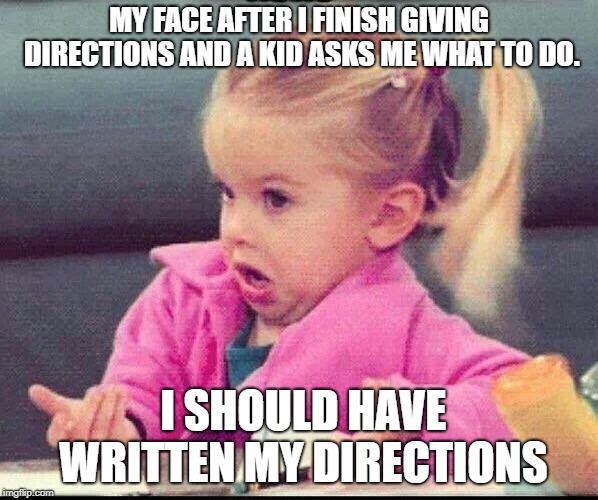
5. Written Directions: Not every kid is an auditory learner. And to be honest, not every kid is even listening when you give directions (I know, they should be, but daydreaming and distractions happen). So how can we help from repeating ourselves five hundred times? How can we stop getting work from kids who clearly missed the directions?
Write them down.
It’s so easy! Why did I never think of it?
Write down the directions step by step. Like this: “Step One: Put your heading on your paper. Step 2: Read the paragraph carefully, looking for a main idea or claim. Step Three: Answer the two questions on your own paper”
 I know you say it. But if you don’t write it (on the board, the screen, or right on the handout) then a bunch of your kids might miss it. Especially ESE kids, ELL kids, kids with auditory processing, ADHD kids, kids who never (or rarely) do anything -- AS WELL AS kids without issues who are just zoning out, secretly texting, half asleep, or daydreaming.
Written directions will help increase the number of kids on task and the number of kids who correctly complete an assignment. Write them down separately for EACH part of your lesson (don’t put bellwork directions on the same list or slide as the reading directions or the exit ticket directions).
4 Praise, praise, praise: There are few tools that I learned from the teacher down the hall that help as much as this one: give your kids constant, individual, public praise.
“Make it rain” with praise.
As kids walk into your room, call them out, out loud, individually, by name, with praise. “Thank you, D’Angelo for coming in quietly and getting your materials out. Thank you, Rachael for sitting quietly and starting your work. Thank you, Hector and Jayden, for staying on task”
This simple act actually hits management from four angles.
a. It tells your kids that you’re watching them and noticing their behavior.
b. It makes a show of the GOOD behaviors, not the bad ones (those negative behaviors like “Juanita, sit down; Milo, be quiet; Olivia, put your phone away”)
c. It gives positive attention to the good kids (who are usually ignored when you’re telling James to stop annoying his neighbor)
d. It reminds kids to do the positive behaviors without waiting for them to mess up.
 You can’t possibly overdo this praise. But don’t do it by whole class. Do it by individual. It makes a whole world of difference. Praise every kid as he or she “gets with the program” and does what he or she is supposed to do. You might think they should do good things anyway, but if they don’t feel that anyone notices, they might stop doing the good things. If you notice, and SAY SOMETHING, you will keep them on track.
3. Formative Assessment. Every day, when your kids leave class, you should know what they did learn and what they didn’t quite get. Every day, when kids leave, you should have done some sort of formative assessment. It’s easy to work it in daily.
 You can give a formal exit ticket or have kids turn in an assignment. BUT you can also just listen in on their turn and talks. You can read what they’re writing. You can do a formal quiz. You can ask them to do a quickwrite with a higher order question. Actually, formative assessments are a GREAT chance to have kids use what they’ve learned and practice applying it!
But you should be able to know every day how it’s going. It doesn’t all have to be at the end of the period, (sometimes it’s best in the middle of your class period. but you should be able to know how your teaching is going (or went). It doesn’t even have to be always graded.
 2. Tell Them WHY: “Why do we have to do this?” It’s a common thing for kids to say. And to be fair, WE-the-teachers usually know WHY we are doing an activity, but we often forget to tell kids that reason.
Set a purpose for every activity you do -- and tell them WHY you ask them to do the stuff you ask them to do. Why do we do bellwork? Why are we doing this in groups? Why do we have to be quiet? Why do we need to know about international organizations? Why do we need to know about Manifest Destiny? Why are we reading this?
Tell them.
Tell them every day. It helps them to buy in to what you’re doing AND it helps them to connect their learning to reasons for that learning!
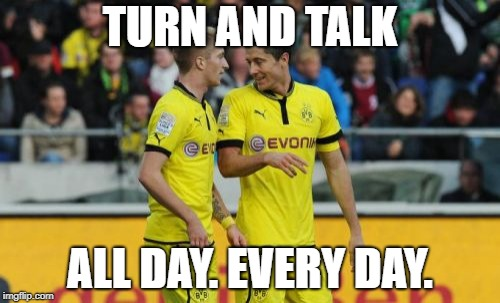
 Turn and Talk: Still winning Most Useful Teaching Tool contests, the turn and talk is versatile and powerful.
It can help you get/keep your kids on track (“turn and tell your neighbor what we’re supposed to do next”)
It can help your kids process content in digestible chunks(“turn and talk about what we just read”)
It can help you take a lower-level lesson up to higher order thinking (“turn and talk about what possible impact this could have”)
It can help you give your kids a chance to talk -- but about content, not about Fortnight (“turn and talk about what you think about that idea”)
It can help you make your classes more student-centered (“turn and explain this concept to your partner”)
It can impress your administration (“turn and talk about why you chose the answer you chose”)
In addition to being powerful and effective -- it’s quick (30 seconds!) and can be thrown into the middle of a lesson when needed.
Kids need breaks to process content. Do you ever notice that they stop paying attention or stop working at a certain point? It’s because they are overloaded and need time to digest content. Turn and talks can provide that “content digestion” and can provide that break from concentration.
In Marzano-land, turn and talks COULD address...
Helping students process new content
Helping students elaborate on content
Reviewing content
Helping students practice skills, strategies, and processes
Helping students examine their knowledge
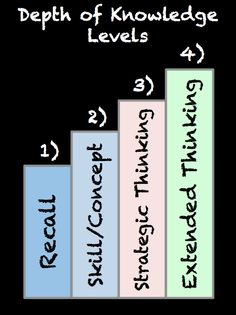
Helping students engage in cognitively complex tasks.
Turn and talks make every lesson better. You only need one or two or three a class period to up the rigor and increase the student ownership in your lessons
 **Honorable mention: Call and response: If you don’t have a quick attention-getting system, please get one. Use a call and response like “”If you hear my voice clap once” or “Hey class/heyteach”. Here are 50. Many are elementary, but not all I know we talked about using a call-and-response to get kids’ attention and to get them quiet.
Here are a couple of Youtube videos showing Call and Responses
If you haven’t tried one of these -- please do! They will make your life easier and drop your stress a notch or two. I promise -- if you try them a couple of times they will become habit and you will see results!
Need ideas? Want to talk it out? Email me at newmantr@pcsb.org


 Reteaching is where the majority of kids didn’t get a concept and you need to try to teach it again, another way. Maybe you tried the first time with a reading and now you’re going to try a concept map. Maybe the first lesson was video-centered. This time, try a graphic organizer. Most kids probably need that lesson retaught.
 If I were going to REMEDIATE Civics Benchmark 2.4, I would first check my data to see which kids struggled with that benchmark. Then, I would use formative assessment data from my class (I might need to make one) to see WHAT PART of the benchmark (or which benchmark clarification) the kids missed. Then, I would specifically create a lesson or a mini-lesson to address and fix that deficit. Maybe we would look at just the amendments they did NOT get -- maybe they got the 1st, 2nd, 3rd, 9th and 10th. So we will work on the others (4, 5, 6, 7, 8) in a small group, using the hand signals and having the kids illustrate those particular amendments.
  So what do we do after the main teaching?