Showing posts with label pacing in social studies class. Show all posts

Wednesday, October 7, 2020

Talk Less, Smile More

In the musical Hamilton, the fictional version of Aaron Burr tries to convince fast-talking, say-whatever-you-think Alexander Hamilton to “talk less, smile more”. What Burr really means is to keep people guessing so they won’t have a reason to dislike him. 
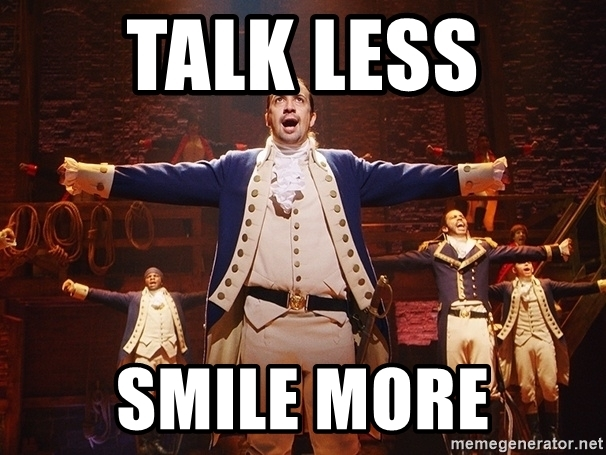

But it’s not a terrible way to think about online & hybrid teaching. 


No, not the “keep em guessing“ part. But the teacher-talking-less part is good advice for all of us. And the keep ‘em bonding part is pretty good, too


Teaching is SO WEIRD right now, right? The online part is definitely one of the weirder parts. For most of us, there are a handful of kids who answer questions and participate. 


And then there are the silent icons. Silent initials.  


Are they listening? Are they learning? Thinking? I have no idea. A bunch of them turn in work. Some of them are just weird lurking icons. They turned off their mics and cameras. Did they turn off the incoming sound and video so they could just watch TV, too?


Their silence unnerves us. As does the repetitive nature of those same four kids who participate. 


And so in our awkwardness and discomfort with the silence, we-the-teachers talk into the abyss. 


And some days, we talk and talk and talk and talk...


It’s a teacher-talkapalooza. And it makes time slow down and class kind of boring. Even those teachers who are natural-born storytellers (and god help the kids who have teachers like me who aren’t). 


Why is this not our best idea? 


First, I think of those poor kids who spend 7 periods a day listening to teachers talk all day. Whew. That’s a whole new kind of tired. I also know that as a teacher, it is exhausting to talk all day - and even more exhausting to talk ON SCREEN. All those studies on Zoom Fatigue are real. It’s reason #815 why you’re so tired. It makes the day go soooo sloooowwww....


But there's one thing I do know about learning 


That the “person doing the talking (about content) is doing the thinking (about content). 


So if the teacher is doing all the talking (about content), the teacher is doing all the thinking (about content). 


If the same four kids are doing the talking, THEY are doing the learning and the thinking.


What are the other kids thinking about? 


Who knows? Pizza? Minecraft? Romantic interests? What are they going to eat tonight? Grandpa’s health? Fave tv shows? Tiktok dances? All of those? 


But probably not content. They don’t need to. The teacher is doing all the work. So they can kick back and daydream about Kid Thoughts that don’t involve content. 


Hey, teacher! Like Aaron Burr says, “talk less”. Maybe have those same four kids talk less, too. 


You might ask what else to do instead of talking. These are weird times in which to teach and we can all use some new thoughts.  


Here are some ideas:

  1. Chunk your class (with timers!): Use a timer for yourself to only talk for 5 or 8 minutes. Use a timer for how long kids should go watch that video you dropped in the chat. Use timers for how long they should take on bellwork, quickwrites, readings, discussions, or anything else you give them to do. Keep. Class. Hopping! Keep it moving to keep kids engaged. 

  2. Use wait time differently: If you want to talk less, it’s only logical that ALL the kids should talk more. But what if they won’t? Wait time hits differently when everyone is silent and unseen. Suddenly, everyone thinks class is over? Or the internet went out? Or the sound stopped working? You can’t just be silent like you could in your all-live class. Nor is it fair to let the only-in-person kids be the only ones to talk. It’s time to use music, a ticking kitchen timer, the Jeopardy tune, or a countdown clock to let them know that you’re waiting -- but that the internet hasn’t actually crashed (not this time, anyway)

  3. Call On Kids: It helps to tell them this ahead of time and not spring it on them like a wacky surprise, but let them know that you are going to call on all of them. And maybe if they answer, it will be for a point somewhere that you have built into participation or something or maybe they get a school “buck” or maybe they can earn a free homework pass or something. But call on every kid. Give them all the opportunity to answer (even if it’s in the chat if they don’t have a mic) You can spin to choose who will answer with Wheeldecide or SuperteachertoolsSpinner OR you can use the RandomNameGenerator Or RandomNamePicker Or any of those tools.But don’t let them off the hook just because they don’t raise their hands. I know, because I have heard from the online kids in the Hybrid class that it is hard, even for the outgoing ones. It’s hard 

  4. Make it Fast: Make it a race. For your in-person kids, give them 30 seconds to write a quick response to what you just read/said/wrote/viewed on their desks with dry-erase markers (everyone is cleaning all the time anyway, right? Might as well wipe down desks again. For your online kids, give them the same 30 seconds to put something in the chat (emojis and gifs count ONLY IF they are a response to the thing you just  read/said/wrote/viewed). Then, have kids share out their answers if they like. 

  5. Walk Away: Give kids a specific SHORT amount of time to do THE THING you just asked them to do. Like, “You all have 5 minutes to read the first paragraph (or two) and underline/highlight any words you don’t know.” or “Please answer the first two questions on your one paper and we will come back together in 8 minutes (at 11:15) and talk about it.” I am HERE at my desk and in the chat if you have questions”. Then, let them do their thing. 

  6. Process, Process, Process: Kids need to process content and information. They need time to “chew” it up. There are 100 ways to do that but some are

    1. Draw something they learned

    2. Talk about it to a partner

    3. Connect it to something they know

    4. Agree/disagree with a statement about the content

    5. Summarize

    6. Address misconceptions

    7. Compare/contrast the content

    8. Examine it from multiple perspectives

    9. Ask questions about what they learned


It’s okay to talk less, even into the silent abyss. But smile more and find ways to make class move at that “lively pace” that you used to have. Make it fun and quick and the kids will learn more. 


And guess what -- I promise, that if you end up talking less during your day, you will be LESS TIRED. (I really DO want you to feel better, work less, be less exhausted, and enjoy your job more. One small baby step at a time. 


I want to make your day easier. I also want to make it easier (and more successful) for your kids. Hopefully, there are one or two ideas here that will work for you AND for them :) 


You got this. Let’s pump up the Pumpkin Spice Lattes and pep up our classes so we can be less tired! 


Let me know if I can help! As always, I love to hear from you! 

-Tracy


Tuesday, May 14, 2019

Dear Future Self


Dear Future Self,

I wrote some notes to you on my lesson plans from this week but you will have no idea what they mean. They were hurried and cryptic. When you try to teach this lesson next year, you will struggle to remember what you did with this lesson.

Did we read this independently or out loud? What reading strategy did we do? How did it work out? Did you have to change it midway through 2nd period? Did they learn it well? Did you have a good processing activity?

Future Self, I apologize for just tucking this reading in a folder with the a sticky note that has 3 words on it. I realize that you are now having to re-create this lesson and that you can’t tell how well or how much the kids learned the last time you did it.

I apologize for not fixing the typos or unclear directions on this handout. I apologize for not making a note about the awesome lesson fix I discovered during 4th period that took the lesson from “ok” to “awesome”.

Dear Future Self, have fun recreating this lesson and doing it Groundhog Day Style -- making the same mistakes as before.

Sorry ‘bout that!  Good luck!
-Love, Me-From-The-Past

* * * * * *


I don’t know about you all, but I am not always the best supporter of Future Me. Future Me would be a lot happier if I ate healthier, exercised more, saved more money, didn’t procrastinate, cleaned out the fridge more often, and flossed more regularly.

One of the ways I can help out Future Me is to make notes about how lessons went this year, so I have something to go off for next year!

There’s nothing worse than being halfway through a lesson and suddenly remembering that it bombed last year. Now what do we do?

It sure helps to reflect in writing so you can save your Future Self some hassle.

There are several ideas about how to do this.
  1. If you type your lesson plans, go back into that document and highlight stuff that went well and strikethrough things that went poorly. Or, type in your thoughts into another column or box so you can see it next year. Then, you have to get in the habit of looking at last year’s lessons when your Future Self writes the new ones.
  2. You can keep a document to yourself in each folder (digital or IRL) of a unit and jot down your thoughts as you go through the unit.
  3. If you hand-write your lessons, go back and add another piece of paper or a couple sticky notes. Put your handouts and thoughts in the same folder to reference next year.
  4. Grab a notebook or calender and keep it by your desk (or better yet, somehow keep it by your door). Then, as you stand at your door between classes, you can multitask and jot down a few thoughts under the date.

Now -- here’s the hard part!

Making sure your Future Self can understand the notes you write!

Make sure you don’t assume that you will remember the context 52 weeks from now. Make that context explicit.  Try some of these ideas:

  • Don’t call it ”the  video”. Make sure to note what video you used.and what you had the kids do with it . Copy the actual link and the length of the video.
  • Instead of saying “read section and did questions”, tell your Future Self that you read the section out loud and that the kids answered #1-3, 5, and 8 and that Question #8 was your formative assessment for the day.
  • If you found a discussion question or a turn and talk prompt particularly great, make sure to write that down!

I know that different teachers write lesson plans differently -- but it might be what we write AFTER we teach the lesson that might be more valuable to us next year.

How do you tell your Future Self about how your lessons went? Do you do it at all? How can you streamline your post-lesson notes to make your Future Self more awesome?

As always, I love to hear! Email me at newmantr@pcsb.org

Tuesday, April 23, 2019

Dear Future Self

Dear Future Self,

I wrote some notes to you on my lesson plans from this week but you will have no idea what they mean. They were hurried and cryptic. When you try to teach this lesson next year, you will struggle to remember what you did with this lesson.

Did we read this independently or out loud? What reading strategy did we do? How did it work out? Did you have to change it midway through 2nd period? Did they learn it well? Did you have a good processing activity?

Future Self, I apologize for just tucking this reading in a folder with the a sticky note that has 3 words on it. I realize that you are now having to re-create this lesson and that you can’t tell how well or how much the kids learned the last time you did it.

I apologize for not fixing the typos or unclear directions on this handout. I apologize for not making a note about the awesome lesson fix I discovered during 4th period that took the lesson from “ok” to “awesome”.

Dear Future Self, have fun recreating this lesson and doing it Groundhog Day Style -- making the same mistakes as before.

Sorry ‘bout that!  Good luck!
-Love, Me-From-The-Past

* * * * * *


I don’t know about you all, but I am not always the best supporter of Future Me. Future Me would be a lot happier if I ate healthier, exercised more, saved more money, didn’t procrastinate, cleaned out the fridge more often, and flossed more regularly.

One of the ways I can help out Future Me is to make notes about how lessons went this year, so I have something to go off for next year!

There’s nothing worse than being halfway through a lesson and suddenly remembering that it bombed last year. Now what do we do?

It sure helps to reflect in writing so you can save your Future Self some hassle.

There are several ideas about how to do this.
  1. If you type your lesson plans, go back into that document and highlight stuff that went well and strikethrough things that went poorly. Or, type in your thoughts into another column or box so you can see it next year. Then, you have to get in the habit of looking at last year’s lessons when your Future Self writes the new ones.
  2. You can keep a document to yourself in each folder (digital or IRL) of a unit and jot down your thoughts as you go through the unit.
  3. If you hand-write your lessons, go back and add another piece of paper or a couple sticky notes. Put your handouts and thoughts in the same folder to reference next year.
  4. Grab a notebook or calender and keep it by your desk (or better yet, somehow keep it by your door). Then, as you stand at your door between classes, you can multitask and jot down a few thoughts under the date.

Now -- here’s the hard part!

Making sure your Future Self can understand the notes you write!

Make sure you don’t assume that you will remember the context 52 weeks from now. Make that context explicit.  Try some of these ideas:

  • Don’t call it ”the  video”. Make sure to note what video you used.and what you had the kids do with it . Copy the actual link and the length of the video.
  • Instead of saying “read section and did questions”, tell your Future Self that you read the section out loud and that the kids answered #1-3, 5, and 8 and that Question #8 was your formative assessment for the day.
  • If you found a discussion question or a turn and talk prompt particularly great, make sure to write that down!

I know that different teachers write lesson plans differently -- but it might be what we write AFTER we teach the lesson that might be more valuable to us next year.

How do you tell your Future Self about how your lessons went? Do you do it at all? How can you streamline your post-lesson notes to make your Future Self more awesome?

As always, I love to hear! Email me at newmantr@pcsb.org

Wednesday, March 27, 2019

Three Rs

I still remember doing a WHOLE lesson on the difference between slavery and indentured servitude. And then, the long-answer question on the test asked the kids to explain the difference. And THEY ALL BOMBED THAT QUESTION!!!!

WHAT THE HECK??!?!? I TAUGHT MY BUTT OFF!!!!

It can’t be that they’re ALL stupid (although I might have said something along those lines, purely out of frustration!).

And then, the inevitable question of “what do I do now?” arises. Do I review the concept quickly and hope that sticks when the “real” lesson didn’t? Do I go back and reteach the whole thing? Do I say “oh well” and move on with pacing?


Well, first, let’s talk about the difference between Review, Reteaching, and Remediation.

Review is spending a shorter amount of time just looking at the content again (re-view). It’s that study guide before the test, the review packet before the exam. It’s a game where we get to look at content from a while back. It’s where you tackle 3 months of content in one class period. Everyone needs review.

Reteaching is where the majority of kids didn’t get a concept and you need to try to teach it again, another way. Maybe you tried the first time with a reading and now you’re going to try a concept map. Maybe the first lesson was video-centered. This time, try a graphic organizer. Most kids probably need that lesson retaught.

*Note: Reteaching requires teachers to make pacing decisions. You WILL have to determine if you take less time on another topic to reteach this one.

Remediating is where you fix a problem, particularly student-by-student. To remediate is to try to address a problem -- like, if Student A didn’t get Concept B. Remediation is more student-specific and attempts to target a problem with a specific piece of content or a skill.. Remediation isn’t the same as reteaching, although they’re often mixed up together. Remediation is more targeted and more clearly defined.


Let’s look at the difference when we look at a one benchmark.

If I were going to REVIEW Civics Benchmark 2.4 (Bill of Rights), I would go back over the Bill of Rights, maybe including it in a review game or playing a video and asking kids to reflect after the video.

If I were going to RETEACH Civics benchmark 2.4, I might start with teaching the hand signals for each amendment (to engage tactile learners) and help the kids organize slips (with one amendment written per slip) into categories. I think I would finally give kids scenarios that had them applying the amendments to a particular topic.

If I were going to REMEDIATE Civics Benchmark 2.4, I would first check my data to see which kids struggled with that benchmark. Then, I would use formative assessment data from my class (I might need to make one) to see WHAT PART of the benchmark (or which benchmark clarification) the kids missed. Then, I would specifically create a lesson or a mini-lesson to address and fix that deficit. Maybe we would look at just the amendments they did NOT get -- maybe they got the 1st, 2nd, 3rd, 9th and 10th. So we will work on the others (4, 5, 6, 7, 8)  in a small group, using the hand signals and having the kids illustrate those particular amendments.

So what do we do after the main teaching?

It depends on IF kids bomb, how MANY kids bomb, and HOW they bomb.

We adjust from there.

There’s no silver bullet. But there are plenty of ways to adapt to moments where kids don’t learn what/as much as you want.

Think about using review, reteaching, and/or remediation to help your kids tackle stuf they need to tackle.

As always, let me know how it goes!
Email me at newmantr@pcsb.org
-Tracy