Showing posts with label literacy and social studies. Show all posts

Tuesday, April 23, 2019

Dear Future Self

Dear Future Self,

I wrote some notes to you on my lesson plans from this week but you will have no idea what they mean. They were hurried and cryptic. When you try to teach this lesson next year, you will struggle to remember what you did with this lesson.

Did we read this independently or out loud? What reading strategy did we do? How did it work out? Did you have to change it midway through 2nd period? Did they learn it well? Did you have a good processing activity?

Future Self, I apologize for just tucking this reading in a folder with the a sticky note that has 3 words on it. I realize that you are now having to re-create this lesson and that you can’t tell how well or how much the kids learned the last time you did it.

I apologize for not fixing the typos or unclear directions on this handout. I apologize for not making a note about the awesome lesson fix I discovered during 4th period that took the lesson from “ok” to “awesome”.

Dear Future Self, have fun recreating this lesson and doing it Groundhog Day Style -- making the same mistakes as before.

Sorry ‘bout that!  Good luck!
-Love, Me-From-The-Past

* * * * * *


I don’t know about you all, but I am not always the best supporter of Future Me. Future Me would be a lot happier if I ate healthier, exercised more, saved more money, didn’t procrastinate, cleaned out the fridge more often, and flossed more regularly.

One of the ways I can help out Future Me is to make notes about how lessons went this year, so I have something to go off for next year!

There’s nothing worse than being halfway through a lesson and suddenly remembering that it bombed last year. Now what do we do?

It sure helps to reflect in writing so you can save your Future Self some hassle.

There are several ideas about how to do this.
  1. If you type your lesson plans, go back into that document and highlight stuff that went well and strikethrough things that went poorly. Or, type in your thoughts into another column or box so you can see it next year. Then, you have to get in the habit of looking at last year’s lessons when your Future Self writes the new ones.
  2. You can keep a document to yourself in each folder (digital or IRL) of a unit and jot down your thoughts as you go through the unit.
  3. If you hand-write your lessons, go back and add another piece of paper or a couple sticky notes. Put your handouts and thoughts in the same folder to reference next year.
  4. Grab a notebook or calender and keep it by your desk (or better yet, somehow keep it by your door). Then, as you stand at your door between classes, you can multitask and jot down a few thoughts under the date.
Now -- here’s the hard part!

Making sure your Future Self can understand the notes you write!

Make sure you don’t assume that you will remember the context 52 weeks from now. Make that context explicit.  Try some of these ideas:

  • Don’t call it ”the  video”. Make sure to note what video you used.and what you had the kids do with it . Copy the actual link and the length of the video.
  • Instead of saying “read section and did questions”, tell your Future Self that you read the section out loud and that the kids answered #1-3, 5, and 8 and that Question #8 was your formative assessment for the day.
  • If you found a discussion question or a turn and talk prompt particularly great, make sure to write that down!

I know that different teachers write lesson plans differently -- but it might be what we write AFTER we teach the lesson that might be more valuable to us next year.

How do you tell your Future Self about how your lessons went? Do you do it at all? How can you streamline your post-lesson notes to make your Future Self more awesome?

As always, I love to hear! Email me at newmantr@pcsb.org

Wednesday, March 6, 2019

Out Loud

Do you have a loud class? One that never shuts up? Especially this week before spring Break?

Some kids need to talk. Some kids never shut up. Some kids who are normally more quiet are loud this week  as they prep for Spring Break. Believe me, I feel for them. It’s probably no surprise that I was one of those kids. (sorry, again, to all of my teachers when I was a kid!)

I know you probably think this is a weakness of that group. And, in many lessons, that’s true. But could we turn it into a strength?

I think there are ways to teach that are more open and helpful for these types of kids. We can harness the energy of the shout-out kids. (It’s true!) It’s not a complex reading strategy and it requires little, if any, preparation.

It goes like this:
  1. Teacher and students all have copies of the same reading.
  2. Teacher reads aloud, pausing strategically at certain words (you might underline or highlight those words on your TEACHER COPY ONLY ahead of time so you know what words you want to make sure they get)
  3. When the teacher pauses, the kids say (shout?) out loud the word that goes there.
  4. The teacher continues reading the selection out loud, pausing at the words he or she wants the students to say (or shout) aloud.

Now, why would I WANT to have my kids shout out loud during reading? I have a couple of benefits I can notice...

  • It helps them stay engaged with the reading.  
  • It helps kids who normally “tune out” during reading to stay with it.
  • It helps with fluency of struggling students.  
  • It helps me-the-teacher to chose important terms and make sure the kids stay with me for those.
  • It’s more fun.
  • It helps use that LOUDNESS for good reasons and not for off-task reasons.

It’s not hard and requires less than a minute of preparation. How can you use this strategy to keep your kids engaged and to emphasize important terms?

As always, let me know how it goes! I love to hear from you all!

And I hope you have an awesome Spring Break full of whatever you like to do in your free time! WE’re ALMOST THERE! HANG IN THERE!!! Enjoy the beach, or your TV, or your beer, or your kids, or your gardening, or your gym, or whatever you get to do!  :)

-Tracy

Wednesday, October 31, 2018

Context

My kid went nuts when we couldn’t find his blue shorts. It had to be THOSE blue shorts. Both of my kids stayed up waaaaay too late. They looked ridiculous. So did I. I let them roam all over someone else’s neighborhood and talk to strangers who looked weird. They ate more sugar than their small bodies could handle and wound up literally running in circles to work some of the sugar out of their systems. Some neighbor had a scary movie playing on a projector on the outside wall and both my kids had nightmares. We went home at the obscene hour of nine o’clock, it was too late for baths,  and the whole family was in tears by ten.

It was so much fun!!!!

“It” was, of course, Halloween.

Context. It makes all the difference.

The difference between “#parentingfails” and “pretty average” is in the context. The question of  Halloween or Regular Wednesday Night has a pretty big impact on your understanding.

Context is an area where a lot of our kids struggle. We as teachers struggle with teaching context sometimes, too. It’s hard to tell the difference between context and content.  What “stuff” about history or government or economics is the important “stuff” and which is just contextual “stuff”.

If you’ve ever showed your students a throwback Thursday picture, only to have them giggle and wonder at your hair or clothes, you know how important context is.

Context is JUST as important in social studies, too.

  • The Constitution did not originally give every adult citizen the right to vote, of course.  Originally, the states determined who could vote, often choosing only land-owning, white men over age 21, often about 6% of the population.

The context behind that is a powerful piece of that understanding. The context of gender, race, power, money, and language in the original electorate was essential to understanding that limited enfranchisement
  • The beginnings of Buddhism as a reaction to Hinduism is a huge reason that Buddhism caught on in the first place. That context of a stratified Hindu society is what makes Buddhism stand out. It’s different. It’s a reaction to its historical context.
  • The Scientific Revolution is only a “revolution” in the context of the previously religious understanding of the universe.


Without context, it’s impossible to understand an “impact” or an “effect” -- because there has to be some context, some THING to be impacted or effected.

So, every single time we bust out a document in class, kids should use some context. There are plenty of ways to do this (APPARTS, Doc Analysis Sheets, etc.) but here are the questions that SHEG (Stanford History Education Group) asks us to use ...
  • When and where was the document created?
  • What was different then?
  • What was the same?
  • How might the circumstances in which the document was created affect its content?

If you’re looking for some quick prompts to practice contextualizing documents, SHEG gives us a few to start with:
  • Based on the background information, I understand this document differently because ...
  • The author might have been influenced by ___ (historical context).
  • This document might not give me the whole picture because...

If you read last week’s WW email, you know we talked about Sourcing. Contextualization is interwoven with sourcing as we look at the people and circumstances around the CREATION of the document to inform our understanding.

Again, this is not just a HISTORICAL Literacy Skill. It’s a Civic Literacy Skill. It’s a Citizenship Skill. It’s a Media Literacy Skill. It’s a Social Media Skill. It’s a Personal Relationship Skills.

It’s a life skill.

Looking at the context of a document is crucial to understanding it. We need to help our students use context when they read the news or a listen to a candidate or watch something online.

Let’s get them in the habit of asking those context questions every time they come across a document. I think it can be powerful in understanding history and current events.

How do you ask your kids to contextualize? Do you do it frequently? How can you tuck in these questions every time you bust out a document?

AS always, I love to hear from you. And Happy Halloween. Don’t let the Candy-Hangovers get you down tomorrow!

-Tracy

Tuesday, October 23, 2018

The Source

Imagine that you got a letter in the mail (with students, I pretend that they found a note in the  hall or in their lockers). Imagine that this letter or note said horrible things about you. Imagine that it accused you of doing terrible things and it called you awful names.

Now, think about who wrote it. You would deal with that letter or note differently if it was from a friend you had a disagreement with ... differently if it was from your ex ... differently if it was from your current significant other (and you thought everything was ok) ... differently if it was from your sibling ... differently if it was from a coworker  ... differently if it was from ANOTHER coworker... differently if it was from a complete stranger!


Sourcing matters.

It matters when you look to see what news outlet a Facebook link comes from. It matters which parent sent which email. It matters what author said which quote. It matters which individual made which comment on your social media. It matters what think tank funded which study. It matters which PAC paid for which ad. It matters which organization sponsors what website.


It also matters whether the document is from the Egyptian pharaoh or the Egyptian slave or the Kushite trader or the Israelite slave in Egypt or the British historian or the Greek enemy.

Sourcing matters.

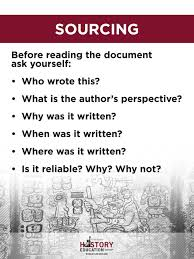
For every document, we always ask:
  • Who wrote this?
  • What is the author’s perspective?
  • Why was it written?
  • When was it written?
  • Where was it written?
  • Is it reliable? Why or why not?

The way we read and understand a document (or even a secondary source, really) depends on sourcing. Just as in the letter/note example, you would deal with that mean and nasty letter differently if it was your ex than you would if it was a coworker.

How would you react if it was your ex that wrote that letter (for some of us it might have been a long time ago and we might be surprised that they even remembered that we exist!)

How would you react if it was your sibling that wrote that letter? (it probably depends on how that relationship with your sibling is these days)

How would you react if it was your significant other wrote that letter? (assuming that things were generally good between you)

It depends on what you know about the author -- or about his time period or about her culture about his location or about her group/organization.

Sourcing matters.

It is the first step in our historical thinking skills AND it is a crucial piece in the civic literacy -- AND it is the a big part of the ELA/LAFS standards.

If I can challenge you this week to do one thing it’s this:

Have your kids dig into the sourcing information of EVERYTHING THEY READ.

They need to be in the habit of looking at the source for Social Studies, for ELA, and for Civic Life.

Teach them how to look at the source of current events, historical documents -- even textbooks!

Did  you read the article a few years ago about the Texas textbook that said that enslaved persons fought FOR the South in the Civil War?


Uhhhhh ....  No.

That textbook writer (OMG that was a textbook writer!!!) pulled info off a Sons of the Confederacy website that has no evidence to support its claim.

It can happen anywhere that people are not careful. If we don’t look at the sourcing information, we don’t understand the author’s point of view.

That doesn’t mean we’re sourcing documents to see if they’re RIGHT or not, TRUTHFUL or not. It means we’re sourcing them to see where the author is coming from.

If you have never seen the SHEG Lunchroom fight lesson on sourcing, it will make this sourcing stuff make MUCH more sense. https://sheg.stanford.edu/history-lessons/lunchroom-fight . You need a login, but it’s free and some of the highest quality Historical Thinking stuff out there!

Goal for the week: Be more intentional about sourcing everything with kids -- including secondary sources! If you make it a good habit, kids will get in that habit too!

Questions? Thoughts? Awesome ways you source documents? As always, email me. I want to hear all about it!! newmantr@pscb.org

Wednesday, September 26, 2018

Teaching Hacks, The Look, and Monitoring


Teaching Hacks, The Look, and Monitoring
Image result for teaching hacks

Y’all know that I love Teaching Hacks! You know what I mean? Those Pinterest-y ideas for quick fixes in the classroom?

Here are a few of my faves ...
  1. Turn and Talks. All day, every day. Makes kids process learning and therefore RETAIN learning
  2. Having kids use Whiteboard markers to write ON the desks. And then baby wipes to remove. (so much more fun than paper!)
  3. Using Plickers to formatively assess in under 2 minutes. Because time is EVERYTHING to teachers. (except today they introduced a pay system?)
  4. Bathroom pass on a lanyard (because, ewww, where does the pass go when they’re using the facilities?)
  5. Written directions for everythingeverythingeverything. Every activity, assignment, everything with written directions on the board or screen. Helps ESE kids, ESOL kids, kids who have auditory processing issues, kids who just weren’t listening, kids who are flakey, and kids who are all over the place. If you write the directions down, half your management improves!

Ok, I’d like to add a new Teaching Hack to your list.

It’s so simple, but so rarely used.

It’s called “Read student work WHILE they’re working”

No, really. Stay with me!

Kids will trick you all the time. They can’t help it. They’re kids.  One favorite trick of most students is The Look.

This is different from the Teacher Look, the Mom Look or  The Administrator Look.

The Student Look is an “I’m innocent look”, maybe an “I’m thinking deeply look”, or even an “I am on task” look.

They use it all the time

Kids are great at looking busy. I used to happily walk around my classroom and monitor my students. I loved to walk around and do what  I THOUGHT was monitoring.

“Thanks for being on task, Destiny!”
“Let’s start our work, Carlos!”
“Brittany, you don’t have any work done! What have you been doing?”
“You’re almost done, Austin! Great job!”

What was wrong with those? I was monitoring for compliance, not for comprehension.

What’s the difference? I used to monitor to see if my kids were DOING their work, not if they were LEARNING what I wanted them to learn!

A kid can write stuff on paper all day but have no idea what we’re learning. They can be compliant by copying their friends’ words, they can be compliant by copying some things out of the book/packet, or they can be compliant just staying quiet and making wild guesses.

Kids can be tricksy. They can definitely LOOK busy but be missing the point.

I was constantly surprised AFTER students turned in their work and it was waaayyyy off, super wrong, or missed the point of the assignment/question entirely!

So how can we monitor for LEARNING? What’s the Teaching Hack here?

It’s so easy. Just read what they write WHILE they’re writing it.

I know we think we’re all already doing it. And maybe it was just me. But I see and hear lots of teachers monitoring around the room talking to kids about DOING work, not about WHAT they’re writing.

As you walk around the classroom, read what they write WHILE they are writing. Are they on point? Are their answers aligned to your question or are they off in left field? Do their answers read EXACTLY like the answers of the kid next to them? Are they wildly making stuff up? Are they copying some sort of answer out of the book without actually understanding it? Are they jotting down “IDK” for every third question?

And then -- when you see them on task but OFF-TRACK (not understanding), STOP and help them right then.

Don’t wait until kids turn in their work. Help them fix it right away, in the moment.

This takes EXACTLY as much effort as your monitoring for compliance does. You DO have to get up and walk around, just the same amount of steps. But it pays out waaayyyy more in student learning.

Totally worth it. Do mostly the same thing you are already doing but make it work better for you and your kids. Don’t get fooled by “The Student Look”. Monitor for LEARNING not for compliance.

Now that’s a Teaching Hack!!

Thoughts? Questions? Email me at newmantr@pcsb.org