Showing posts with label gradual release. Show all posts

Tuesday, September 18, 2018

If The Kids Can't Read

BTW -- today’s email is NOT for reading teachers. Reading people, you already do al lthis stuff. So feel free to avoid me today.

The Social Studies teachers, though? Today is for US!!

There’s an old joke that a man sees a musician get out of a taxi in New York and asks “How do you get to Carnegie Hall?” The musician answers “Practice, practice, practice”

It’s old and it’s dumb, but it has truth. If you want to get better at anything, you have to practice.

So, what do we do when so many teachers tell me that their kids “can’t read”?

We have those kids practice, practice, practice.


Seriously, if a kid wants to be an NBA star or a concert violinist or the next Jay-Z or a comic book illustrator or a videogame designer or the inventor of the next Tesla, there’s only one real strategy.

Practice, practice, practice

So, if our kids want to become better readers (or, maybe more accurately, if WE want OUR KIDS to become better readers), they need to practice. Every day that they are in our class, they need to practice.

“But Tracy”, you protest, “They can’t read!”

I’d like to call “BS” on the majority of those that you think “can’t read”.

Maybe they aren’t strong readers. Maybe they aren’t fluent readers. Maybe they aren’t confident readers. Maybe they aren’t on-grade-level readers. Maybe they aren’t voluntary readers. Maybe they aren’t engaged readers.

But very, very  few of them can’t sound out words and get some meaning from many of those words. That’s literally all they do all day for 2/3 of the elementary school and a good chunk of the middle and high school day. ESPECIALLY if they’re in an additional reading class during their day.

They CAN read, some.
So, let’s stop saying they “can’t read”. There’s a pretty huge continuum between can’t-sound-out-letters and voluntarily-reading-college-level-material. There’s a million shades of grey between the two polar opposites. Let’s look at which shade of grey we’re talking about.

Now, let’s go back to Carnegie Hall. If kids aren’t strong readers, how to they become strong readers? There are a million scaffolds and strategies, but it all comes down to this:

Practice, practice, practice.

If you have low readers in your classroom, they need to practice reading Every. Dang. Day. IN YOUR CONTENT AREA (not just in reading class)

Here is what they don’t need:
  • They don’t need the reading broken down for them in bullet points on the screen.
  • They don’t need to be “spared” from reading (even of they don’t love it)
  • They don’t need you to lecture instead of making them read.
  • They don’t need to read ONLY in reading class.

Here is what they DO need:
  • Reading. Every. Single. Day.
  • in Every. Single. Class.
  • Time in front of text.
  • Gradual release
  • Your patience.
  • Think alouds

If your kids “can’t” comprehend your social studies text (or science text or health text or art text), then they need practice in that type of text.


Here’s the easiest way to help with literacy IN YOUR CONTENT AREA.

Gradual release it.
And chunk it.

If kids are struggling readers, start with something small. Start with a paragraph. Heck, if it’s a tough primary source, start with a sentence or two.

Then, model how you read and think aloud and gain meaning from the text.

Then, give them the next sentence or paragraph. Have them work on gaining meaning from the text.

It’s okay if they aren’t AS good at it as you are. Remember, you have a college degree and they don’t, so they won’t do as well as you do. That’s ok.

Chunk the text.

Start small and gradually give them more text until you build their skill and confidence and stamina.

After a week or two, move up to a larger paragraph. Then two paragraphs next month.

Especially with strugglers,  it’s appropriate to start in manageable bites and then gradually challenge them more and more.

Don’t expect them to become better readers by NOT reading. Help them become better readers by having them read something (even small) every day.

What do you have them read daily? How do you move your struggling readers up a level or two? As always, I love to hear from you! Email me at newmantr@pcsb.org

Tuesday, April 3, 2018

Somebody Wanted ...

Summarizing is an important skill. It’s kind of a big deal, which is why it always surprises me when soooo many kids struggle with it!

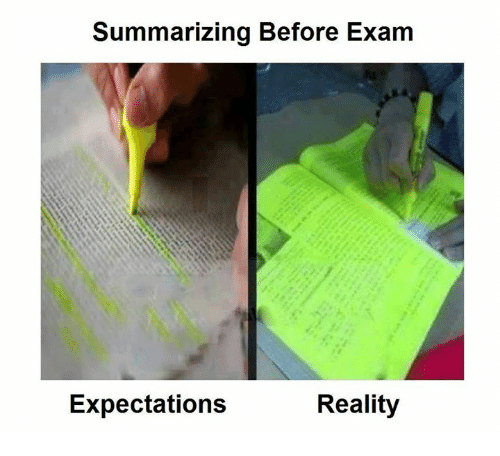
But it is really hard for many kids! Maybe it’s because the internet summarizes things for them, whether it’s a movie trailer, a product review, or the 700,00 versions of “Cliff Notes”, kids don’t really have to summarize much any more. So when we ask them to summarize and they highlight the whole page, it’s not because they’re stupid. It’s because they need help with the skill of summarizing.

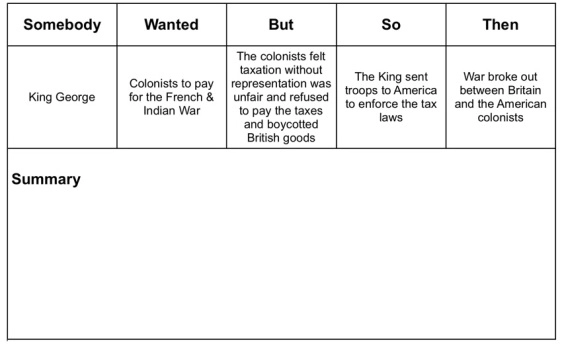
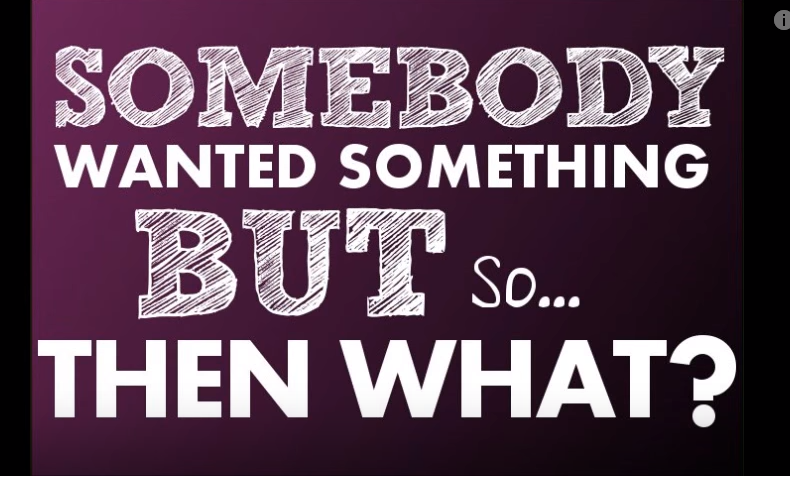
One of the quickest and easiest ways to summarize is a simple strategy called “Somebody Wanted ... But/So... Then”.

This strategy is useful for any student who struggles with summarizing, whether it’s an ESE or ESOL student or a regular student who has trouble summarizing and prioritizing info. It’s actually helpful for keeping our gifted students on track and out of left field, too.


It goes like this ...


  • Somebody (who?) Wanted something (what?)
  • But (what was the problem?)
  • So (How did they try to resolve the problem?)
  • Then (What was the result?)

History and Social Sciences are FULL of moments when a person or group wanted something, which becomes a catalyst for other events.

Like this ...  (real 6th grade student answers below)

  • The Abolitionists wanted freedoms but the South was worried about economics so they made reforms. Then, the reforms made people pay attention.
  • Women wanted equal rights but they were faced with challenges like their ideas and words being denied by men, so the women had a convention at Seneca Falls where they decided to argue and protest for their rights. Then, it took a long time before they had the right to vote.  

Wow! If I could get my kids to boil down the info of a chapter or topic into one of those awesome sentences, I would have WON the teaching game!

Because once they know the summarized basics, once they can sort out the important info from the less-important info, THEN we can really think and analyze and dig further into the content.

I even found a teacher somewhere who made a song (with accompanying video) that is electronic dance music style (https://www.youtube.com/ watch?v=N6EMIaoE9_Q ). It may or may not be your style but it’s repetitive and your kids may like it.  


Try it this week. It’s quick, easy, and a wonderful way to help kids practice summarizing critical information.  Then, give them the initials (SWBST) and have them summarize on their own. Use gradual release. Start with the scaffold of this strategy, have them practice it whole class, and then in small groups,and then independent practice. Finally, remove the scaffolding so they can use it independently.

How can this strategy improve your students’ summarizing skill? How can you practice it this month? How is it going? As always, email me at newmantr@pcsb.org
-Tracy

Tuesday, March 6, 2018

Start Me Up

So, when Mick Jagger sang “start me up”, I am pretty sure he wasn’t talking about sentence starters.

But I am.

I have learned a lot of things over the years about kids and learning. One of those things is that kids often struggle to know where to start when a teacher gives them an assignment. They also struggle to use academic language. (I can’t tell you how many times I got a writing assignment with a “lol” somewhere in there!). They also struggle to figure out what the teacher wants from them. Sometimes they struggle to understand the question.


Well, I have one idea that will cover those issues.

It’s a sentence starter.

Seriously.  It sounds so silly, I know. Some of us think of early elementary school, and think it’s not useful for our secondary students, but I would respectfully disagree.


I think a good sentence starter can help our kids first know where to start with a task, whether it’s a writing assignment or a graphic organizer or whatever. If you start a sentence for the kid, it will lead their thinking where you want them to go. Your kids will be more successful at thinking and at writing about the topic.


I also think a good sentence starter can help students use academic language. It doesn’t come naturally for many kids, especially kids who don’t hear more formal language at home. Heck, I don’t use formal academic language at home. (or here, either, when I say “heck”). Kids are not naturally academic speakers and writers and so we need to teach them how and when to use academic language.


Sentence starters help the kid figure out what the teacher is looking for. If you ask a kid for the causes of the Civil War and you give her “Three important causes of the Civil War are _____”, she can better understand the question and better frame her answer.

I also love sentence starters because they are a fabulous way to differentiate. Do you have English Language Learners? Sentence starters are a quick and effective way to help students who are acquiring the English Language to understand and express your content.  

I also think it helps with some of your “out of the box” thinkers. The kids who are smart but can’t keep their assignments on track without going off on a tangent -- it can help them too.  You can also differentiate “up” to challenge your more academically successful kiddos by asking them to do more than one thing with a sentence starter.

Wait! I want to clarify! Please know that when I talk about sentence starters, I don’t mean cloze notes. Cloze notes have one answer that goes in the blank. They’re basically copying made easy and unless your student has been learning English for two years or less, they’re not appropriate for middle or high school students. By sentence starters, I mean the teacher has begun the sentence for the students, to guide them, but then releases the students to finish their own thoughts with their own words.  Cloze notes are low level. Sentence Starter is higher order.

Cloze Notes: The _________ of the Civil War were __________ and __________/  
Sentence Starter: The most important cause of the Civil War was __________________________ because __________________________________________.

So, let’s wrap this up. Sentence starters help your kids get started, so they can be more successful. They help you differentiate for both English Language LEarners and kids who just need direction. They increase the practice your kids have with academic language. They are not the same as Cloze Notes.

How can you use sentence starters in your class and not make a grown man (or woman, or kid) cry? How can you start them up so they will be more successful with their thinking and writing?

As always -- I love to hear! Email me at newmantr@pcsb.org
-Tracy

Wednesday, February 14, 2018

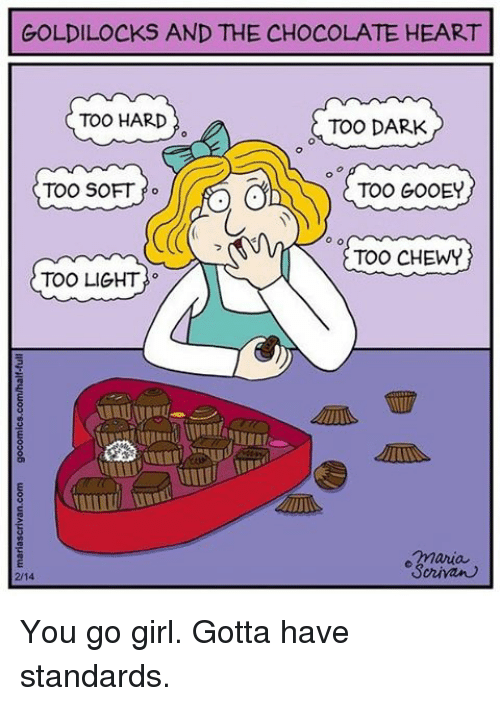
Goldilocks and The Three Teachers

Goldilocks and the Three Teachers:   
A Metaphor Story

Once upon a time, there was a student named Goldilocks. One day, she went for a walk (with a pass) through campus. As she walked, she came across three teachers.

She knocked on the door (and showed her pass) and politely entered the first classroom where the teacher was teaching.  Goldilocks decided that the learning looked appealing and sat down to get a taste of that learning.

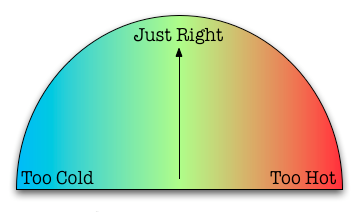
But when she started to try to take a bite of the learning, she closed her mouth and shook her head. This teacher gave TOO MUCH support! Before Goldilocks had a chance to think, the teacher was telling the class the answers, pointing to the page, and lowering the thinking level to recall level.

Of course, there must be some bears, I mean, students who need that level of support. But not all of them! And certainly not Goldilocks!!

So Goldilocks politely took her hall pass and headed out of that “too hot” class with the TOO MUCH SUPPORT. She walked to the room next door, knocked on the door, showed her pass, and took a seat in the second class.  The teacher was giving instructions and Goldilocks thought that maybe this would be the tasty learning that her brain needed that day!

But when she looked at her materials to start learning, she closed her mouth and shook her head again! This teacher gave TOO LITTLE support! Where the first teacher was doing all the work for the students, the second teacher just handed out the assignment and then left the kids to figure it out on their own! Goldilocks didn’t know where to begin, so she just didn’t start anything.

Of course, there must be some bears, I mean students, that don’t need any support with their assignment. But not all of them! And certainly not Goldilocks!

So Goldilocks politely took her hall pass and headed out of that “too cold” class with the TOO LITTLE SUPPORT. She walked to the room next door, knocked on the door, showed her pass, and took a seat in the third class. Goldilocks thought that maybe THIS would be the JUST RIGHT learning that she needed!

In the third class, the teacher was giving support that was JUST RIGHT! Goldilocks sat and stayed all period and learned ALL the things! She learned so much and was so much more successful!

What did that support look like?
  • Written AND verbal directions
  • Incorporation of visuals with new concepts
  • Gradual Release of skills and procedures
  • Chunking content and work into manageable pieces
  • Differentiation (giving more support to kids who need more and less support to kids that don’t need as much)
  • Collaboration (the real kind, not just I-do-the-first-half-and-you-do-the-second-half)
  • Using sentence starters for ESOL students
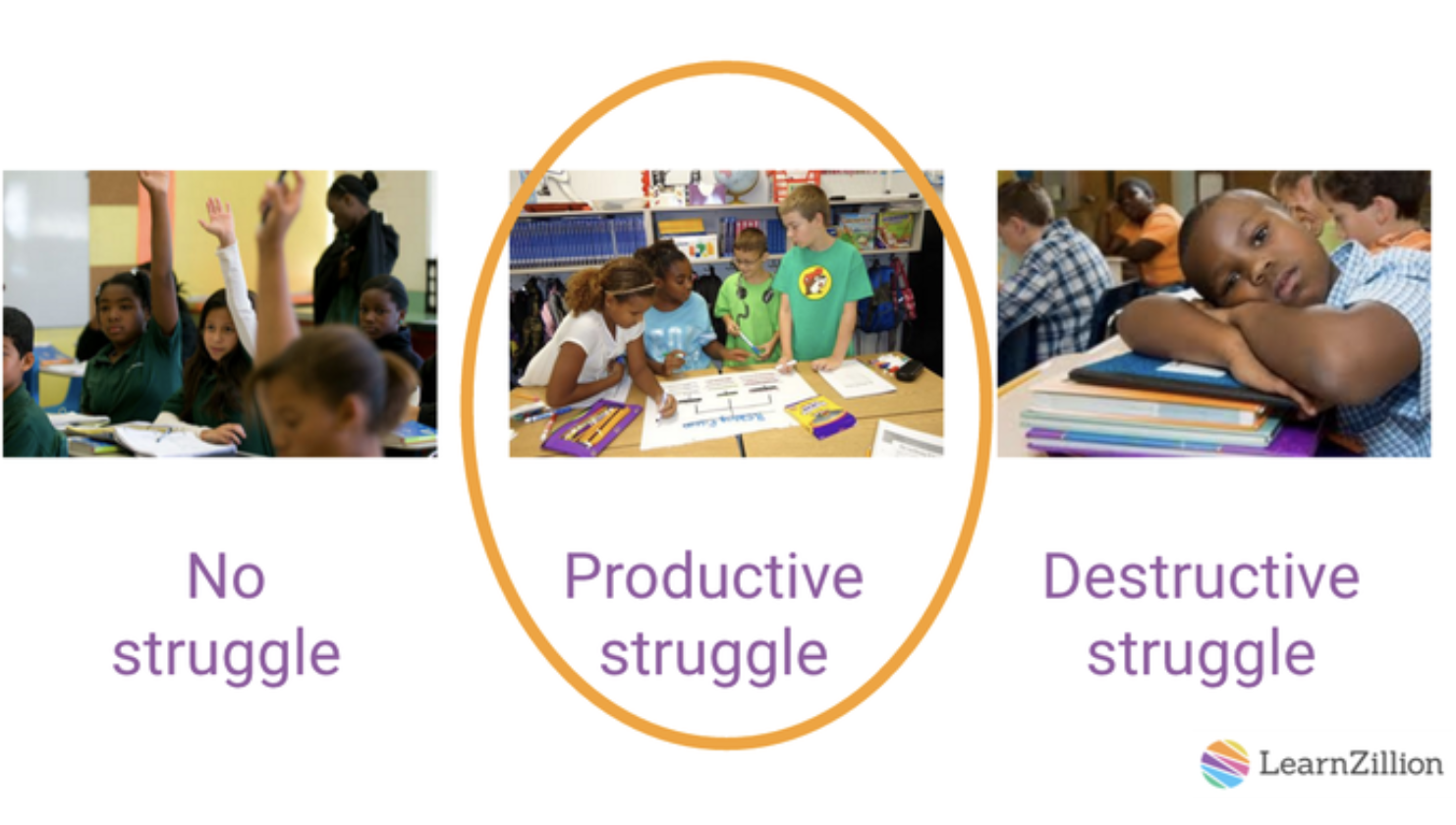
  • Letting kids have productive struggle

It’s easy, like Billy Joel sings, to “go to extremes”. We all have done it from time to time.

It’s easy to either give TOO MUCH SUPPORT, where we do the learning FOR the kids and they don’t have to do anything. These are the days where we are exhausted because we run around pointing out all the answers, lecturing and telling all the kids what to know, and give them word-for-word notes. It’s TOO MUCH support for almost all kids.  They don’t learn much because we-the-teachers are doing all the talking, all the thinking, all the work -- and the kids aren’t doing the thinking, the talking, or the work. They don’t own it.

It’s just as easy (maybe easier?) to give TOO LITTLE SUPPORT. Where we just tell the kids to figure it out on their own, where we just won’t jump in and save them or even help them. The kids don’t learn much here either (except the personally, naturally-intrinsically-motivated kids). This is where even a kid motivated by grades puts her head down and decides not to even try. This is when we had out the assignment, the packet, the work and tell the kids it’s due Friday.

Giving JUST RIGHT SUPPORT is tougher, more “grey area”. JUST RIGHT SUPPORT depends on the kids. Some kids need more support, other kids need less. You have to know your kids -- by data AND personality! You have to adjust what you do a little for each kid, each class. It means that third period might need you to give them six questions and fourth period might only need four. It might mean that 7th period needs the directions written and verbal and choral read aloud -- but first period needs everyone to stop talking about the directions so they can get started and concentrate.  JUST RIGHT SUPPORT might mean that sixth period needs to do just the top half of the page, and then get together and check to see if they’re doing it right before moving on to the bottom half -- while second period just needs the time and the quiet to zoom through the whole assignment. Half of fifth period needs you to read aloud to them to help them comprehend the text and the other half doesn’t.

It’s tricky but SOOOOO worth it.

How can we be Goldilocks and give JUST RIGHT SUPPORT (not too much, not too little)?  How do you do this? How can you be more intentional about this? As always, I love to ehar from you! Email me at newmantr@pcsb.org

-Tracy

Wednesday, January 10, 2018

Write It Down

Happy New Year!

I’m not doing New Year’s resolutions, per se, this year. I’m just...
  • Cutting back on my holiday eating and tracking my food
  • Trying to keep my family room more picked up (darn it!)
  • Finding more time for personal (not work) reading.

New Year's’ Resolutions are a little cliche. And are often “fails” before Valentine’s Day. So instead of thinking about a New Year’s Resolution, I am just trying to be more conscious and intentional.

I feel that way about my new semester. I don’t need a real “resolution:. I just need some attempts at improving myself and my instruction. .

Now, I certainly haven’t taught every type of kid out there. But I have taught a bunch.  
  • I have had classes of entirely ESOL students with not an English-speaker to be found.
  • I have taught entire classes of all gifted students.
  • I have taught ESE Inclusion classes and classes that just happened to have 90% ESE students.
  • I have taught classes with 26 boys and 3 girls (who does that?!?!).
  • I have taught classes of all girls
  • I have taught 6th graders and 12th graders and most grades in between.
  • I have taught required courses and electives

And here is the number one teaching hack that I feel is rarely used.

Are you ready for it?

It’s so stupid, it’s brilliant.

Here goes:

Write. All. Your. Directions. Down.

Write ‘em down. Write ‘em on the board, write ’em in a powerpoint, write ‘em on the handout  before you photocopy it. Write ‘em in portal, for make-up work. Write ‘em digitally in your Google Classroom or class website.

Just put the directions in writing to whatever activity or assignment.

It’s amazing how frequently a teacher shows me some student work and bemoans the quality of work ... and then when we look at it more clearly, they notice that a kid missed some part of the directions.


You know. The kid copied the whole question when they weren’t supposed to. Or they answered the first part of the question but missed the second part. Or they totally didn’t find the answers in the reading. Or they didn’t know that there was a second page.

This is not because the kid is stupid. This is because some kids are not auditory learners.


I am not an auditory learner. I need directions written out for me.

When you give verbal directions, some kids are going to miss parts of those directions. If the directions are written, the kid can go back and look to see what she missed.

Here is the beginning of a  solid set of written directions from superstar/Pinellas teacher, JH.

Step 1: Get into groups of 3.  No groups of 4.  You will be in 2 groups of 2 instead.   No, you can’t work by yourself.
Step 2: Read both documents written by Camillo di Cavour in your group.  Come up with comments or questions for each paragraph, and write them on the margin.
Step 3: Discuss the documents in your group.  What is di Cavour’s main idea?  What idea is he trying to spread?
Step 4: Underline the passage every time he makes an argument for nationalism.   Are you convinced? Why or why not?  Write your answer somewhere on the document for each underlined argument.

There is more to the assignment, but do you see how students choosing groups can be a little distracting and can make the kids forget what they’re supposed to be doing next?

Instead of just giving the directions verbally, write them down, too.

Seriously. This is such a small “teaching hack” that can make such a huge difference.

Written directions can help
  • the ESE student who struggles with more than one-step directions.
  • the gifted student who gets distracted and goes down the rabbit hole.
  • the ESOL student who needs to connect the written word to the spoken word, helping his language acquisition.
  • the kid who was daydreaming, talking, texting, or staring at her love crush du jour across the room.

It’s not a magic fix-all. But it sure does help more kids be more successful at the learning tasks in your class. And if they’re more successful with the tasks, then they can be more successful with the  learning.

Try it. It’s so simple, it’s awesome.

Write the directions down. And see if that boosts the success of some of your kiddos.

I love to hear about it. Email me! newmantr@pcsb.org
-Tracy