Showing posts with label secondary classroom management. Show all posts

Monday, February 24, 2020

They don't care about education

Sometimes, the universe converges so we hear the same phrase over and over again. I heard some version of this phrase at DWT, in classrooms, in meetings, overheard in hallways. 

It was teachers, expressing frustration about their students. Saying some version of “they don’t value (or care about) education”. Sometimes it was about the kids’ parents or families. 

And I totally get being frustrated with your students! I wish I could name all the kids who refused to do anything in my class. It sure looks like lack of caring, lack of value on education! But here’s four that stick out in my mind.
  • Corey, who literally didn’t put pencil to paper all semester. He had an 8% in my class. 
  • Yasmin, who showed up to school so rarely, I had to look up her name when she finally did. 
  • Jeremy, who just wanted to goof off and crack jokes all period. He really didn’t take class seriously and was a distraction to the rest of the class. 
  • Brianna, who argued with anything and everything I said (or anyone else, really). She didn’t like the assignments or how I gave them or how I graded them -- so she wouldn’t do them. 

So frustrating! 

I keep thinking back about them and about the phrase I kept hearing this week, about kids who “don’t care about their education”. 

Did I say that about Corey? About Yasmin? About Jeremy? About Brianna? I hope I didn’t. But maybe I did?

Did I actually think about the fact that their brains were in development and not fully “done” yet? That their impulse control and their problem solving skills were not fully formed and imperfect because of biology? Did I think that maybe I didn’t have a full picture of what’s going on in their lives? That while my housing and relationships are stable, maybe theirs are not?

Did I actually presume to make judgments about their inner values based on their adolescent behaviors?

Oh dear god. I hope not.

Did I really know what was going on in their lives? Did I know that Corey had executive function struggles, especially with the“task initiation” part of executive function?  Did I know that Yasmin’s mom was really sick and that Yasmin was skipping school to watch her little sister? Did I know that Jeremy lived with his mom but his dad had come back after being gone for a while and Jeremy was acting out because he didn’t know how he felt about Dad being back? Did I know that Brianna was acting tough and arguing with everyone because she was battling a bully? A bully that was making her feel awful about herself so she was making everyone around her feel awful too?
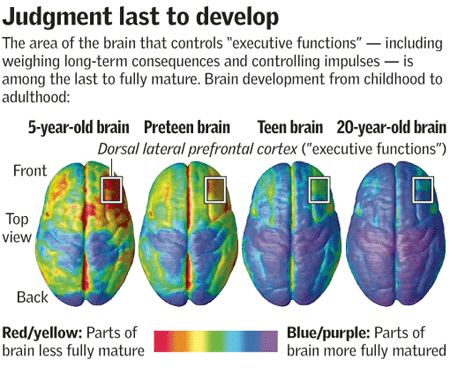
All that was happening to hormone-uneven, social beings with issues. They’re not fully formed human brains. They're still developing. They don’t make good decisions because the parts of the brain involved in decision-making aren’t fully developed until they’re 25 or so. These kids are nowhere near 25! So of course they're going to make bad choices. It’s part of growing up, not a sign of poor values.

It’s like asking an elementary school kid to dunk a basket on a regulation height hoop. Of course they can’t. They’re not done growing! They're not there yet, even if they’re trying. 

Same with asking a 15 year old to consistently make good decisions. They can’t. They’re not done growing. They're not there yet, even if they’re trying. 

That doesn't mean we don't ask kids to make good choices and we don’t expect them to and we don't teach them how to and we don’t reinforce HOW TO make good choices. Of course we do! 

It means we don’t assume that poor choices on the kids’ part equate to poor values. 

Poor choices equate to mistakes. Period.

I made poor choices when I was their age. You did too. 
A kid who skips school might value education just fine. She might just value not getting beat up by a bully that day even more. If I were in her shoes I might value the same priorities. 

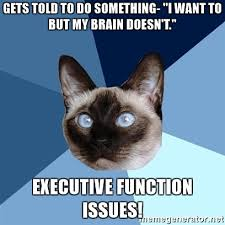
A kid who doesn’t do any work might value education but not know how to start. It might be like how I avoid cleaning out my closet because it’s such a big task and I don’t know where to start. It’s called “task initiation” and it’s a real area of executive function. It’s not a problem with his values. It's a problem with his brain development. He might just need some accommodations. Sometimes, I don’t know where to start either. But I have developed strategies. He might not have those yet.  

A kid going through something emotional will act out. So will I. I was a lousy teacher the year I got divorced, all those years ago. Because while I prioritized my job, my emotions got in the way and distracted me. And I even had a fully developed brain at the time! 

(Remember being a teen and going through a break up and not knowing how to handle it because your brain wasn’t done growing and you didn't have experience to draw from? Ugh! That was so awful and heartbreaking!!) 

So I hope I didn’t make judgments about my kids ... but I probably did, because none of us are perfect. I’ve been caught up in negative thinking, too. So I hope you don’t make the mistakes I did. I hope you don’t take the behavior of poor choices and emotions and partially-formed brains and called those “values” or “caring”. 
Instead, I hope you DO the caring. Remember that these are children. They don’t have your experience or your perspective or your stability or your fully-formed brain. 

I hope you give them the love and support and caring  in your class that will HELP THEIR BRAINS DEVELOP FURTHER AND BETTER. Honestly, not to simplify, but feeling safe and loved and supported is like a cast on a broken bone. It supports the brokenness and lets it heal and grow what and where it needs to safely without being further damaged. 

Getting on their case regularly, yelling at them, or writing them up for not working -- it’s like bumping that broken bone. It doesn't let it heal. 

Kids who struggle have hormones and emotional turmoil. They have social media drama that we didn't have. They have family problems we don’t know about. They have romance confusion we have forgotten about. They have executive functioning struggles and learning disabilities many of us don’t know as much about.  

But 94% of them want to go to college. Most of them care about their education. But that other stuff gets in the way, just like my couch (or my last bout of being sick) gets in the way of my valuing my health and exercise. :) 

How can you help them develop their brains and become stronger students? How can you work to see the caring behind all the crap they have to deal with? How can you bring that out of them in a positive way? I love to hear the amazing things you’re doing? Email me newmantr@pcsb.org

Tuesday, May 14, 2019

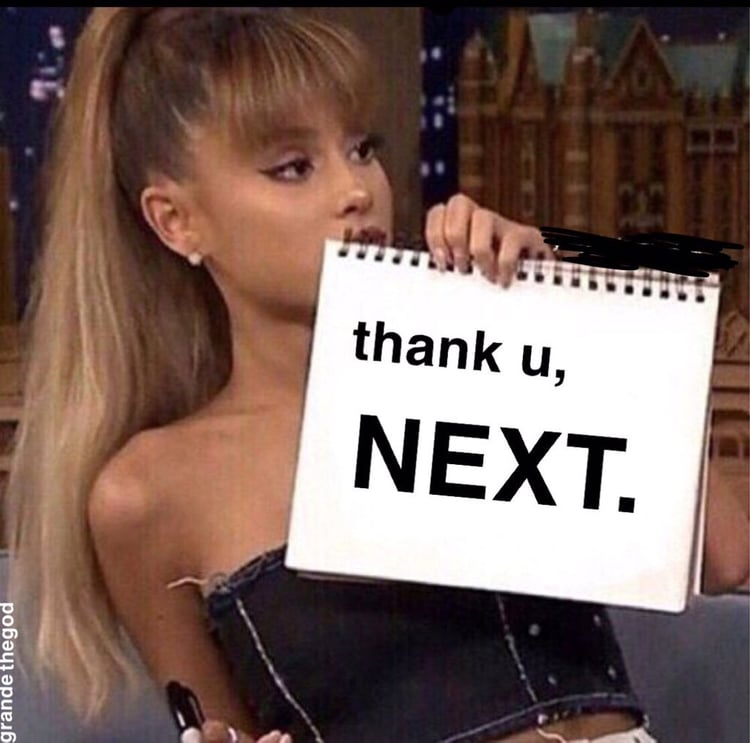
Thank U, Next

I realize that I am too old to listen to Ariana Grande but I do anyway. I refuse to be the kind of person who stopped listening to new music when grunge died.

If you are too old to listen to Ariana Grande, too, you might have missed the song, “Thank U, Next” where she sings to all of her exes and tells them what she learned from them and how ready she was/is to move on from them.

At this point in the school year, you may be ready to say “Thank U, Next” to this year’s group of kids. Some years, I remember feeling that way in February.

“Thanks, kids. Is it time for next year yet? Or at least, is it time for summer yet? When will these children be GONE?!?!?!”

What I really want to focus on, is the ability to learn from anyone who crosses your path -- including the students.

I know THEY are supposed to learn from YOU. But I think you can learn a lot from them, too.

The best way to do that is through an end-of-the-year survey.

Sure, your students have been annoying and ... REALLY annoying ... and some of them have been dishonest or unpleasant or bewildering or even outright nasty.

But you will be surprised at how many of them will be honest and helpful on a survey like this. Sometimes even the toughest kids might open up on this sort of thing.

You can survey them on paper. You can survey them digitally. You can survey them pre-printed (does anyone have any copies left?!) You can survey them on index cards, or with QR codes or on their phones or on plain old notebook paper or in OneDrive or Google Docs or on scantron.

It’s a great thing to do on one of those weird days when you see one group for three hours and the other for 15 minutes.

But just do it.

What  should I ask on a survey?

It depends on what you want to know and where you want to grow....

Here is a huge pile of questions. DON’T ask them ALL! Choose the 5-10 you most want to know about and ask those. You can gear them more toward your management, your lesson planning, your learning activities or your emotional support.

  • Which unit was the most interesting to you this year?  
  • Why was this unit the most interesting to you?
  • Which way did you learn the most? (then, give options like “reading”, “group work”, “projects”, “graphic organizers”, etc.)
  • Why do you think these ways were the best?
  • If you could go back and start the year/semester over again, would you do anything differently? Why or why not?
  • What was the best part of this class?
  • What was the worst part of this class?
  • What could I have done to teach you better?
  • What did I do that was the most helpful to you?
  • What was the most important thing you learned this year?
  • What could I have done to improve this class?
  • What will you remember most about this class?
  • What else do you want to tell me about this class?
  • Name something that made it hard for you to learn this year.
  • What should your teacher do differently next year?
  • Did you feel challenged this year? Why or why not?
  • How has your confidence in _________ (subject) improved this year?
  • What is one piece of advice that you would share with a student who is entering this class next year?
  • Did you feel as though I had high expectations of you?
  • Explain a time in class in which you were able to overcome a struggle.
  • Finish this sentence: “If Mr./Ms. ______ only knew __________________”

I’ve said it before and I’ll say it again.

Kids are surprisingly insightful and honest on these things.

I know you are end-of-the-year exhausted, but this is totally worth the 5 minutes it will take to pick your favorite questions from above and put them in the format of your choice.  

Your kids will surprise you.

In a good way.

Have any great survey questions I missed? Email me at newmantr@pcsb.org


Thursday, January 24, 2019

Make Your Life Easier

Now that we’re over the “honeymoon” period of the new semester. They’re all done with that post-winter break sweetness and they are up to their old tricks again.
Life is getting complicated again. The stack of stuff to grade is back. The lesson plans we got caught up on are now all used up and the next ones aren’t yet written. The meetings and conferences are filling up the calendar.
So let’s make life easier.
Here are my top five favorite tips to make your life easier in the classroom. Maybe if ONE of them works, then one little corner of your life has gotten easier? I can’t promise miracles. But if your frustration level is a 6 today, maybe we can move it down to a 5 or even a 4 with one of these ideas.
5. Written Directions: Not every kid is an auditory learner. And to be honest, not every kid is even listening when you give directions (I know, they should be, but daydreaming and distractions happen). So how can we help from repeating ourselves five hundred times? How can we stop getting work from kids who clearly missed the directions?
Write them down.
It’s so easy! Why did I never think of it?
Write down the directions step by step. Like this: “Step One: Put your heading on your paper. Step 2: Read the paragraph carefully, looking for a main idea or claim. Step Three: Answer the two questions on your own paper”

I know you say it. But if you don’t write it (on the board, the screen, or right on the handout) then a bunch of your kids might miss it. Especially ESE kids, ELL kids, kids with auditory processing, ADHD kids, kids who never (or rarely) do anything -- AS WELL AS kids without issues who are just zoning out, secretly texting, half asleep, or daydreaming.
Written directions will help increase the number of kids on task and the number of kids who correctly complete an assignment. Write them down separately for EACH part of your lesson (don’t put bellwork directions on the same list or slide as the reading directions or the exit ticket directions).
4 Praise, praise, praise: There are few tools that I learned from the teacher down the hall that  help as much as this one: give your kids constant, individual, public praise.

“Make it rain” with praise.

As kids walk into your room, call them out, out loud, individually, by name, with praise. “Thank you, D’Angelo for coming in quietly and getting your materials out. Thank you, Rachael for sitting quietly and starting your work. Thank you, Hector and Jayden, for staying on task”

This simple act actually hits management from four angles.

a.       It tells your kids that you’re watching them and noticing their behavior.
b.       It makes a show of the GOOD behaviors, not the bad ones (those negative behaviors like “Juanita, sit down; Milo, be quiet; Olivia, put your phone away”)
c.       It gives positive attention to the good kids (who are usually ignored when you’re telling James to stop annoying his neighbor)
d.       It reminds kids to do the positive behaviors without waiting for them to mess up.

You can’t possibly overdo this praise. But don’t do it by whole class. Do it by individual. It makes a whole world of difference. Praise every kid as he or she “gets with the program” and does what he or she is supposed to do. You might think they should do good things anyway, but if they don’t feel that anyone notices, they might stop doing the good things. If you notice, and SAY SOMETHING, you will keep them on track.

3. Formative Assessment. Every day, when your kids leave class, you should know what they did learn and what they didn’t quite get. Every day, when kids leave, you should have done some sort of formative assessment. It’s easy to work it in daily.

You can give a formal exit ticket or have kids turn in an assignment. BUT you can also just listen in on their turn and talks. You can read what they’re writing. You can do a formal quiz. You can ask them to do a quickwrite with a higher order question. Actually, formative assessments are a GREAT chance to have kids use what they’ve learned and practice applying it!

But you should be able to know every day how it’s going. It doesn’t all have to be at the end of the period, (sometimes it’s best in the middle of your class period. but you should be able to know how your teaching is going (or went). It doesn’t even have to be always graded.

2. Tell Them WHY:  “Why do we have to do this?” It’s a common thing for kids to say. And to be fair, WE-the-teachers usually know WHY we are doing an activity, but we often forget to tell kids that reason.

Set a purpose for every activity you do --  and tell them WHY you ask them to do the stuff you ask them to do. Why do we do bellwork? Why are we doing this in groups? Why do we have to be quiet? Why do we need to know about international organizations? Why do we need to know about Manifest Destiny? Why are we reading this?

Tell them.

Tell them every day. It helps them to buy in to what you’re doing AND it helps them to connect their learning to reasons for that learning!

  1. Turn and Talk: Still winning Most Useful Teaching Tool contests, the turn and talk is versatile and powerful.  
  • It can help you get/keep your kids on track (“turn and tell your neighbor what we’re supposed to do next”)
  • It can help your kids process content in digestible chunks(“turn and talk about what we just read”)
  • It can help you take a lower-level lesson up to higher order thinking (“turn and talk about what possible impact this could have”)
  • It can help you give your kids a chance to talk -- but about content, not about Fortnight (“turn and talk about what you think about that idea”)
  • It can help you make your classes more student-centered (“turn and explain this concept to your partner”)
  • It can impress your administration (“turn and talk about why you chose the answer you chose”)
In addition to being powerful and effective -- it’s quick (30 seconds!) and can be thrown into the middle of a lesson when needed.

Kids need breaks to process content. Do you ever notice that they stop paying attention or stop working at a certain point? It’s because they are overloaded and need time to digest content. Turn and talks can provide that “content digestion” and can provide that break from concentration.

In Marzano-land, turn and talks COULD address...
  • Helping students process new content
  • Helping students elaborate on content
  • Reviewing content
  • Helping students practice skills, strategies, and processes
  • Helping students examine their knowledge
  • Helping students engage in cognitively complex tasks.

Turn and talks make every lesson better. You only need one or two or three a class period to up the rigor and increase the student ownership in your lessons

**Honorable mention: Call and response: If you don’t have a quick attention-getting system, please get one. Use a call and response like “”If you hear my voice clap once” or “Hey class/heyteach”. Here are 50. Many are elementary, but not all I know we talked about using a call-and-response  to get kids’ attention and to get them quiet.

Here are a couple of Youtube videos showing Call and Responses
https://www.youtube.com/watch?v=78eiLtQjmss (don’t do bubble in the mouth. That’s elementary school. But some of the others might work)
https://www.youtube.com/watch?v=l1QxsqrdpyI (elementary and over the top, but fun)
https://www.youtube.com/watch?v=99Wr9NDcTMs (dance moves I don’t think I could master, but he requests eyes tracking him and that’s important)


If you haven’t tried one of these -- please do! They will make your life easier and drop your stress a notch or two. I promise -- if you try them a couple of times they will become habit and you will see results!

Need ideas? Want to talk it out? Email me at newmantr@pcsb.org