Showing posts with label DBQs. Show all posts

Thursday, October 6, 2016

Digital DBQ Might Change Your Life

Digital DBQ might change your life

Y’all know I LOVE a top-ten list, right?

I got to attend the Digital DBQ training (twice!) this week and I am DYING to try it with actual kids! If you didn’t get to go yet (or if you need a cheerleader for Digital DBQ anyway), please see my list below!

Top Ten Things I Love-Love-Love about Digital DBQ
10. You can blow up all the in-color images, huge, and dig into them. No more squinting at blurry copies of copies of copies or illegally scanning them into your computer. Everything is in color (except, you know, stuff that was photographed in black and white). Hooray for analyzing maps, photographs, artworks, and graphs!!!

9. You don’t have to teach the WHOLE thing digitally. If you can’t get a computer lab for a whole week, you can teach it blended -- do SOME digitally and SOME paper-and-pencil. I can even do some digitally as a whole-class, on the projector!
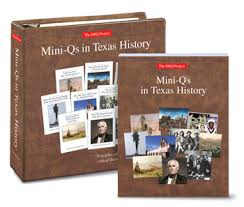
8. It gives me access to DBQs I may not have in my building. Like the Texas Mini-Qs. Or Salem Witch trial (which isn’t in older versions of the US Vol 1 Binder). High school teachers -- you just won the DBQ PRoject Lottery! Check it out....

7. It READS STUFF ALOUD to kids. With REAL ACTORS (not a Siri-sounding computer voice). I love that it reads the background essay and documents out loud to kids. I might even do that with the whole-class, in my projector!

6. It lets me differentiate easily. I can choose which kid gets which supports/accommodations. I can give my ELL learners a more-scaffolded Doc Analysis sheet and my regular kids a regular doc analysis sheet. I can decide that Student A, whose 504 says she reads a lot slower than her peers, should get  one less document. I can decide that Student B, who struggles with writing, gets the Guided Essay while other students work with the traditional outline. AND I DON’T HAVE TO DO ANY EXTRA PREP BUT SOME CLICKS! Woo-hoo!!
5. It mimics the FSA test. Kids take the FSA via computer and have tools like the ones available in Digital DBQ -- like highlighting, underlining, and note-taking. Kids can even click the boldface words and get definitions! It’s web-based so you don’t have to download anything. It even saves all the kids’ work every 3-5 seconds, so their work won’t disappear.
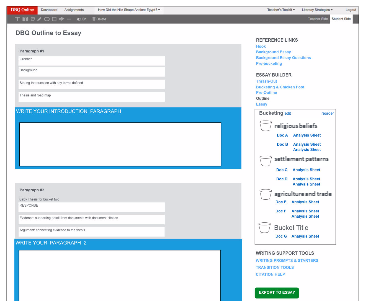

4. More writing support! The “Essay Builder” feature will let kids take their buckets and chickenfoot and helps them to construct their essay one chunk at a time. It gives them more prompts and more structure. Hooray for better writing!

3. More writing flexibility! Students can add or remove “buckets” -- and their chickenfoot will automatically add or remove chicken “toes” accordingly. This lets them have more flexibility over their essay structure so it’s not so rigid

2. You don’t have to input all your students into the system. All you have to do is give your kids a link (write it, put it in Portal, text it, project it) and have them login with their R2.D2 logins. No name-entering!!!
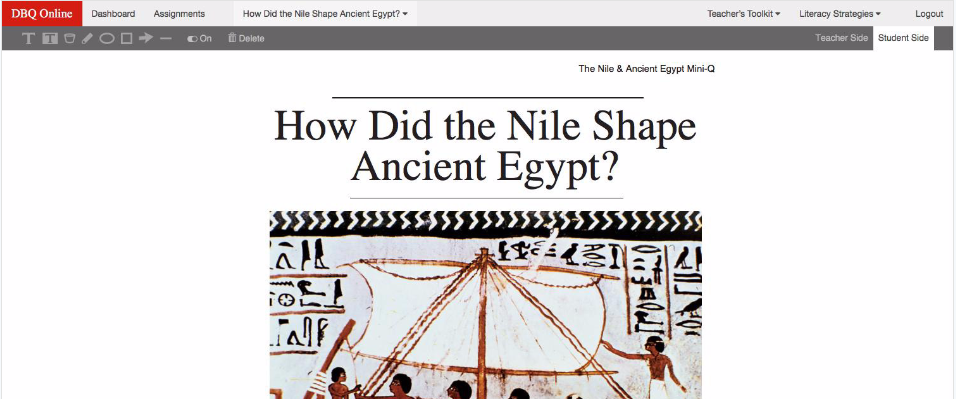

1. It’s JUST like the regular DBQs -- it looks the same, the documents and hook exercises and everything are the same -- it’s even the same font.  You still have the “student pages” and “teacher pages”. It’s not “one more new thing”. It’s the same, comfortable, familiar thing -- but on a computer!

A few quick notes... Our district has a one-year subscription to Digital DBQ. We need to try it out -- with our kids --- to decide if it’s worth paying for next year. AND if we DO decide that it’s worth paying for -- we have to show it by having our kids actually use it.

We are having Digital DBQ training this upcoming Wednesday, Oct 12 during the PD day for elementary and middle school teachers. This training will be offered both north county and south county, both morning and afternoon. If your principal will give you permission, we’d love to see you there! We hope to offer another evening training on this, too. We will let you know when it is scheduled!

Digital DBQ looks like an awesome tool! I hope it is as awesome for you as I think it will be. The only way to know is to try it out with your kids!

As always, I love to hear from you! Email me at newmantr@pcsb.org

Wednesday, January 6, 2016

Luke, I Am Your Father

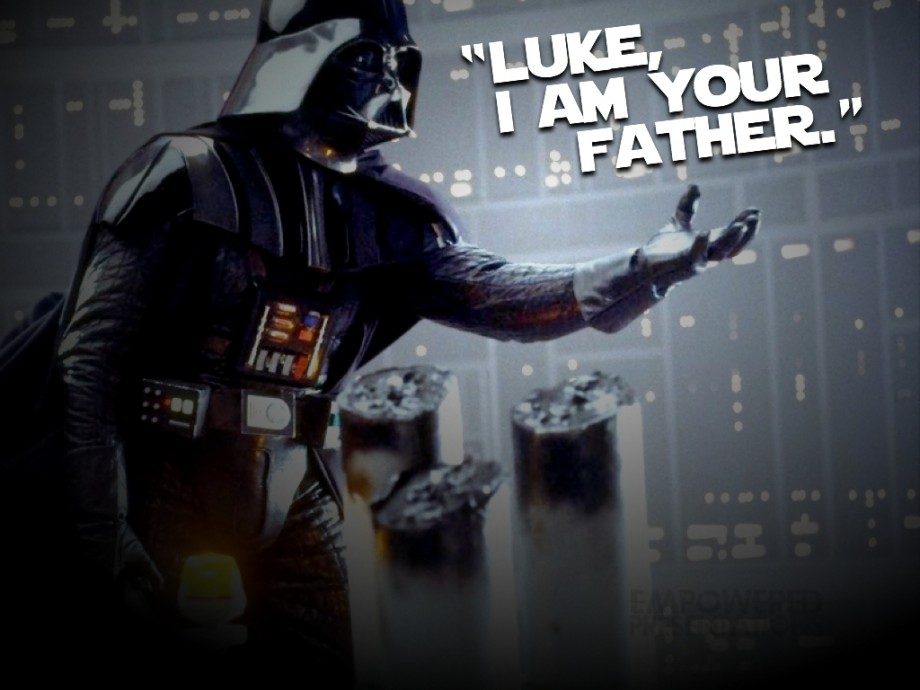
One of the most iconic moments in pop culture is this: 
Darth Vader, breathing heavily (loudly) and uncomfortably confessing, “No, I am your father”

Of course he is Luke’s father. The next few Star Wars movies are built around that premise.

But that was a HECK of a bomb to drop on Luke (and the millions in the audiences around the world) at the time.

We forget how absolutely SHOCKING that was in 1980. We forget how audiences had hated him as the ultimate enemy through two and a half movies (and three actual years).  With those four words, Darth Vader went from a stereotypical villain to a three-dimensional, complicated human being.

Well,  I haven’t seen the new Star Wars movie yet. My vacation was ridiculously busy and I need to find a babysitter.

But I think about Darth Vader and the enormity of that one line -- both in the Star Wars franchise and in pop culture in general. How when we know the end of the story, like we do in 2016, everything is predictable. For those of us who watch it NOW, of course Darth Vader is Luke’s father. Of course! that explains so much.

When we know the ending, the story seems predictable, almost destined, inevitable.

But Darth Vader is not really that simple.

Neither is most of history.

We tend to teach history like readers who skipped to the final pages of the novel (Full disclosure: I’m totally guilty of this on occasions). When we know “whodunit” in the mystery, we can see all the clues light up before us to create an obvious path to the “right answer”.

But when we live our lives and make our decisions, we don’t know how it is going to turn out.

When people in history lived their lives and made their decisions, they didn’t know how it was going to turn out either.

The National Standards for History (which are optional standards not adopted in Florida but are good for pondering...) say this:
"The student is able to challenge arguments of historical inevitability by formulating examples of historical contingency, of how different choices could have led to different consequences."

What many kids get out of textbooks is what I get when I flip to the end of the novel to find out the ending. We lose what author Philip Roth calles "the sense of inevitibility".

My favorite SS blogger, Glenn Wiebe asked, "Do we know what's going to happen ... in middle eastern countires? Will China actually become a superpower? In the moment, no one really knows what's going to happen but we teach history as if what actually happened was 'inevitible' ... Roth says that 'the terror of the unseen is what the science of history hides'. We lose the 'unseen' when we don't ask good questions and don't encourage kids to solve interesting problems.

If a few things had been different, maybe the US would not have won its independence from Britain. Maybe slavery would have ended earlier or the Civil War would have been different. Maybe WWI could have been avoided. Maybe different people would have won different elections and made different choices.

Not everything in history was predestined. History happened because of both decisions and indecision, because of both human effort and human mistake, because of both chance and calculations.

To every action is a reaction. From every cause is an effect, intended or unintended.

History is not (and was not) inevitable.

Teach your students to not assume that every moment in history was part of one unbroken line that was destined to be that way.

Teach your students about the decisions and indecisions that real people made in history and how those things impacted the towns, countries, and world in which they lived.

Then, teach them that their choices, too, impact the world in which THEY live. Their words, their actions, their votes impact their world as much as the actions, words, and votes of people in the past did.

There’s power in knowing that the world is not destined to be a certain way and that we can influence it.

Use the idea of historical inevitability to engage your students about the past AND the present. Use the idea of historical inevitibility to raise "big" questions and to get students thinking.

The world isn't always predictable. Darth Vader certainly wasn't.

Do you teach about historical inevitability? Or do you “skip to the end of the book” and teach the ending first? Can you find the Franz Ferdinand trivia in this email? How do YOU teach about historical inevitability and human choice? Can you imagine a world in which we DIDN’T all know that Darth Vader was Luke’s father? What did you think of the new Star Wars movie?

As always, I love to hear from you! email me at newmantr@pcsb.org

-Tracy

Wednesday, November 4, 2015

Driver's School

So, I got a speeding ticket recently. It happens, right? I totally deserved it.  There was a good song on the radio and I was jamming out and let my foot get a little too heavy on the accelerator.

Well, as many of you may know the deal is this. Some traffic infractions equal some points on your license. The more points you have, the higher your insurance will go.

So, in order to keep my car insurance costs low, I elected to go to driver’s school.

Online.

Here’s what I learned from driver’s school.
1.    Proper following distance in good weather is two to three seconds.
2.    You never “have” right of way; you can only yield the right of way.
3.    Your reaction time after reading a text is worse than your reaction time while being intoxicated.


Here’s what I didn’t learn:
How to drive slower when singing along with the radio.

I took the test at the end of my online course. There were 40 true/false and multiple choice questions about driving trivia. (I passed. Whew!)

Not one test question actually tested my driving. There was only one scenario and it didn’t ask me what to do, only who was at fault.

I really need to use my higher-order thinking skills. I need to THINK about MY driving and APPLY what I learn about driving to the real road.

I don’t know about you, but knowing ABOUT something doesn't make me good at it. I know about the benefits of daily exercise. That doesn’t make me GOOD at exercising daily. I know ABOUT how to clean my house. That doesn’t make me GOOD at keeping it clean

So knowing ABOUT history and government doesn’t make me a good citizen.

APPLYING my knowledge to the real world makes me a better citizen. Using what I learn to make informed opinions and informed actions makes me a better citizen.

That’s why we need to teach our kids higher order thinking skills.

Image result for higher order thinking skillsWhat do I mean by higher-order thinking skills? Well, use Webb’s DOK, Bloom’s Taxonomy or Marzano. But really, higher order thinking involves analyzing (breaking things down), summarizing (putting things together), evaluating (making decisions about information), hypothesizing (making predictions about content) and creating (using information to create something new).

There’s more to it than that, but that’s a start.

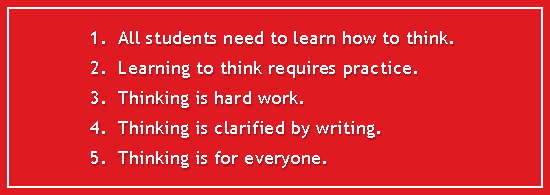
The DBQ Project says it like this:
Core Beliefs Box·         All students need to LEARN how to think.
o    They aren’t all naturally talented at thinking any more than they are all naturally talented at baseball or piano or driving
·         Learning to think requires practice
o    Like baseball or violin, even kids who are naturally inclined need regular practice every day
·         Thinking is hard work
o    We often get frustrated at mental laziness. But if kids aren’t taught that thinking is hard work and aren’t expected to do that hard work every day, they aren’t used to it any more than they would be used to practicing pitching or long-distance driving)
·         Thinking is clarified by writing.
o    You can’t get better at thinking if you don’t hone that skill with writing anymore than you can improve your piano playing with the same piece of music)
·         Thinking is for everyone
o    Thinking is not just for magnet students or AP students or advanced students or Level 3s or gifted students or native English speakers. IT. IS. FOR. EVERYONE.

Think about how you teach.

You don’t have to TEACH a DBQ to teach higher order thinking -- but it is one wonderful tool.

Do you use gradual release to teach HOW to think? Or do you err on the side of “I’m going to tell you the answers because you can’t do it”? Or do you swing to the other side of the pendulum and have the kids “just do it” without enough instruction, modeling, etc.


Do you “chunk” content, readings, and activities into small, think-able bites? Or do you give kids too much where they get frustrated and give up?

Take a look at your classes -- and your assessments. Are you teaching higher-order thinking every day? Are you giving students many opportunities to practice that thinking? Are you understanding that it is hard work? Are you giving opportunities to clarify and improve that thinking through writing? Are you really teaching higher-order thinking to everyone or just certain students or groups?

Image result for how's my drivingDriver’s school didn’t make me think. It made me use rote memorization, very little of which is impacting my driving. If you’re on the road please know that I am self-aware enough to try to be safer and less ticket-y. I promise I am not a danger on the road.

Don’t teach like driver’s school did.

Teach kids how to think.

Give them opportunities and practice and writing and expectations of higher order thinking.

It’s on their EOCs and dd-EOCs. But more importantly, it’s what we want from our citizens.

How do you teach thinking? Any guesses on what I was jamming to when I got pulled over? As always, I love to hear! Please email me at newmantr@pcsb.org


Wednesday, February 4, 2015

OMG! The FSA is a DBQ! SMH...

When I started teaching, in my New Teacher packet,  I got an awesome list of education-industry acronyms. This was a super helpful list as I tried to sort through the VE, EBD, ESE, and/or ELL kids who did or did not have ABC or ABS or OSS at the MS or HS or even the ES. I knew what PE was and who TAs were but not STEM or PMAC or SWBAT.  I was confused by DWT, IPDP, NCLB, IDEA, but knew I didn’t want to go to OPS. I wondered about the NAEP, FCAT, SRI, SAT, AP results of my students. I joined PCSS, FCSS, NCSS and PCTA. At least I could ask for things ASAP and learned to CYA and MYOB.

All that was before text messages and twitter further shortened our world of acronyms.

Isn’t it funny how we can write entire sentences where we use more acronyms than words?

So here’s my acronym speak for the week.

FYI, the FSA is a big DBQ.

Ok, so that isn't’ nearly enough acronyms in one sentence to go in my acronym hall of fame, but seriously, here’s how it works.

The kids read a couple of documents (generally of social studies and/or science topics) and then write either an informative or argumentative essay about a big overarching question.


Sound familiar?

Sure, there’s no hook activity or buckets, but that is the basic gist of a DBQ: Read multiple texts, connect common themes, answer question in written essay form.

So -- do me a favor. W8...don’t do me the favor, do a favor for your students -- ESE, ELL, AP, EBD, or whoever --

Do one more DBQ in the next month to help prepare your kids for that Writing FSA.

OMG, it will be so helpful!

Seriously, your ELA (English/Language Arts) and Reading colleagues are teaching their butts off to make sure the kids are familiar with the format, the computer program, the standards and the essay planning before the FSA writing test next month.  Preventing as many IDKs as possible ... SMH ...

We, as social studies teachers can be super huge helps to our students -- and to our school grades -- if we do one more DBQ this month before Writing FSA.

If you’re wondering if this is really a part of your job, BTW, when you have your own EOC coming up, go  to CPALMS (SRSLY -- CPALMS.org) go there, pull up your course, and click on the standards. The beginning ones that say LAFS...RH or LAFS ... WHST -- those are for you.

LAFS stands for Language Arts Florida Standards and RH means Reading History while WHST stands for Writing History, Science, Technical subjects.

Those are the ELA standards that go with your NGSSS. They are in your course directory from the FLDOE and they are an important part of your course.

Here’s a reminder of the alignment between the DBQ, the LAFS and the FSA.

The DBQ, LAFS, and FSA Match-up!
*Ellipses (…) are used in place of grade level band for Florida Standards. For grades 6-8 LAFS, the ellipses mean 68 in the traditional coding. For grades 9-10 the ellipses stand for 910. For grades 11-12, they stand for 1112. For example LAFS.1112.RH.1.2 or LAFS.68.WHST.2.2
Parts of a DBQ
Corresponding Florida Standards
Corresponding FSA
The Hook Exercise
Where the DBQ introduces the main concept in the DBQ and hooks the students’ interest
·         The Hook Exercise does not explicitly address the Florida Standards in reading and writing, but it does address the Florida Standards in Speaking and Listening. It is also an essential part of setting purpose and engaging the students.
·         Not explicitly FSA but the Hook is a great part of setting purpose and engaging the students.
The Background Essay
The students and teacher read a background essay to “even the playing field” and put everyone literally on the same page. This is a textbook-style secondary source to give students context for the documents ahead.
·         Introduces the academic vocabulary  
(LAFS…RH.2.4)
·         Helps students practice finding the main idea (LAFS…RH.1.2)
·         The background essay is like one of the informational texts in the FSA test. Working through the background essay helps kids practice reading strategies
Understanding the Question/Pre-bucketing
The students make sure they completely understand the over-arching question of the DBQ and all terms within the question.
·         Produce clear and coherent writing …appropriate to the task, purpose, and audience
(LAFS...WHST.2.4)
·         On the FSA, students will need to thoroughly understand the question before they respond to it in writing.
Document Analysis
The students deeply read and analyze several primary and secondary non-fiction documents on the same topic, showing various viewpoints, types of text, and
·         Analyze primary and secondary source text
(LAFS…RH.1.1)
·         Determine main idea of primary and secondary texts (LAFS…RH.1.2)
·         Analyze in detail a series of events in a text/text structure  (LAFS…RH.1.3)
·         Analyze how a text uses structure to make a point (LAFS…RH.2.5)
·         Integrate visual information and charts and data with print text (LAFS…RH.3.7)
·         Assess whether the reasoning and evidence support the author’s claims (LAFS…RH.3.8)
·         Compare and contrast the treatment of the same topic over multiple primary and secondary sources (LAFS…RH.3.9)
·         Read complex text (LAFS…RH.4.10)
·         On the FSA test, students will read and analyze several varied sources on the same topic and will need to understand them well enough to respond in writing.
Argument and Thesis
Students argue or “thrash-out” the topic, as a pre-writing strategy. They then write a thesis statement and a “roadmap” for their argument paper.
·         Compare the points of view of multiple authors (LAFS…RH.2.6)
·         Compare and assess whether the reasoning and evidence support the author’s claims (LAFS…RH.3.8)
·         Compare and contrast the treatment of the same topic over multiple primary and secondary sources (LAFS…RH.3.9)
·         Introduce a claim (LAFS…WHST.1.1a)
·         Support a claim with evidence (LAFS…WHST.1.1b)
·         Gather and use relevant evidence from multiple sources (LAFS…WHST.3.8)
·         On the FSA test, students will need to construct clear and coherent arguments based on the multiple sources they have read and analyzed. Four out of ten points are based on organization and focus.
Writing the Argumentative Essay
Students write formal, argumentative essays from their thesis statements based on evidence from the documents and on reasoned historical and political arguments.
·         Write arguments focused on discipline-specific content (LAFS…WHST.1.1)
·         Introduce claims and thesis (LAFS…WHST.1.1a)
·         Support your claim with evidence (LAFS…WHST.1.1b)
·         Write clearly, make appropriate transitions, and use formal style (LAFS…WHST.1.1c and 1d)
·         Write a thoughtful conclusion (LAFS…WHST.1.1e)
·         Produce clear and coherent writing that is appropriate to the task and audience (LAFS…WHST.2.4)
·         Gather relevant information from multiple sources and assess the usefulness of each source (LAFS…WHST.3.8)
·         Draw evidence from informational texts to support analysis and reflection (LAFS…WHST.3.9)
·         On the FSA, students will have to write a strong, argumentative or informative essay using the multiple sources they have read and examined. Four out of the ten points are based on student use of evidence and elaboration

PLZ -- do a DBQ. ASAP. DYI. The Writing FSA is next month. The Reading FSA is in April. Give your kids another great opportunity to hone their skills and prepare!

What DBQ are you doing in February? Email and let me know!
-Tracy