Showing posts with label Marzano and Social Studies. Show all posts

Wednesday, September 12, 2018

How Do I Increase My Rigor?

So, your administrator is asking about the rigor in your class? And Marzano asks that students “engage in cognitively complex tasks”. And those ISM walk-throughs are checking for the “level of rigor” on their walk through forms.


And, honestly, you know as well as I do that nobody cares if kids know a whole lot of lower-level facts when they grow up. We all know that kids using those facts, information, and skills is a more frequently used part of academics.
Rigor is king of a big deal

I recently had a colleague tell me about lesson plan and ask me how I would increase the rigor of it.

OMG!!! WHAT A FABULOUS QUESTION!!!!

For a long time, I hadn’t found a solid, consistent definition of rigor. And then I found this: Rigor is the higher level thinking a student can do on his or her own.

Now, rigor can ABSOLUTELY include scaffolding. (pleasepleaseplease use scaffolding! Don’t skip the scaffolding!!!!)

But then, the kids need  to be doing higher level thinking without the teacher doing it for them.
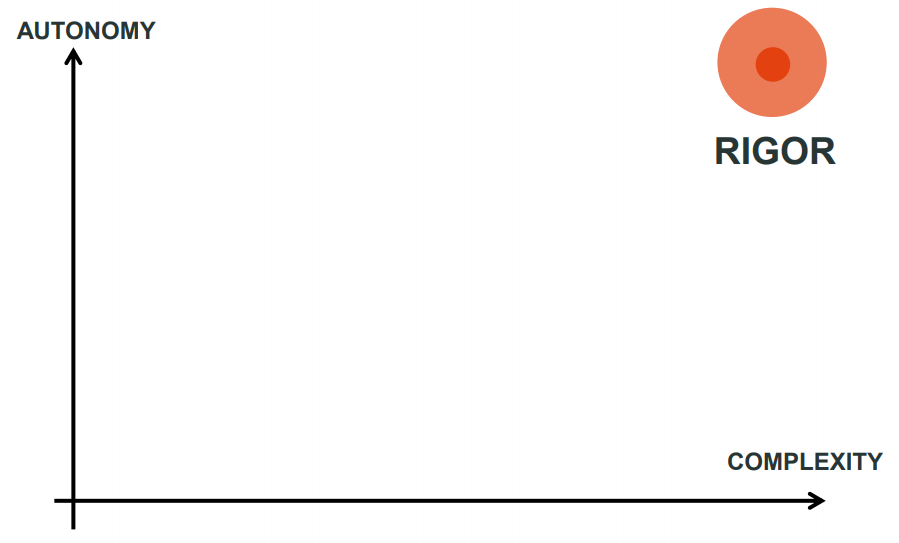
Check out this visual to help it make sense -->

Meaning, lead them up to the higher order thinking but then take off their training wheels and let them try it on their own.
(Actually, HOT thinking is likely to fall apart into disaster if you DON’T lead them up and give them scaffolding. But that’s another conversation for another day.

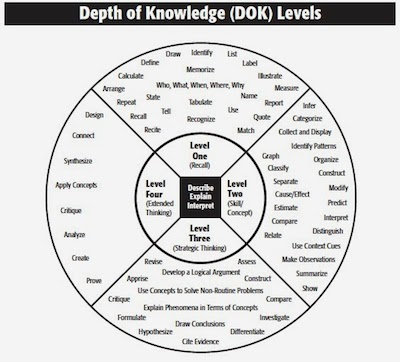
Do you know  my friend, the DOK Wheel? The DOK Wheel isn’t actually my favorite, but it’s the one the FLDOE uses to describe benchmarks and EOC questions, so we can go with it.

So let’s back that up. How can we increase higher level thinking without making kids’ (and teachers’) brains explode?

  1. Don’t let kids off the hook. They will pretend to be stupid. They will pretend to “only” be able to give you the “right there” answer. Use wait time and probing questions to get them to think at higher levels. Don’t accept “I can’t” (or “I don’t know”) for an answer.
  2. We slowly increase the rigor through the lesson. We sometimes call this “Spiraling questions”. OF COURSE we start with “right there” tasks! “Where was?” “What was?” “When was?” Then we move to putting pieces together, summarizing multiple parts, apply knowledge  to another topic/time/term.
  3. Then, we raise the questioning up to level three and sometimes 4 of DOK. Here are some quick and easy HOT (Higher Order Thinking) question stems. Choose ones that match what you’re teaching.  https://www.saydel.k12.ia.us/cms_files/resources/general%20hots%20question%20stems%20and%20processing%20activities.pdf

Ok, Tracy, I think I’ve got WHAT Higher Order Thinking actually IS. But what does that actually look like? What does rigorous learning look like?

Here are a few quick ideas to start to introduce more rigor in small, manageable ways in your classroom.
  • HOT Question Turn and Talks: The quickest and easiest (and most natural-feeling) way to incorporate rigor is to incorporate it into quick turn and talks. Talk/read/watch about some lower-level stuff and the ask the kids to turn and talk about it with higher-level stuff. That’s a quick and easy way to include rigor.
  • HOT quickwrites: Not feeling the turn and talk ideas? Use the same questions as above but pose one or two as a quick write. Bam. Kids are thinking and you have both blissful peace and quiet AND evidence of their rigorous thinking (or what you need to work on tomorrow...)
  • HOT Plickers: Don’t have a lot of time? Throw a HOT multiple choice question up on the board and use Plickers (Paper+Clickers) to have kids answer a quick higher-level multiple choice question in less than a minute. Bonus -- now you have DATA on that rigor stuff...
  • HOT Focused Notes: Taking Focused Notes? When students make connections (not YOU making the connections for them, but them making their OWN connections), that’s more rigorous. When students take notes and reflect on them and add some Higher Order THinking
  • HOT Benchmark Reflection: Don’t have anything prepared -- but you DO have your  Learning Goal (aka Benchmark) posted on the board? Turn it into a question and ask the kids to reflect on it. Here are a few examples ...
    • SS.6.W.2.5 “Summarize important achievements of Egyptian civilization.”
      • Describe two important achievements of Egyptian civilization AND connect how they impacted Egyptian Civilization.

    • SS.7.C.2.11 “Examine the impact of media, individuals, and interest groups on
    • monitoring and influencing the government”
      • How do the media, individuals and interest groups (pick one or two) monitor the government?How does that work? Give an example.
    • SS.912.A.3.4 “Compare the first and second Industrial Revolutions in the United States.”
      • What’s the same between the first and second Industrial Revolution? What’s different? Why are they more same or more different?

There are hundreds of ways to increase your rigor in the classroom. But there’s no reason you can’t start small.

Let’s start small and grow from there! Questions? Email me at newmantr@pcsb.org

Tuesday, October 11, 2016

What Comes Next?

Happy month-after-formative-assessment-month

So we spent a month looking at types of formative assessment. So now what?

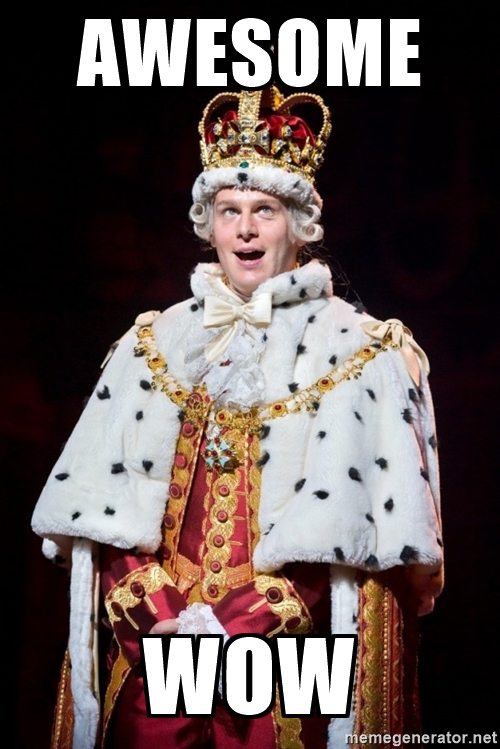
In the Best Musical Ever*, Hamilton, after the colonists win the American Revolution, the King of England, King George III sings gleefully,

What comes next?
You’ve been freed
Do you know how hard it is to lead?
You’re on your own
Awesome. Wow.
Do you have a clue what happens now?

*As rated unscientifically by me

I’d like to follow up to our thinking about formative assessment with King George’s first question (not his third question, which iis kind of snotty and jerky. His second question isn’t really related to this post.)

What comes next?

Meaning, what comes next, after you formatively assess your students? What comes next, after you see if they know the content or not -- in real time, once or even twice a class period?

What comes next?

The answer is  -- adapt.

Lesson plans are written (and often posted or emailed or shared...) but they’re not in stone. Despite the impression others may try to give you, your lesson plans should be living documents. In addition to the benchmarks, strategies, vocabulary terms, objectives, and whatever else your administration asks for ... you should include one thing FOR YOURSELF, not because someone asks for it.

You should include a contingency plan, based on your formative assessment.

Image result for heavy dLike Whitney Houston, your formative assessment asks “how will I know”?
Like Heavy D and the Boyz, you should be able to answer “now that we’ve found out, what are we going to do with it?”

Meaning, what do I do IF such-and-such happens....

What do I do ...
  • If my kids get my lesson more quickly than I thought?
  • If SOME of my kids get my lesson more quickly?
  • If SOME of my kids get the lesson quickly and SOME are lost?
  • If my lesson bombs and NONE of my kids get it?
  • If the kids get part of the lesson but not another part?

If you don’t want to put this stuff in your written turn-it-in lesson plans, that not my business. I’m not your boss or anyone’s supervisor.

BUT -- I would think it out, at least, for my lessons.

Two-steps:
  1. Formatively assess students
  2. Adapt lesson based on what the formative assessment tells you.

Some ideas on your adaptation --
  • How might you reteach to the whole class?
  • Are you ready to move on to the next part if they get it really quickly?
  • How might you use strategic grouping of students to help kids who struggle with different parts of the lesson?
  • How can you differentiate for ELL students, ESE students, gifted students, other groups?


There are a million ways to do this. More than I can fit in this email, at least!

What comes next? How do you adapt your lessons based on what you learn in your formative assessments? What’s working? What’s not?

I’d love to hear about your responses to formative assessment! As always, email me newmantr@pcsb.org

Wednesday, September 21, 2016

How Will I Know?

Happy (I-made-it-up) Formative Assessment Month!


Image result for bee girl blind melonI was the kind of kid who was forever putting on shows for whoever I could con into watching.  Dance routines, plays, synchronized swimming with my best buddy.


I realize this explains a lot about my personality to some of you who just went “Yup. I can see that”.


I went through a huge Whitney Houston phase one spring in late elementary school. I had a dance routine to every song on the Whitney cassette tape. I think I literally wore it out.


One of my favorites was “How Will I Know?”. If you aren't  familiar, the lyrics to this piece of pop perfection ask “how will I know” if he (a boy) really loves me?”


As a fourth grader, I had no idea how a person would know if a boy liked her. This was a definite mystery to me, so I could really wonder along with Whitney Houston.


As a teacher, my “How Will I Know?” question is less about dance routines and boys -- and MORE about what my students are learning.


Seriously -- how DO we know? We could wait until we give  (and GRADE) a quiz....


But I would argue that that would be too late. I need to know now -- THIS CLASS PERIOD -- how well my students are mastering the material. Otherwise, how can I adapt my lesson?


One more strategy for you to try with formative assessment is this -- Text Graffiti.


It works like this.
  1. Find something you’re going to teach. Maybe it’s a quote or excerpt. Maybe it’s an image. Maybe it’s a map. Maybe it’s just a phrase to get them thinking.
  2. Actually, find a couple of those. Maybe 4 or  5 for your class?
    1. For example, for the “key figures of the colonial era” you can have a stimulus for each of four different colonial figures.
3. Now, write or gluestick those stimuli to a piece of chart paper, in the middle.
4. Put a big question or some directions on the top
5. Have your kids go around at the BEGINNING of class in one color of pen or marker and write what they know about the topic.
6. Then, teach your stuff. You know, the way you do.
7. At the end of that chunk of content, have the kids go around in a DIFFERENT color and write on the chart paper what they LEARNED. They can draw arrows or connect to other pieces from before.


There are a couple of benefits (other than getting the kids up and moving)
  • First, you can see where the kids are at the beginning of the lesson, like a pretest, but more creative and flexible.  You can adjust your instruction from there.
  • Second, you can see the progress they made during class from ‘first-color” “before-learning” to “second color” “just-learned-it”
  • Third, you just have  to LOOK and adjust your instruction there, in the moment. You don’t have to GRADE ANYTHING (hooray!)
  • Finally, you can see whether, overall, your class mastered the content. Did they get it or not? You can learn a lot about how the lesson (or lesson chunk) went if they all wrote the same thing, or if they all threw out “important” vocab terms without explaining them, or if they were just as lost at the end as they were in the beginning.


Try this as ANOTHER formative assessment strategy. See what they know when they walk into your class -- and what they know after your instruction.


Bonus -- it may actually make you feel good to see what they learned. Or it may tell you exactly how to tweak your next bit of instruction so you can get your kids just that little bit further.


The more you know (about how your lesson went) ... the more THEY know (about your content).


All this needs is chart paper and markers or something. You can even do it on your board if you don't have chart paper (just take a picture of it at the end to refer to later).


What do you think? Are you up for ANOTHER formative Assessment strategy? Try this one and let me know how it goes. As always, I love to hear about your formative assessment -- and your love of Whitney. Email me at newmantr@pcsb.org
-Tracy

Wednesday, September 14, 2016

Trucks and Formative Assessment

Did you know that September is National Formative Assessment Month?
(I totally just made that up. But I think I’ll make a mini-series of Wednesday emails on Formative Assessment ideas for the rest of the month....)


My two year old is obsessed with trucks. Particularly, construction trucks. You probably don’t know that there are some dads on Youtube who have cashed in on the toddler love of trucks and written songs -- with trucky music videos about all different kinds of trucks. There are thirty videos these guys have made.


Thirty. Different. Truck. Songs.


Seriously. And you all wonder why I listen to the Hamilton soundtrack whenever I get the chance...


And despite my pledge to not be the parent who throws a screen in front of her kids... well, let’s just say that our whole family has learned the words to every one of those dang truck songs.


And my two year old is such a sponge! He might still throw a complete fit about who-knows-what, but he is learning more about trucks all the time.


And so am I. Because of these Youtube dads, my two year old and I now know what feller bunchers and concrete boom pumps are.


My husband and I were marvelling at our recent knowledge acquisition recently. Our conversation went like this.


“I used to think there were, like four or five kinds of construction trucks. Who knew there were so many?”


“Turns out there are over a dozen -- that my two year old knows. Real engineers and construction folks probably know even more!”


“How is it that my two year old is teaching me about something other than Elmo?”


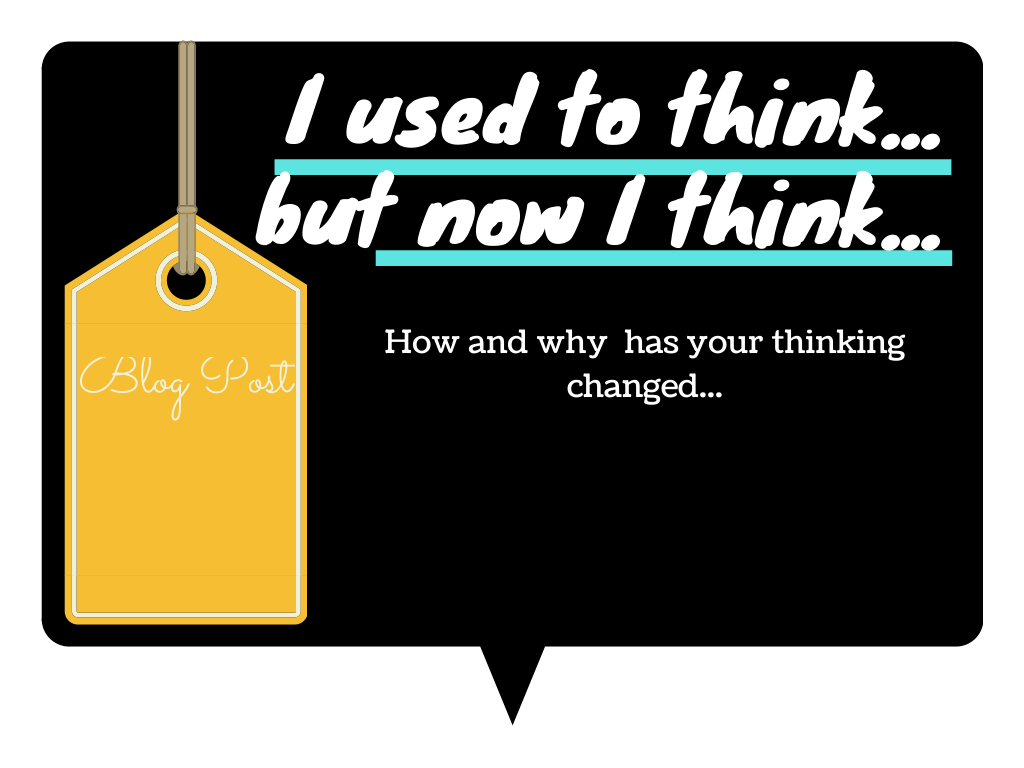
And this reminded me of a wonderful strategy for formative assessment. It’s called  ”I used to think ... but now I know...”


Remember, formative assessment is a way to see if your kids are getting it, if they are understanding the learning target. Formative assessment is so we don’t wait until “the test” to see if our kids are with us, or if they’re lost. When we get tired of the same exit slips and “whiparounds”, we need new ideas to mix it up in our formative assessment.


“I used to think ... but now I know ...” is a strategy that works just as it sounds like it would.


At the end of a task, an activity, or a lesson segment,  ask kids to take out a sheet of paper. You can maybe even have them just draw a line under their “so-far” writing and write to the prompt based on the task, activity, or lesson segment:


I used to think ...  
But now I know ...


This is a routine for reflecting on how and why our thinking has changed. This strategy comes from the Harvard Visible Thinking routines. They believe that if we make student thinking visible, we can better foster students intellectual development. The idea of visible thinking helps to make concrete what a thoughtful classroom might look like.


All we have to do is plan to put it in a stopping point or a transition point, explain it, and ask students to complete the two sentence starters -- about content from that day or lesson.


For example:
I used to think that there were three or four types of construction trucks.
But now I know that there are at least twelve that all have different jobs on the construction site: dump trucks, cement mixers, excavators, front end loaders, crane trucks, graders, backhoes, road rollers, concrete boom pumps, forklifts, bulldozers, and scrapers.


So simple. It’s a great way to do several things at once
  • Formative assess how well students have grasped the content in a mid-lesson (or “so-far”) point in order to adapt the next step of the lesson.
  • Help students identify and articulate errors in logic or reasoning (Marzano DQ:3 Element 18)
  • Help students track and reflect on their progress.


We KNOW we’re supposed to use formative assessment regularly, every day. We KNOW we’re supposed to use it to inform our instruction -- to make in-the-moment decisions about where to go next in your teaching. We KNOW we should take that formative assessment and decide whether to move forward or back up in instruction.


But we don’t always know HOW to do this.


So here’s a strategy for reflective formatively assessing: “I used to think ... but now I know ...”


Try it and let me know how it goes. Is this a strategy worth using regularly? How will/did you use it? And ... can you figure out what a feller buncher does? As always, email me at newmantr@pcsb.org