Wednesday, September 23, 2015

#WeddingDJ

The Wedding DJ

I used to be a Wedding DJ, as a part time job. I actually DJ-ed weddings for 7 years on Saturday nights. It was kind of a fun job -- everyone is happy and excited and trying to have a blast at weddings. It’s like being the wedding singer -- without the actual singing stuff. #dontgivemeamic

Other than introducing the wedding party and MC-ing the first dance and all that stuff, the hardest part was trying to figure out the musical tastes of the crowd -- which aren’t always the same as the taste of the bride and groom. It’s hard to read if one particular crowd is going to really get into Frank Sinatra or ”Don’t Stop Believin’” or “Baby Got Back” or “Uptown Funk” or something in between.

But on a dance floor, the crowd votes with their feet. And a full dance floor usually equals tips. If the crowd loves “Get Lucky”, you’ll know because they are on the dance floor, shaking it up and singing along. And if they hate it, well, you’ll know that too. The dance floor will be empty (except small children and/or the one drunk person) and people will suddenly come up to you with suggestions of better songs. #heydoyouhavethatonesong

Formative assessment is easy on a wedding dance floor. You know if they’re getting it or not -- either they’re dancing or they’re not.

It’s a whole lot tougher in a secondary social studies classroom.

Have you ever given a test and then gotten frustrated at the kids who didn’t get it? Especially when you think you taught the heck out of the topic?

Wouldn’t it be nice if you knew -- before the test -- if your kids had a clue or not? If they were getting it or not?

You can. It’s called formative assessment.

Formative assessment is tool to give students feedback (corrective or right-track) and to help the teacher guide his or her instruction.

There are a million ways to take formative assessment. Here are a handful of my favorites.

  1. Plickers -- Go to www.plickers.com, sign up, download the app onto your device and print the plicker pages. Then, make multiple choice questions to check how your kids are getting it and adjust your instruction from there.
  2. List Three -- As an exit-ticket or a mid-period check-up, have kids jot down three misconceptions their peers might have -- and how to correct them.
  3. Check for Transfer -- Have students use a concept or vocabulary term in a different way to make sure they can transfer the idea. Have them explain “social structure” in terms of the school (principal, administration, teachers, students) or the role of the media in a different political or social issue.
  4. Call on Every Kid -- use https://www.classdojo.com/ or a another call-on system to make sure you hold every kid accountable for learning -- not just the motivated ones in the front row with their hands up.
  5. Today’s Meet/Padlet -- Have every kid leave a comment -- or comment on a thread -- on https://todaysmeet.com/  or https://padlet.com/ It’s like an active bulletin board where kids can talk about the lesson silently.
  6. Document the Turn and Talk -- Don’t judge(!), but it helps to take notes if kids are “getting it” or not, based on their turn-and-talk conversations.
  7. Gimme Five -- Have kids hold up five fingers it they really, really get it, four fingers if the mostly get it and so on until they get to one finger (no, not that finger) which means that they don't get it. This is good for quick checkpoints along the way.
    1. PS -- this is NOT equivalent  to your scale. Please don’t equate the two!
  8. Check Predictions -- have kids predict what they’re going to learn about (with a bellwork or an Anticipation Guide) and then at the end of class, see if they can make conclusions. Did they predict correctly? What did they get right or wrong?
  9. #Hashtag -- See if your students can summarize or connect what they learned by creating a hashtag (or two) about the lesson or activity. For the founding of the Maryland Colony, students might try #religiousfreedom or #catholicswelcome or even #lovethepope. I bet they’re a whole lot more creative than I am.  
  10. One Sentence Summary -- an “oldie” but a goodie. Have the kids summarize the reading, the political cartoon, the concept, the unit, -- whatever -- in one sentence. It’s good to be succinct. It’s better to use brevity to help us see whether our kids get it or not.

It’s easier to see where you “stand” when people are on their feet, like at a wedding. It’s harder to interpret your students. What’s your favorite form of Formative Assessment -- and will you try one of these new ones this week? Do you use formative assessment every day? Every period?

Don’t Stop Believin. Haaayyyy Macarena! #Iloveweddingmusic

As always, I love to hear about it! Email me at newmantr@pcsb.org
#formative #ithinkigetthis #checkingthelearning #whatdoyouknow


Constitution Day!

Tomorrow is Constitution Day. For those of you who don’t teach Civics or Government -- tomorrow is especially for you.


Every day is Constitution Day in Civics and Government courses. But for the rest of us, sometimes, it’s a stretch.


I mean, 6th Grade is currently teaching Mesopotamia. 8th grade is currently teaching the Colonies. High School World History is on Islam. High School US History is currently working on Industrialization.


None of those are quite as easy to fit the Constitution Day lessons into as it is in Civics or Government courses.


But it’s still important in all those other courses. Especially in those other courses.


Use some time tomorrow to figure out a way “tuck” the Constitution into your lesson.
  • Teaching about Mesopotamia and the Characteristics of Civilization? Try to talk about Government back then and Government here and now -- which is the Constitution!
  • Teaching about the Colonies? Talk about the Mayflower Compact and colonial governments -- and then talk about how those are related to our modern Constitution.
  • Teaching about Islam? Take some time to look at the First Amendment and the issue of religion in our Constitution and what that looks like today.
  • Teaching about Industrialization? Talk about how immigration and citizenship are addressed in the Constitution and how that continues to be a current issue.


And in case you need some last-minute inspiration, here are a few links to Constitution Day resources to get you rocking.

How do YOU celebrate Constitution Day? As always, I love to hear! Email me at newmantr@pcsb.org

Wednesday, September 9, 2015

Oatmeal Raisin or Chocolate Chip? Making Predictions

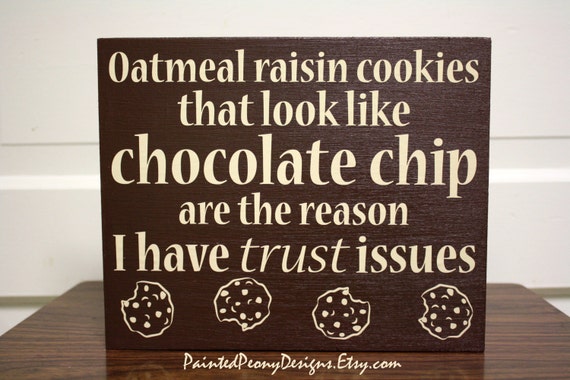
I have a friend who passionately detests Oatmeal Raisin cookies. She doesn't actually hate raisins, on  their own.  Her thinking is that one always expects chocolate chips in a cookie. Anything else is a bait-and-switch. A disappointing bait and switch.

We like to predict our foods. I, personally, predict that when a restaurant menu says something comes with “jack cheese”, I assume they mean Monterey Jack. Imagine how mad I was when my no-spicey-food-wimpy-tastebuds were given Pepper Jack cheese when the menu referenced “jack” cheese.

It helps to make predictions. Even if you’re wrong -- at least you have thought about it and tried to predict.

I think that sometimes our students think that they know what reading passages are going to be about -- only to be surprised when the passage turns out differently than expected.

Or worse -- they don’t think about it at all. They just start a “cold” read.

One of the ways we can help our readers -- both our struggling readers and our high-achieving ones -- is to teach them how to make text predictions before they read.

This is super simple. Here’s how to do it.

  1. Step One: Before the students read a passage, the teacher selects a handful of words (colorful, unusual, and/or unfamiliar) that were used by the author.  If you have time, you can select 20. If you are doing this as a bellwork or a quick activity, try selecting about 10-ish. You may put those in categories for the kids.
*Note: They can’t all be proper nouns. You can’t do this activity well with all names and places and documents (i.e. Ponce de Leon, La Florida, Fort Caroline, Timucuan, Menendez, St. John’s River). You need some other types of words -- Tier 2 words like “explore, encounter, claim, squabbling, stalwart,, animosity, politics”

  1. Step Two: Students work in small groups to combine the words into sentences that might make sense (reviewing or working to define unfamiliar words)

  1. Step Three: Students use their sentences to make predictions of what the passage is about.  

  1. Step Four: Students read the actual text.

  1. Step Five: After reading, students revisit their lists and identify how the author actually used these words. Teachers may choose to ask why the author choose the words he or she used, whether the students would have used different words, and what effect wording can have on the meaning of the text.

Hold on.

What just happened? Several awesome benefits of this strategy.

First, your students just activated any prior knowledge they may have had -- or showed you-the-teacher more closely where those prior knowledge gaps exist. (i.e. They’ve heard about the Fountain of Youth or they live in Ponce de Leon neighborhood but they don’t know about the Timucuan)

Second, students just interacted with vocabulary, some new and some with which they were familiar. That strengthened the student acquisition of new words and strengthened the connections between those terms and the previously-known ones.  

Third, you gave kids a purpose for reading. They were reading in order to figure out if their predictions were correct.

Fourth, students they looked at word choice, which is an important ELA/formerly-known-as-the-shhh-Common-Core skill as well as helpful in discerning author point of view and/or bias (which are decidedly Social Studies skills).

This is a quick (5-10 minutes) strategy to help students preview text and make predictions -- as well as acquire (and own) new vocabulary.

Help your kids predict whether the cookies are raisin or chocolate chip.

Try this new strategy as a different way to help students preview text - and let me know how it goes! As always, I love to hear from you!
-Tracy

Wednesday, September 2, 2015

Failure, Smarties, and Scales

Once upon a time, there was a teacher, let’s call her Stacy Shewman... She learned a lot of Western Civ in her high school and undergraduate careers. All of her history classes ended with WWII.  She knew nothing of the world after 1950 (except the Berlin Wall and Martin Luther King) and even less about places not covered in Western Civ...

In her first year of teaching, while her students were calling everything “ghetto” (“You’re ghetto”, “he’s so ghetto”, “that shirt is ghetto”, and so on), a Jewish student whose grandfather had survived the Holocaust asked Ms. Shewman to help the class redirect the use of that word. Tracy ... I mean Stacy ... called a class meeting and asked her students to find a new slang word.

No big deal right?


Well, her students next decided to call everything “jabooty”. (He’s jabooty, she’s jabooty, those shoes are jabooty) etc...

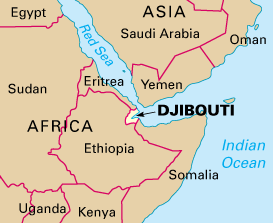
And a week later, Tracy .. I mean Stacy ...  turned to the next chapter in the Geography textbook  to plan her instruction of Chapter 19. East Africa. Country: Djibouti. Pronounced “Ja-booty”


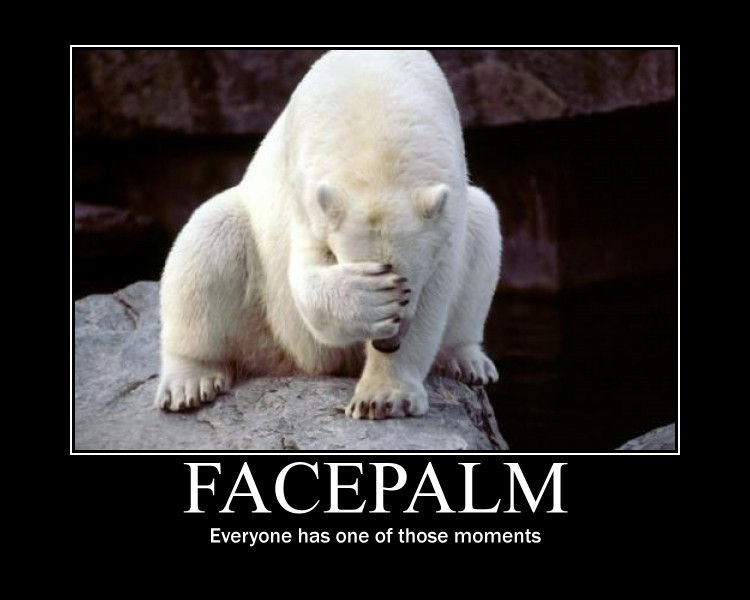
Facepalm.

I , I mean she, had to call another class meeting and ask the students to come up with another word. AND THEN, she had to explain why she had let them use that word for a week before she stopped them.

So there’s her -- um, MY --  embarrassing epic teaching fail. Epic ignorance fail.

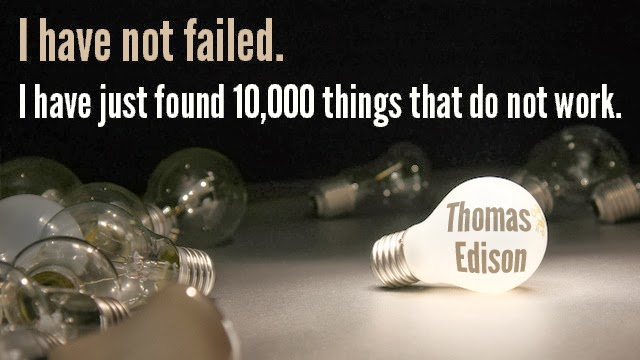
I have failed at many things in my life so far. I’m pretty sure I will fail at more.


The problem with us-the-teachers is that we don’t usually come from the bottom of the academic pack.  Teachers tend to come from A and B students, people for whom school comes easy.

Because most of us were “good students”, we have two problems.

First, it makes it difficult, sometimes, for us to empathize with struggling students. It’s hard to know what to do with the student who won’t (or probably can’t) read when we, personally, were early readers who still  LOVE to read! It’s hard to know how to explain map skills to a student when we don’t remember a time when we COULDN’T understand a map.


Secondly, one of the problems with smart kids (as many teachers were) is that they don’t deal well with failure. Smart kids like to do things well the first time -- or not at all. It’s why we have so many smart kids that refuse to try at certain academic tasks -- they’re so afraid to fail that they don’t what to try or they are afraid of the struggle.

Which brings me to our Marzano Scales. I’m talking to you, my Pinellas colleagues!

Please hear me out. I know that YOU-the-teacher were a smart kid and that you are now a smart adult. I know that you don’t like to struggle and that you get frustrated when you don’t understand things the first time or when you don’t do things perfectly the first time.

We have got to get over the “I don’t like to fail” hang ups and try this scale thing.

And know that you don’t have to be perfect at it the first time.

Or even the second time. Or third time.

But I hope you’re making progress. I hope your scales get better -- and easier for you as you get better at them.

I hear a lot of frustration these days from colleagues who are stressed and anxious about creating beautiful scales.

It’s the SECOND WEEK OF SCHOOL, my friends! You will get better at your scales. They will get easier to make and easier to use in your instruction.

I know it’s easier said than done. I get that.

But be patient. You will rock these -- soon!

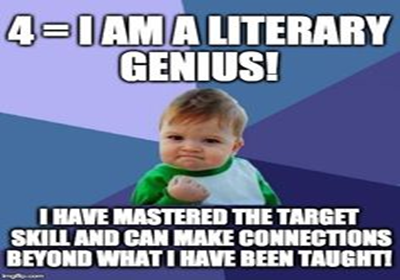
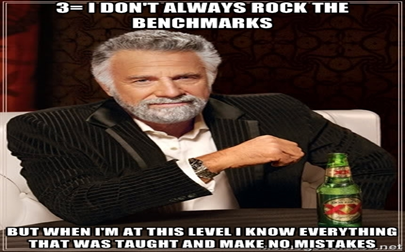
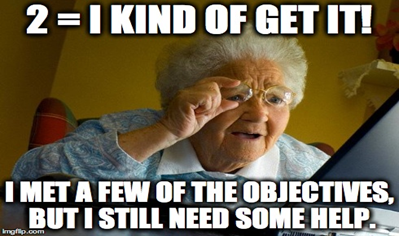
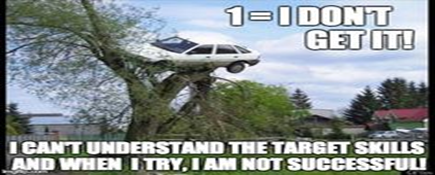
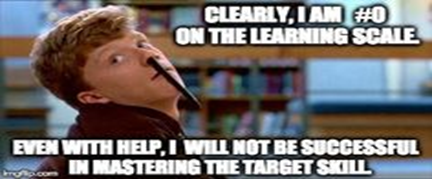
In the name of humor, please see our Meme scale below, shared with me by a brilliant colleague. And know that you do not have to be perfect the first time. You will get better.

Thoughts? Ideas? As always, email me at newmantr@pcsb.org