Showing posts with label #SSCHAT. Show all posts

Tuesday, October 23, 2018

The Source

Imagine that you got a letter in the mail (with students, I pretend that they found a note in the  hall or in their lockers). Imagine that this letter or note said horrible things about you. Imagine that it accused you of doing terrible things and it called you awful names.

Now, think about who wrote it. You would deal with that letter or note differently if it was from a friend you had a disagreement with ... differently if it was from your ex ... differently if it was from your current significant other (and you thought everything was ok) ... differently if it was from your sibling ... differently if it was from a coworker  ... differently if it was from ANOTHER coworker... differently if it was from a complete stranger!

Sourcing matters.

It matters when you look to see what news outlet a Facebook link comes from. It matters which parent sent which email. It matters what author said which quote. It matters which individual made which comment on your social media. It matters what think tank funded which study. It matters which PAC paid for which ad. It matters which organization sponsors what website.


It also matters whether the document is from the Egyptian pharaoh or the Egyptian slave or the Kushite trader or the Israelite slave in Egypt or the British historian or the Greek enemy.

Sourcing matters.

For every document, we always ask:
  • Who wrote this?
  • What is the author’s perspective?
  • Why was it written?
  • When was it written?
  • Where was it written?
  • Is it reliable? Why or why not?

The way we read and understand a document (or even a secondary source, really) depends on sourcing. Just as in the letter/note example, you would deal with that mean and nasty letter differently if it was your ex than you would if it was a coworker.

How would you react if it was your ex that wrote that letter (for some of us it might have been a long time ago and we might be surprised that they even remembered that we exist!)
How would you react if it was your sibling that wrote that letter? (it probably depends on how that relationship with your sibling is these days)

How would you react if it was your significant other wrote that letter? (assuming that things were generally good between you)

It depends on what you know about the author -- or about his time period or about her culture about his location or about her group/organization.

Sourcing matters.
It is the first step in our historical thinking skills AND it is a crucial piece in the civic literacy -- AND it is the a big part of the ELA/LAFS standards.

If I can challenge you this week to do one thing it’s this:

Have your kids dig into the sourcing information of EVERYTHING THEY READ.

They need to be in the habit of looking at the source for Social Studies, for ELA, and for Civic Life.

Teach them how to look at the source of current events, historical documents -- even textbooks!

Did  you read the article a few years ago about the Texas textbook that said that enslaved persons fought FOR the South in the Civil War?


Uhhhhh ....  No.

That textbook writer (OMG that was a textbook writer!!!) pulled info off a Sons of the Confederacy website that has no evidence to support its claim.

It can happen anywhere that people are not careful. If we don’t look at the sourcing information, we don’t understand the author’s point of view.
That doesn’t mean we’re sourcing documents to see if they’re RIGHT or not, TRUTHFUL or not. It means we’re sourcing them to see where the author is coming from.

If you have never seen the SHEG Lunchroom fight lesson on sourcing, it will make this sourcing stuff make MUCH more sense. https://sheg.stanford.edu/history-lessons/lunchroom-fight . You need a login, but it’s free and some of the highest quality Historical Thinking stuff out there!

Goal for the week: Be more intentional about sourcing everything with kids -- including secondary sources! If you make it a good habit, kids will get in that habit too!

Questions? Thoughts? Awesome ways you source documents? As always, email me. I want to hear all about it!! newmantr@pscb.org

Thursday, January 18, 2018

I Like to Move It, Move It

Happy New Year (still)!

When was the last time you sat in a long meeting, PLC, or training. Feel free to call me out on this one from some meeting or PD you were in with me (“Tracy! That's that one long meeting with YOU!”)

If I can ask a personal question, how do you FEEL after sitting for that long? Do your legs go numb? Does your foot bounce up and down? Do you change posture over and over again? Does your backside get too tired of those plastic molded chairs we find almost everywhere?


Uhhhhh, Trace? Pot? Kettle?

Yup. I’m not a superstar at incorporating movement in my instruction or my PD,  I admit it.

Sitting too long makes you tired. It makes your eyes glaze over. It makes you zone out. It makes your fitness tracker chirp at you. And if you sit there every day in 45-minute chunks (or longer!!) and rarely get to move ...

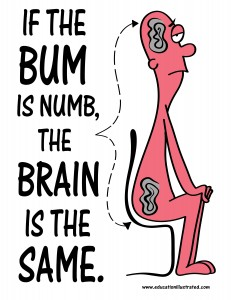
Your brain won’t work as well. You need oxygen to your brain, produced by body movement.

The average learner regardless of age (that means we- adults as well as our teens and tweens) needs to briefly move their bodies every 15-30 minutes If you’re in a 45 minute class, you need to have kids get up once in the middle. If you teach on block, you need to get them up multiple times a block.

Here are a couple of benefits of movement breaks:
  • Brain needs processing time for short term memory
  • As students return to content, their brains can refocus; movement re-energizes learning
  • If students are uncomfortable or stressed, the brain will not retain new information easily.
  • There is much less movement in today’s world of Ubereats, social media, and Shipt. Kids and grown ups need to move!
  • Our best ideas often come when we are taking a break.
  • Movement and collaboration heighten participation.
  • Movement can builds relationships, self-esteem and sense of belonging
  • Movement boosts listening skills and communication

  • Approximately 90% of the oxygen in our bodies are “stale” until we take a deep breath, yawn, or move.
  • Lack of oxygen results in confusion, lack of focus, and memory problems.

Yeah. It’s kind of a big deal.

“But Trace,” you say, “if I let my kids get up, they’ll go crazy!! (more likely in middle school) or “my kids will think it’s stupid and they won’t want to do it (more likely in high school)

If you’re worried your kids will get wacky, then set parameters, like you do with everyone else. Then don’t give them a “wiggle break” or a “stand and stretch” break. Instead, work it into your lesson.

Try things like
  • If you agree with x, stand up at your seat. Now sit down. If you think it’s y, stand up at your seat.
  • Please walk around the room to find someone who chose the same answer you did. See if you two (or three) can explain why you chose what you chose.
  • Please send one member of your group to me to check the answer.
  • Go post your response on a sticky note on the board/question when you’re done.
  • Do a gallery walk in small groups.
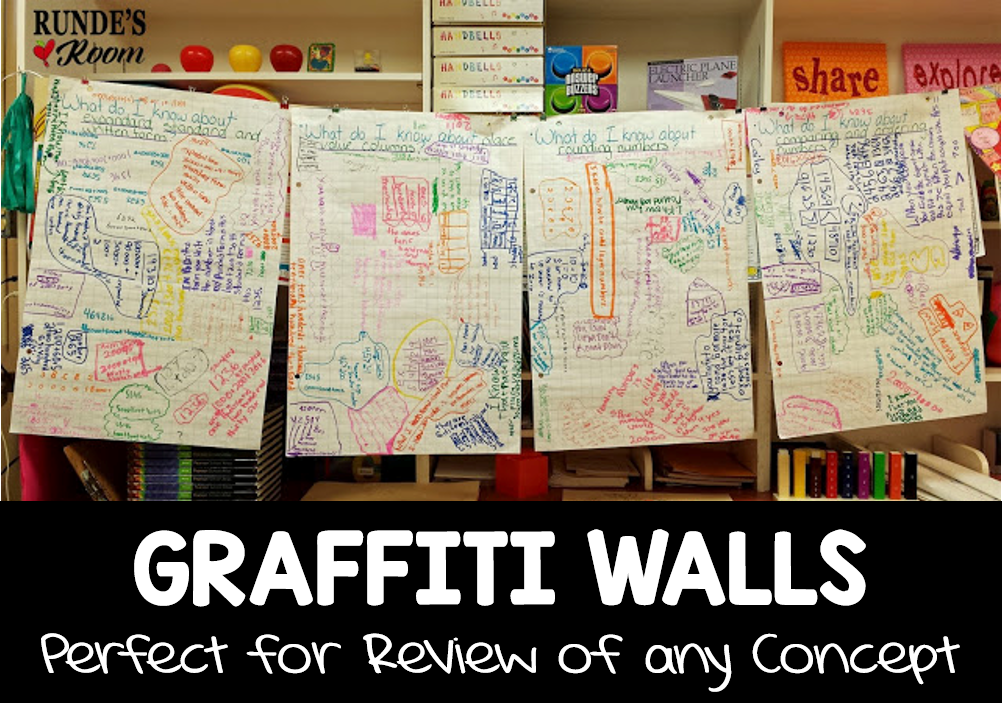
  • Graffiti challenge -- post prompts, misconceptions, or political cartoons on chart paper on the board. Have kids go respond to those question with graffiti. No chart paper? Have them write right on the whiteboard
  • Turn and talk -- but GET UP and find someone to talk to  ... (whose name starts with the same letter as yours, someone whose birthday is in the same month as yours, someone who as the same math teacher as you.. whatever)

One last note -- Movement is one of the 6 Ms of Culturally Responsible Instruction. When kids are up and moving, they are interacting with each other. When they speak and are heard by each other, they are being culturally responsive. And when they get up and move you-the-old-person-teacher (yes, even you, recent-college-grad. You’re old in their eyes), your Old Self is being responsive to their youth culture. And youth (children and teens) need to MOVE! It’s developmentally appropriate. So with movement, you are incorporating a small piece of CRI (Culturally Responsive Instruction)


And today, it might get the blood flowing through their frozen little limbs.

Try some movement. It doesn’t have to be a big thing. It doesn’t have to be elaborate. Put some rules/parameters on it and give it a purpose. You’ll be surprised at how much it improves student learning.

And then, get up and move it, move it. (You’re welcome for that Lin-Manuel Miranda "Moana" earworm!)

Let me know how it goes. Does your class implode? I hope not! Email me to tell me! newmantr@pcsb.org

Thursday, December 14, 2017

Graffiti Challenge

Ok, team! The countdown to Winter Break is down to single-digits! Wahoo!!! After today, there are seven school days left -- and several of those are exam days!  So let’s do one last review game -- one that requires VERY LITTLE PREP!!! (almost none)

Here is our last Review Strategy for December...


Higher Order Review: Graffiti Challenge
Prep:
  1. Use it before an assessment or project to review key concepts, words, or HOT questions.
  2. What you need:
    1. Key concepts (1 for each poster)
    2. Chart paper
    3. Markers
  3.  Write each of the chosen key concepts or HOT questions in the middle of the poster and spread the posters around the room.
Play:
4. Put students into groups, each one with a poster.
  1. Hint: Keep groups small (no more than 3-4 a group) and let the kids name their groups if they want.
  2. Give students the markers or let them choose (you can have them next to the posters).
  3. Describe to them the process and the intervals. They are to write as many words, phrases, sentences, or draw pictures that relate to the concept or HOT questions within the allotted time interval.
  4. Hint: Don’t make it a long time interval. 3-5 minutes max.
  5. You call SWITCH and they rotate to the next poster.
  6. Follow this procedure until students return to their original poster.
  7. Collect the posters and display them; or have the students choose where to display them.
  8. As a class, go through the posters. Correct any mistakes if necessary and add any important information where necessary. This can also be student-led.
  9. As you go through the posters, ask additional higher-order thinking questions!

Pro tips:
  • Explain the rules, expectations, and concept of the game prior to beginning it.
  • Have the students lead the discussion at the end.
  • Have the students tally up points at the end.
  • Keep a strict and consistent time interval. It creates a sense of urgency.
  • Give each team their own color to help you keep track of who said what on the chart paper.

Benefits of Graffiti Challenge Game:
  • Because the kids will love it! Especially having a choice between writing a word, phrase, sentence, and drawing.
  • It forces the students to pull from their own knowledge and collaborate with each other.
  • It gives the students an opportunity to move about the room while you still maintain control.

Watch Out For:
Students get a little “crazy” because they don’t know what to do. That can be solved by thoroughly and explicitly discussing your rules, expectations, and the reasons for the review game. It can also be solved by maintaining a consistent time interval during the rotations.

All you need is a little chart paper, some markers, and some open-ended questions! Can you use it? Will it help your kids review content? And ... can you make it these last few days before Winter Break? I’m a little antsy myself.

As always, email me and let me know how it goes!
-Tracy

Wednesday, November 29, 2017

Crumple and Shoot

My first year of teaching, I had a 6th grader named Lamar. Lamar was the wiggliest, squirmiest, most energetic little guy I had seen yet. He literally rolled around on the floor almost every day.

And I, a 24 year old “newbie” was supposed to keep him in his seat? And focused? And LEARNING? Uhhh... they didn’t teach that part in college.

Seriously?

I had no idea how to do that. When I told him toget in his seat, he would usually do so -- only to “fall out” two minutes later. When I turned my back, he had dance moves ready. Sometimes seated, sometimes not. He would accidently-I-mean-on-purpose mess up his paper so he could throw it out -- and make points for the basketball shot into the trash can.

Well, Lamar, here is the game I wish I had for you.

It’s called “Crumple and Shoot” and it’s a review game. But it’s BEST use is as a review game for higher order questions. Here’s how it works:

Prep the game. :
1.      Create/compile a stack of higher order questions that would help students with the upcoming assessment. Don’t forget the answer key!
2.   Chop some scrap paper in quarters. Old worksheets or messed up copies are perfect! You need a lot – one per team, per question.
3.   Make sure your trash can is clean-ish and useable. Or, use a box or another basket. Place it in a clear area. Place a piece of masking tape at a reasonable spot a few feet away, and then another behind that one.
4.   Create a scoreboard on the board at the front of the room.
Play the game:
5.      Arrange students in teams of three or four.
6. Go over rules with the students:
  • Stay in your seats at all times
  • No heckling
  • Both feet must be behind the line until the ball leaves your hand. Otherwise, your shot doesn’t count.
  • One piece of paper per shot.

7. Teacher reads the higher-order question aloud – or display it on the board on power point.
8. Group members discuss and agree on an answer then write it LEGIBLY on one piece of paper. Not too loudly – don’t want other groups to hear!
9. After the teacher says “Answers Up”, one group member holds up the paper.
10. If your answer is wrong, the teacher will take the paper.
11. If your answer is right, the teams will send up one person to crumple the paper and shoot it in the basket (or box or basket).
12.  If the shooter makes it, the team gets a point. The group with the highest points wins.
13.  Consider having winning team get an extra credit point or two on the assessment.
Pro Tips:
  • Create a “one point” line and a “two point” line a little further from the trash can.
  • Create a bulls-eye, like in darts, around the trash can.
  • Give points for good behavior, so kids don’t get squirrely.
Benefits of Crumple and Shoot Game:
·         Student engagement and teamwork
·         Way to make higher order questions more fun.
·         Engages students who prefer physical movement
Watch Out For:
  • Kids struggling to know answers. Consider making this open book/open note/open brain.
  • Kids getting rowdy.  Remind students that they are not to get out of their seats or to heckle. Award points for good behavior.
  • One team is winning and others are giving up.  Award a second place prize to keep the rest engaged.

What do you think? Do you have a version of Lamar in your class? Some kid who can’t stop moving? Do you think he would be successful at this game? Will you try it? As always, I love to hear! Email me!  newmantr@pcsb.org

-Tracy