Showing posts with label vocabulary in social studies. Show all posts

Wednesday, February 7, 2018

What Are You Asking?

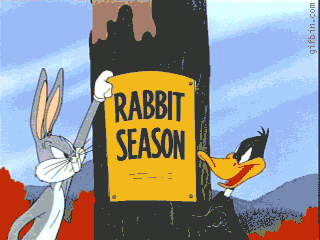
It’s not Duck Season! It’s not Wabbit Season!

It’s almost Testing Season! The time of year when schedules get crazy and your pacing goes out the window!

One of my least favorite things about testing season is the post-game talk of the students. After the test is over, despite the fact that they swear that they won’t talk about it, they of course DO talk about it.


So they come in my class after a three-hour testing block and the kids start talking about the test. And invariably, some kid will talk about something and some other kid will say “holy $#@!! Is that what that part was about? I totally thought it was asking about blahblahblah”

Aha. Here lies the problem. It happens on my classroom assessments, in district assessments, on the FSA, SAT, ACT, ASFAB, GED, GRE, and any other alphabet-soup of a test.

Kids don’t understand what the question is asking for.

For example, the question asks kids to analyze, but they describe. Or it asks them to contrast but the kids compare.
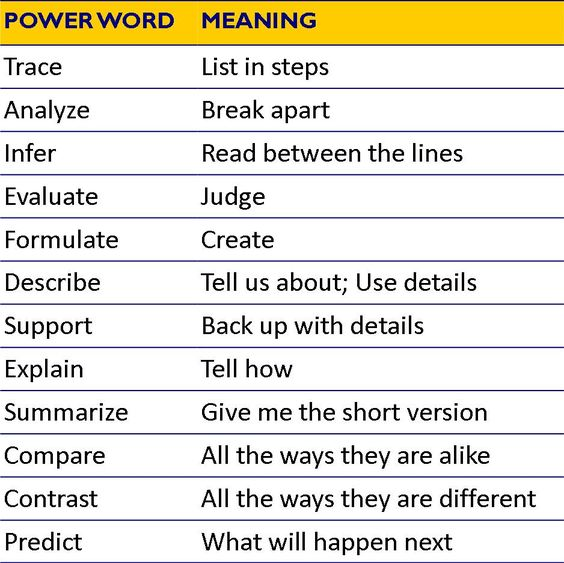
I’d like to propose that over the next couple of weeks, as we get closer to testing season, that we explicitly teach what those “power words” are and what they mean and what a kid should do if given that word in a test.

It depends on where you take your words from, but the internet (which, I know, I know, is NOT the authority of everything) often uses the “12 Power Words”.

Every teacher does NOT have to teach every one of these words.

But when they come up in your class over the next few weeks (and they should come up frequently), STOP! And explicitly teach the word.  (Honestly, if your class is not tackling at least SOME of those words, then your class is not hitting a lot of higher order thinking.)

It shouldn’t take a lot of time. A couple of minutes, at most. Which is worth it if your kids are mastering Tier Two Vocab.


What do I mean by teaching it explicitly?

  1. Well, when that word comes up in an assignment or assessment or whatever, I will stop the class and see how many students can define the term with their shoulder partner.
  2. Then (because kids will so often tell us that they understand things when they don’t) I will either solicit a few student definitions or give them my own.
  3. I will have the kids practice  their acquisition of the term by having them do a turn and talk where each partner uses the word in a real sentence about anything they want. We will share those out, too.
  4. I will have each team practice using the term by making a content-related question.
  5. We will talk about the type of answer the question (the one we began with) is asking for. Is the question asking for you to compare? What would a compare answer look like?
For example: Based on the document, infer the author’s point of view.  
  1. Turn to your partner and see if you can explain what “infer” means! Who wants to share  with the class?
  2. Student A had a great definition! Infer means to get something out of words that isn’t “right there”!
  3. Turn to your partner and use the word “infer” about something in your life. Mine is “I can infer from the fact that you’re not answering my texts that you don’t want to talk to me”.
  4. Now, use the term “infer” about something regarding the Treaty of Versailles. “I can infer from the fact that Germany has to pay a bijillion dollars, that it’s kind of a punishment”
  5. Now, what would an “infer” answer look like? It should include us getting something out of the document/text/cartoon/whatever that isn’t “right there”.

How do you teach the “power words”? What steps do you take? How can you really hammer this home in the next few weeks?


Thursday, January 25, 2018

It's Aliiiiive!!

How asleep are your kids this week? Maybe it’s the rainy weather or the fact that a chunk of kids  are out sick this week. Maybe it’s just the January blahs.

Well, let’s wake ‘em up. Let’s get ‘em moving. Let’s make those little monsters come aliiiiiive!!!!!

So remember that I wrote last week about movement in class? It’s kind of a big deal.

Sooooo ....  let’s get our kids up, for just a minute. You don’t have to ask them do dance or jump or anything crazy. Just .... move to another partner and talk...
Here’s a quick, easy strategy that can work with any content. It’s called Words Alive, from Teacher Created Materials. It’s actually adapted from strategies to use with ESOL but because it involves movement, it should be useful with all kids.

How do I do this?  
  1. a. Before class, choose a text to tackle together and a list of terms from that text you want to emphasize. Try to be judicious so that you choose ONLY the most important terms. Try to keep the number of terms down to 5-10.
  2. Read the text together. This can be a document or a textbook selection or an article.
  3. Write the 5-10 most super-duper important terms on the board for your most struggling group. You can skip this scaffold if a particular class doesn’t need it.
  4. Give each kid an index card. Explain that they are going to create their own card. If you don’t have index cards, just cut blank paper in half.
  5. Explain to kids (with written directions) that on one side of the card they will write a selected term. On the other side they will draw a visual representation of the term.
  6. Give the kids a few minutes to do that.
  7. When they have completed their “Words Alive” cards, divide the kids in pairs or small groups. Explain that they will be working as a group to guess the words based on the visual representation, like pictionary.
  8. Students should only show the back of the card (the term written) until the other student has guessed
  9. Have students change groups/partners so that they get to guess another word from another classmate.
  10. Keep the cards to use later on in the unit/year and to increase the number of exposures to the terms.  
How do I keep my kids on task?
  1. Make sure they know what the terms mean before they make the vocab cards.
  2. Partner them strategically.
  3. Use a timer to keep things moving.
Why should I try this one?
  • It can be a valuable frontloading strategy to pre-teach vocab before a lesson.
  • Or, it can be used during/after a lesson to review, clarify, and solidify understanding. It works because the KIDS make the meaning. THEY make the images and THEY do the guessing.
  • They’re not passively copying vocab. They’re doing the thinking.
  • It gives the kids a chance to use the terms in a non-threatening setting (not a test or whole-class embarrassment)
What could go wrong?
  1. Kids could not understand the terms and therefore have misconception-oriented visuals.
    1. Fix by checking their visuals before they group up
2. Kids could get off task during the partner/small group time
  1. Monitor closely and use a timer

What do you think? Will you try Words Alive? I think it can be an easy, controlled way to use movement for a learning purpose (not for just stretch-breaks). Let’s make words come alive -- and in the process, let’s make our kids wake up and look alive. Will you let me know how it goes? As always, I love to hear about it! Email me! newmantr@pcsb.org

-Tracy

Wednesday, October 11, 2017

Vocab Strategies That Don't Suck


I don’t know about you, but I’m not entirely certain that my hand and my brain are connected. I can totally copy something and not engage my brain at all.

It’s possible that something is wrong with my brain (no comments, y’all!) but it’s also possible that some (many?) kids don’t engage their brains when they copy things either.

Let me tell you the reasons why I STOPPED having kids copy definitions for vocabulary terms.

Seven Reasons to NOT Have Kids Copy Definitions.  (#5 will surprise you!)
  1. It takes forever. Who’s got extra class time to take on that?
  2. The kids don’t always understand the written definition, so they can’t fully “get” the term.
  3. Kids hate to write.  It makes them grumpy, which makes them less receptive to learning.
  4. Kids don’t have to mentally interact with the definitions. So they often don’t.
  5. Copying definitions don’t allow kids to construct their own meanings. And a meaning a kid constructs herself is a meaning that lasts.
  6. Even if a kid memorizes the written definition (and many don’t), they get a 2-dimensional definition, not a dynamic, elastic, adaptable definition that they can use in different situations and contexts.
  7. We live in 2017. We have copy machines (copy limits absolutely acknowledged)! But we can just GIVE the kids the definitions. They don’t NEED to copy them by hand like a European monk before the printing press.

“Okay, okay, Tracy, I get it.”you say to me in my imaginary conversation, “But I don’t know what ELSE to do! Copying vocab helps me get the vocab in the kids’ hands and get around my copy limits and keeps the kids quiet”

True, true, all of it.

But we can do better. Here goes....

Four Strategies for Making Vocabulary “Stick” in the Kids Brains (And Suck Less)


Students should already have journals and the definitions of the vocabulary words should already have been made available to them. This is simply using quick-write entries that incorporate vocabulary words. In most cases only one word would be used for each entry, unless the words are connected in some way. Students simply respond to a question using the vocabulary word. Here is an example:

For the word irritating: "List three things that you consider irritating. Why do these things irritate you?"

This should be done when first giving out vocabulary words. Vocabulary list should be limited to about 5 words or less as students tend to lose interest after that.

First, explain the "formal" definition of a word, then give several examples of the word in context. After that, provide a question (like the questions for the Vocab Quick Writes) and have the students discuss this in class together, using the word in their discussion. Have them share the highlights of their discussion with the class. This strategy might take more time, but the students thoroughly understand the words afterwards. And it takes less time than copying definitions.

It is incredibly simple to use in the classroom but it can have a huge impact on your kids.

Basically this strategy asks students to organize words or phrases into piles that make sense to them. The strategy is useful as both a pre-and-post reading strategy. During pre-reading, kids use their prior knowledge to organize words and establish a purpose for reading. As an after-reading strategy, students reflect on what they read and process the ideas presented in the text.

There are two types of sorts:
  1. Closed word sorts are when the teacher defines the process for  categorizing the words. This requires students to think critically as they look for specific concepts, word structures and definitions. Meaning, the teacher gives the students the categories (examples of categories could include: people, places, things OR 15th, 16th, 17th century OR England, France, Italy)
  2. In an open word sort, students determine for themselves how to categorize the words. Because of this, open sorts can prompt divergent and inductive reasoning. Meaning, they have to come up with their own categories. a)      Select 15-20 words that are important to the understanding of the lesson. At this time, the teacher should determine if it will be an open or closed sort.
Copy words onto index cards or print them on slips of paper. Provide enough words for each group of 3-5 students. Pass out words to groups. Based on if this is a pre-reading strategy or after-reading strategy, the teacher should decide how much support to provide.

If the activity is a closed sort, remind students they will need to use the categories provided to them. If it is an open sort, suggest to students that they categorize the words into groups that make sense to them. Remind them that they will need to be able to explain their rationale for the groups they created.

Give students approximately 10 minutes to create their sorts.

As students read the text or discuss it in more detail, allow them to reclassify their words.

Have students to reflect on their sorts and how it increased their understanding before and/or after the reading of the text. Did they make changes? Why or why not?

4. SEMANTIC FEATURE ANALYSIS http://www.adlit.org/strategies/22731/
With a Semantic Feature Analysis chart or grid, one can examine related concepts but make distinctions between them according to particular criteria across which the concepts can be compared.

A set of concepts is listed down the left side (or across the top; it doesn't much matter which) and criteria or features are listed across the top (or down the side). If the concept is associated with the feature or characteristic, the student records a Y or a + (plus-sign) in the grid where that column and row intersect; if the feature is not associated with the concept, an N or - (minus-sign) is placed in the corresponding square on the grid. For instance, consider types of government: democracy, dictatorship, monarchy, oligarchy, theocracy, and republic. What might be the characteristics of governments that might be associated with various types?

Which of these strategies do you already use? Which ones could you try this week? Can you give up the precious silence of copying vocab for engaged chatter? What if it helps them learn the terms better? As always, I love to hear from you! Email me at newmantr@pcsb.org
-Tracy
FDR
JFK
Nixon
Reagan
Clinton
Democrat
+
+
-
-
+
War Time President
+
-
+
-
-
Congress of Same Party
-/+
+
-
-/+
-/+
Re-Elected
+
-
+
+
+
Served in Congress
-
+
+
-
-
Won Majority of Popular Vote
+
-
-/+
+
-