Showing posts with label civic literacy. Show all posts

Tuesday, November 3, 2020

Our Most Important Job

 I know, I know. It’s TUESDAY. 

The first Tuesday after the first Monday, to be exact. 


And it is most certainly NOT Wednesday. And I am sending a Wednesday email on a Tuesday. What the heck?


Well, TODAY (in case you’ve been living under a rock) is Election Day. Which means tomorrow is a great/awful/hard/facinating day to teach Social Studies. 


On the one hand, it is your job, as a social studies teacher -- and nobody else in the world’s -- to teach the impartial, non-partisan part of the election. The PROCESS. The WHAT happened. (It’s the families’ jobs to teach what their family values and who they vote for. It’s YOUR job to teach the impartial part)

*And if you’re not a Social Studies teacher and you can allow your students to address the election in a fair and unbiased way, rock on. 


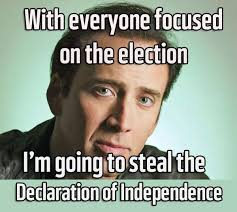
On the other hand -- uuggggghhhhhhhh!!!! Ew, David! I get it. No matter what happens, tomorrow is going to be ugly. There are going to be unhappy voters and unhappy students. We may or may not know the outcome. There is even talk of violence. Nicolas Cage is even going to steal the Declaration of Independence again! (JK). 


But imma be straight with you. 

It is entirely possible -- even probable -- that NOBODY ELSE that is going to teach what happened/is happening in a fair and unbiased way in most kids lives --  OTHER THAN YOU. Democracy depends on you -- not just because of your vote but because of your processing and debriefing in a fair and unbiased way with your students


And there is nothing more important than that. I don’t care what your pacing guide says. I don’t care if you teach Ancient World History or the American Revolution or Economics or AP HuG or whatever. I don’t care if you’re way behind. So is everybody else. 
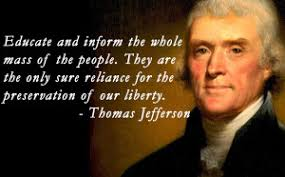

The. Whole. Reason. Free and public. Education. Exists. Is For. Informed. Citizens. 

(It’s not for tests. It’s not for grades. It’s so they can be good citizens) ‘Kay. ‘Nuff preaching. 


And if social media is going to misinform them, you can take one day and talk about it the right way


What IS the right way?? (These suggestions are adapted from Facinghistory.org )


  1. Start with yourself. You are a human. One that lives in the US and who has lived through the really tough year of 2020 and who has political opinions of your own. I hope you do! I hope you voted! Then be intentional in your own reflections:

    1. What emotions does this election raise for you?

    2. What perspectives will you bring to your reflection on the election with your students?

    3. What can you do to ensure that students with a range of perspectives are supported in your class reflection?

    4. As news continues to develop throughout the day, how will you continue to learn alongside your students?


  1. Consider your students needs: Kids have feelings. Lots of them. And they don’t always control their feelings as well as you do. If results aren’t known, kids may feel anxious or uncertain. If results are determined, kids who supported the losing candidate may feel disappointed or maybe even unsafe! Use these questions to reflect on the students needs and emotions:

    1. What emotions might your students bring to a discussion of the election? For example, which students might be feeling excited, disappointed, or vulnerable?

    2. How can you foster a learning environment that respects a range of emotional reactions?

    3. Are there any students who might benefit from one-on-one follow up from you or another staff member at your school?
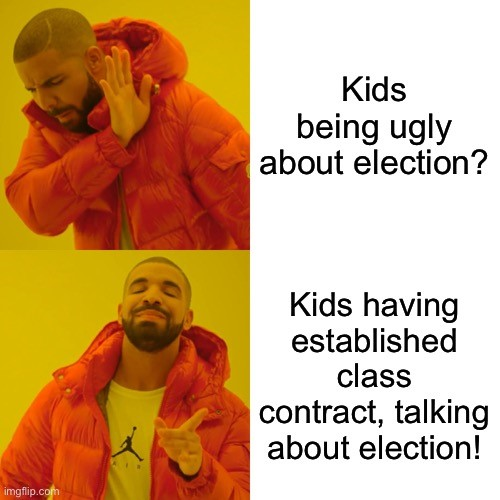
 

  1. Class Contract: Remind kids that your classroom is a safe and brave space. Make a class contract or refresh your class contract (especially with all the schedule changes!) and emphasize the respect and listening parts. If you already have a class contract, invite kids to add or modify the contract especially for THIS conversation. Use these questions to prompt their thinking: 

    1. What would a meaningful conversation about the election look like, sound like, and feel like?

    2. Which norms in our class contract are most important for guiding a meaningful conversation about the election and why?

    3. Are there any new norms we need to add

      1. For Online-kids, check out Contracting for remote learning (you might need a free account to Facinghistory.org, but it’s totally worth it) 

      2.  

  2. Update your kids: You, as a plugged-in, social-studies-teacher-adult may know what happened, but your kids may not. Especially if the results have been trickling in. They may not know the updates you know. TELL THEM in kind ways based on RELIABLE INFORMATION SOURCES (not social media updates). If violence or unrest is happening, you should also share reliable info about that in order to dispel rumors and misinformation. 

 

Helpful sources of information on the election include:

To share the results of local elections and ballot initiatives go to Tampa Bay Times and Bay News 9


  1. Journaling: Doesn’t matter if it’s digital or pencil/paper, individual reflection time is the absolute best place to start. Give kids a few minutes to write in their notebooks or a Canvas assignment (NOT a discussion board today!). You might have them divide their paper into three sections and answer these three questions:

    1. Section 1: What information do we currently know about the results of the election?

    2. Section 2: How do you feel about the election and what is happening in the aftermath?

    3. Section 3: How should individuals or politicians act in order to protect our democratic institutions? You may or may not choose to have your students share any of their reflections. If you choose to have them share, the Wraparound strategy can help make sure that all voices are heard.

      1. If kids are simultaneous, make sure that all voices are heard. This is a touchy day. We want to be especially careful to make sure that all kids are given a voice!

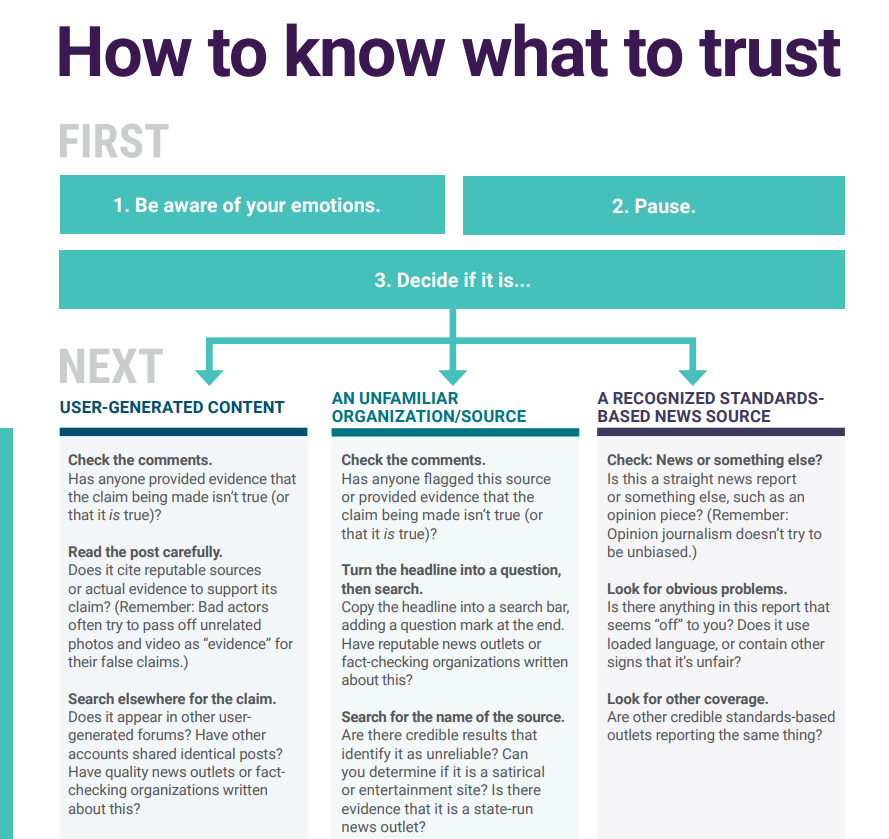
  1. Discuss how to find accurate information: Misinformation is everywhere on social media, and many kids don’t go anywhere BUT social media! Today is a great day to teach reliability! Ask kids:

    1. How could seeing or reading misinformation about the election make people less likely to trust the results of the election?

    2. What impact could it have if people lose trust in our government or elections?

    3. Share the How to Know What to Trust resource and have students discuss if they follow any of those processes and if they can work on them

      1. Invite students to write down their goals for how they will follow the news. Prompt them to respond to the following questions:

        1. What can you do to ensure that the news and information you use to form your opinions is accurate?

        2. How will you decide what news to share with your friends or family or post on social media?

        3. What effect could misinformation have on our democracy?

  1. Analyze the Election Results: Have kids write their answers first and then share what they’re comfortable with second. 

    1. Why might the results of the 2020 presidential election matter to me?

    2. Why might they matter to people around me (my family, friends, or community)?

    3. Why might they matter to the country?

    4. How might recent events in the United States have influenced the turnout and the outcome of the elections?

    5. How are the election results making you and people you know feel in terms of their own agency, vulnerability, and inclusion in American society?

      1. Lead a discussion around the answers, reminding kids of their agreements in the class contract. 
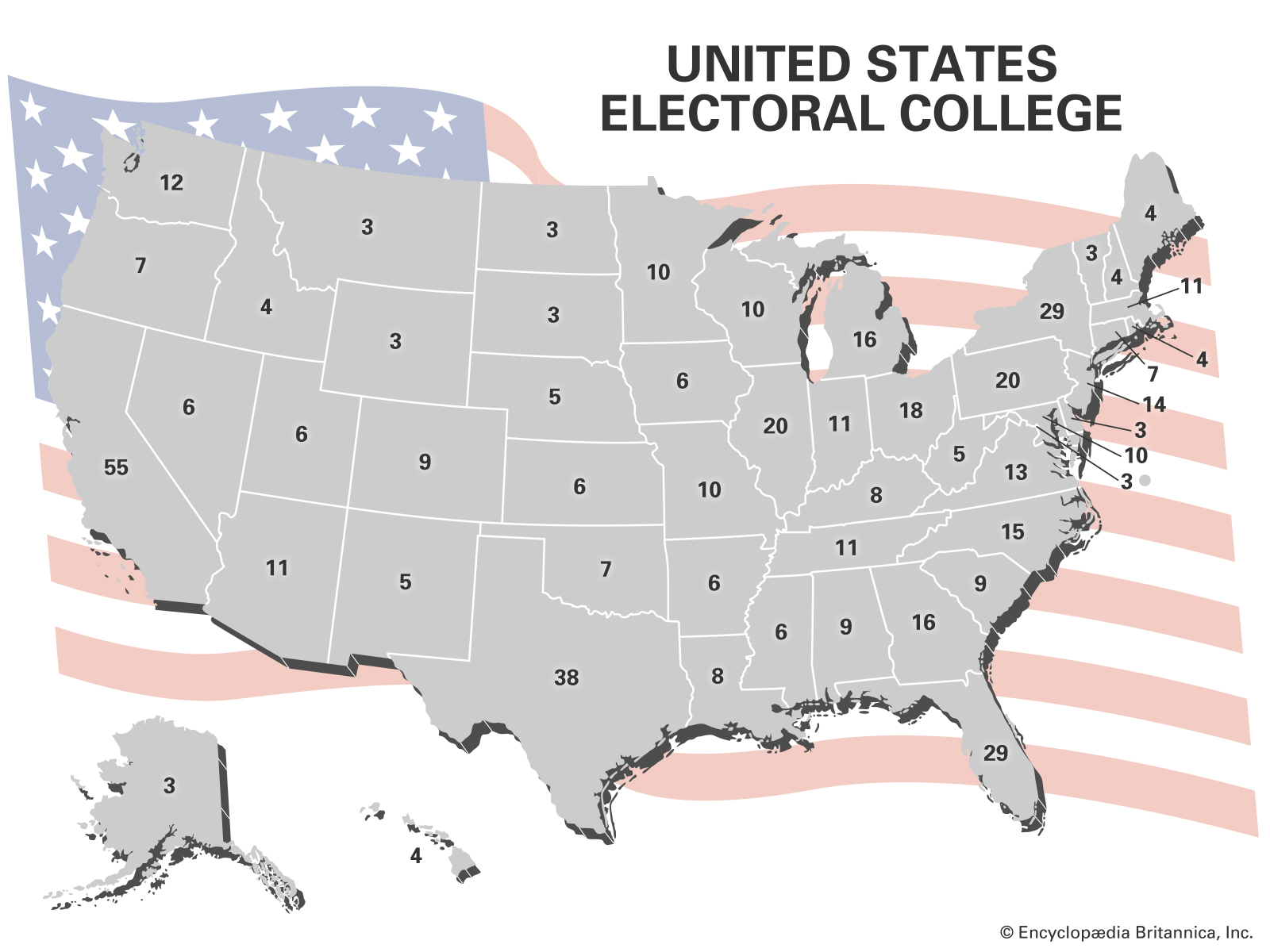

  1. Look to the Future: Finally, ask students to think about how the results affect their thinking about the future. 

    1. Because of the election results, do you think things will get better, worse, or stay the same?

    2. How can we support people who are feeling vulnerable because of the election results?

    3. What’s next for me/us? What can we do to strengthen our schools, communities, and country, regardless of the election results?

I know it’s a lot. I know you’re here, feeling your own feelings. But I promise you, this is the most important thing you will do all year. Stop teaching the Declaration of Independence. Stop teaching the legislative branch or Egypt & Kush. Stop teaching the Renaissance or US Imperialism or indicators of economic performance. 


Take a day to talk about what all the kids want to talk about anyway. There’s built-in engagement and social-emotional learning. It’s your civic duty as a social studies teacher. The tests don’t really matter (especially in a pandemic year). THIS is what matters. Not just the election, but how the kids PROCESS the election. 
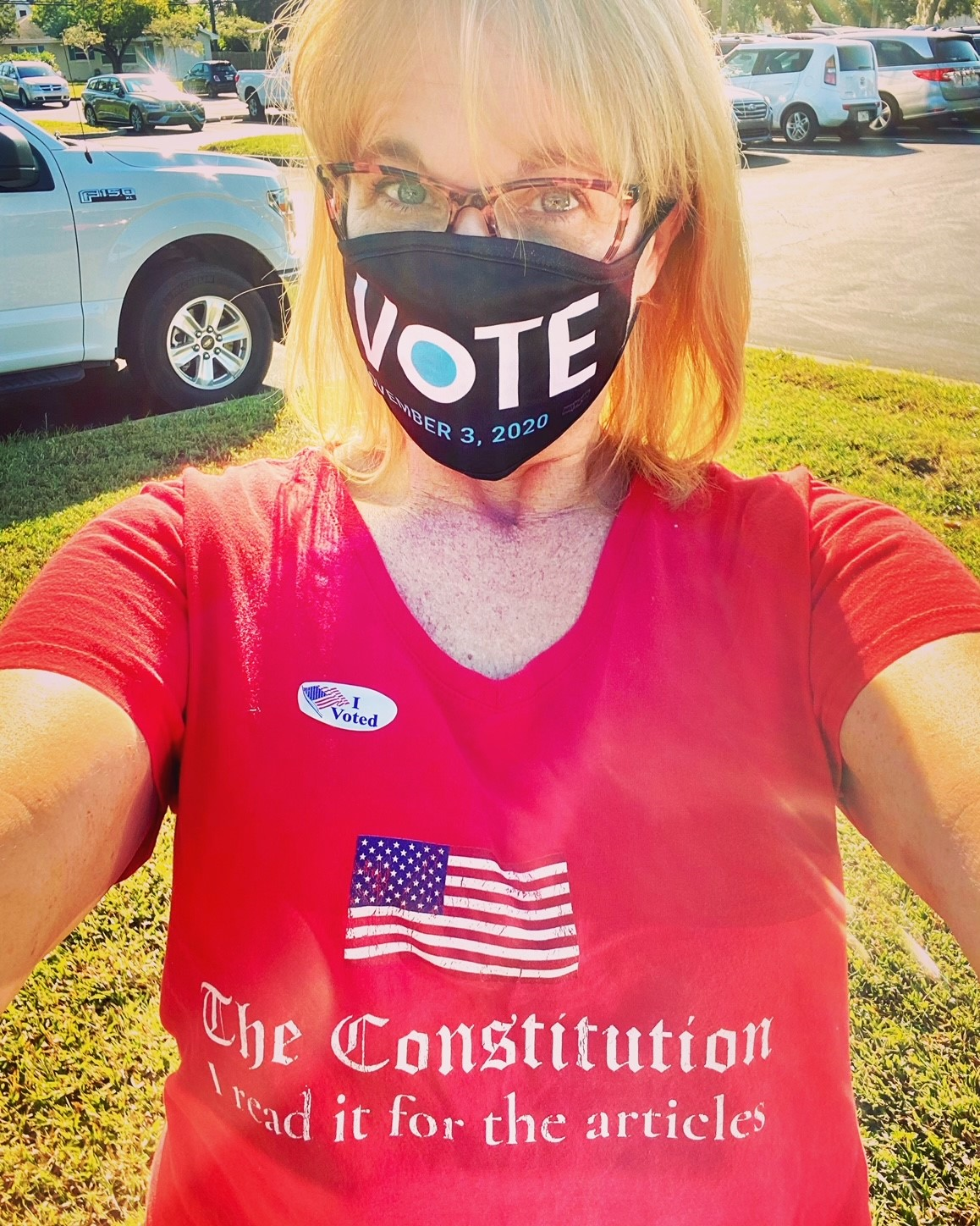

Go with it -- but do it carefully, respectfully, and thoughtfully. 


And take care of yourself tonight! It’s hard to handle all those adolescent emotions if you haven't slept. Remember to practice self-care. This ain't a football game. Your candidate’s winning or losing isn’t dependent on your staying up late watching. Go to bed if the election isn’t clearly called by a REPUTABLE NEWS ORG by your usual bedtime. You are not going to affect the outcome by staying up late. 


But you ARE going to affect the way your classes go tomorrow.  


Take care of yourself and do the most important teaching day of your year! 


Email me if you want to talk through the lesson! I’m here! newmantr@pcsb.org 


Tuesday, February 26, 2019

Beginning Middle End

Last week, those of you who were able to attend the DWT at the Museum of Fine Arts or the James Museum got to dig into some wonderful, diverse works of art. In doing so, we got to try out some cool pedagogy called “Artful Thinking”Strategies. These come from Harvard’s Project Zero, which is a cool study on making thinking visible.

Anyhoo, ... I thought it might be nice to a) revisit some of those for those of you who got back in the teaching groove and forgot them and b) introduce them to those of you who were out that day or were at different DWT sites.

So, many of us like a good story, right? For many of us that’s how we were introduced to History -- as a story to be told.

So ...  check out this strategy to use a work of art.

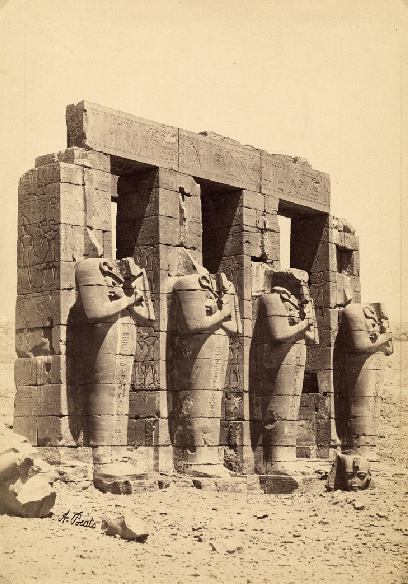
First, picture one artwork you use (or plan to use) in your classroom. It actually works better as NOT a photo.

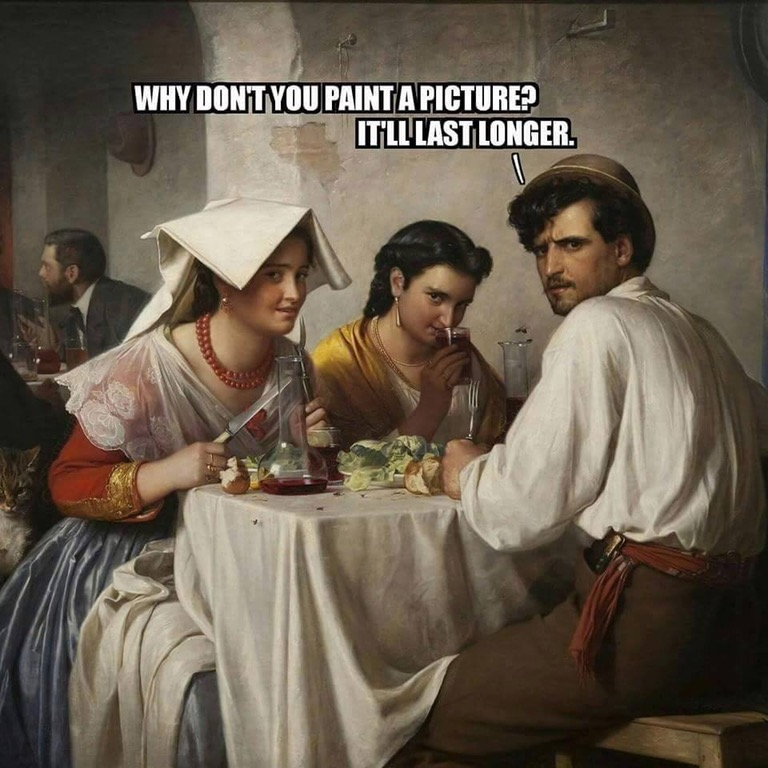
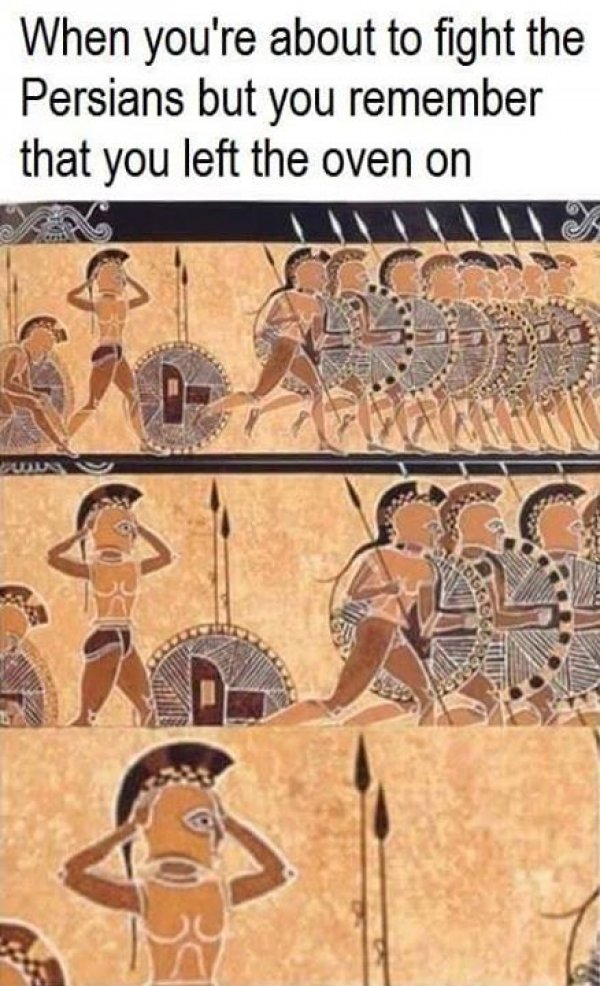
Got it in your mind? Is it THIS? Or THIS? Or THIS?  Or THIS? Or THIS?

This strategy is called “Beginning -- Middle -- End”

Ok, now, have your kids imagine what the context would be if that artwork were the BEGINNING of a “story”?
Now, how would the context be different if that artwork were the MIDDLE of of a “story” ?
Now, how would that context be different if that artwork were the END of a “story”?

I initially was curious how middle and high school teachers would respond to this. And then I had a high school teacher of AP classes tell me how great it was going to be in those AP classes and I realized that I had been thinking too narrowly...

This is a great strategy to help kids think more richly, more wholey, more broadly about how an artwork intersects with the world... and what the context might look like.  

I love seeing how students can wonder about context around a work of art. And see what they can learn about the actual context.

This strategy helps kids use the idea of a narrative to dig deeper into a work of art. It teaches them to elaborate or extend an idea. It helps kids look for connections, patterns, and meanings.

This strategy is quick and easy. You can use it with any artwork that stands still in time (not a video or something that shows something over time or something. You can have something prepared on the screen/board/handout or you can just wing it and ask the questions as a Turn and Talk, journal moment, bellwork, or discussion.

Try it with whatever artwork moves you. Try it out loud or on paper.

Just try it.

And let me know how it goes!

As always, I love to hear from you! Email me at newmantr@pcsb.org
-Tracy

Monday, November 26, 2018

A Tale of Two News Shows


I know YOU know that people are often judged based on their choice of news outlets. “I don’t believe the liberal media” or “he heard that on Fox News”.

Did you know that this isn't new? Before the US Civil War, there were separate mailed newspapers that went to people with different political views. This whole Fox News vs. MSNBC thing isn’t new. There were entire newspapers devoted to journalistic obliteration of Andrew Jackson and entire newspapers devoted to supporting him. Often the separate newspapers were actually funded entirely and openly by political parties!

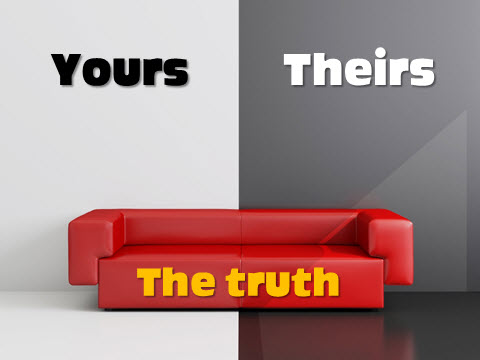
There are always multiple views on any issue, particularly on political and social “hot topics”.. There are always different ways to look at an issue or an event.

Just ask four different kids about the most recent campus fight and you will get four different stories. Add in the AP or nearby teacher or hall monitor and you have another set of stories.


Then, wait a week and ask about that fight again. Chances are, with time and perspective, that you will have some slight variations on that fight.

Then, ask someone’s mom. Or a student from another school. And you will get yet another side to the story.

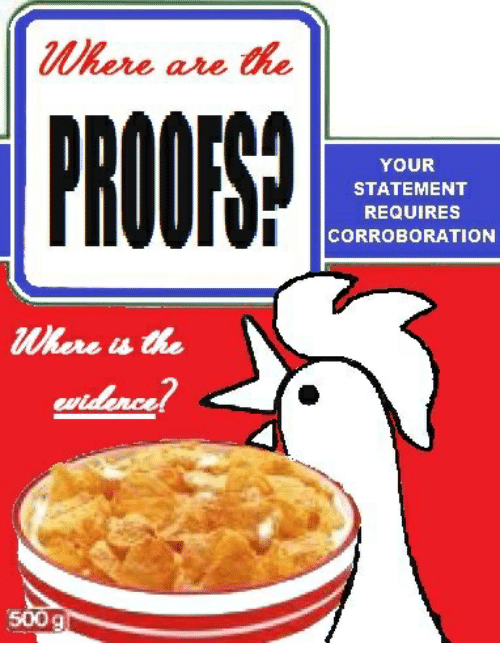
Finding the middle ground between multiple sides of the story is what CORROBORATION is all about.

Corroboration is about establishing what is most probable by comparing the documents together. It recognizes disparities between accounts.

How can I teach my kids to look at corroboration between documents and accounts?

Here are some good prompts/questions to use to help kids dig into the corroboration...
  • What do other documents say?
  • Do the documents agree? If not, why?
  • What are other possible documents?
  • What documents are most reliable?
  • The author agrees/disagrees with . . .
  • These documents all agree/ disagree about . . .  
  • Another document to consider might be . . .

This is, again, a Civic Literacy skill. It’s a reading skill. It’s what Common Core asks for. It’s what the LAFS ask for. It’s what the FSA asks kids to demonstrate. It’s what we want our voters to do. IT’s what we want ALL citizens to do -- not just the “advanced” kids or the “magnet kids” or the college-bound.

We want ALL kids to understand and master the skill of corroboration!

How can we continue to give kids intentional practice corroborating? As always, I love to hear from you! Email me at newmantr@pcsb.org

-Tracy

Wednesday, October 31, 2018

Context

My kid went nuts when we couldn’t find his blue shorts. It had to be THOSE blue shorts. Both of my kids stayed up waaaaay too late. They looked ridiculous. So did I. I let them roam all over someone else’s neighborhood and talk to strangers who looked weird. They ate more sugar than their small bodies could handle and wound up literally running in circles to work some of the sugar out of their systems. Some neighbor had a scary movie playing on a projector on the outside wall and both my kids had nightmares. We went home at the obscene hour of nine o’clock, it was too late for baths,  and the whole family was in tears by ten.

It was so much fun!!!!

“It” was, of course, Halloween.

Context. It makes all the difference.

The difference between “#parentingfails” and “pretty average” is in the context. The question of  Halloween or Regular Wednesday Night has a pretty big impact on your understanding.

Context is an area where a lot of our kids struggle. We as teachers struggle with teaching context sometimes, too. It’s hard to tell the difference between context and content.  What “stuff” about history or government or economics is the important “stuff” and which is just contextual “stuff”.

If you’ve ever showed your students a throwback Thursday picture, only to have them giggle and wonder at your hair or clothes, you know how important context is.

Context is JUST as important in social studies, too.

  • The Constitution did not originally give every adult citizen the right to vote, of course.  Originally, the states determined who could vote, often choosing only land-owning, white men over age 21, often about 6% of the population.

The context behind that is a powerful piece of that understanding. The context of gender, race, power, money, and language in the original electorate was essential to understanding that limited enfranchisement
  • The beginnings of Buddhism as a reaction to Hinduism is a huge reason that Buddhism caught on in the first place. That context of a stratified Hindu society is what makes Buddhism stand out. It’s different. It’s a reaction to its historical context.
  • The Scientific Revolution is only a “revolution” in the context of the previously religious understanding of the universe.


Without context, it’s impossible to understand an “impact” or an “effect” -- because there has to be some context, some THING to be impacted or effected.

So, every single time we bust out a document in class, kids should use some context. There are plenty of ways to do this (APPARTS, Doc Analysis Sheets, etc.) but here are the questions that SHEG (Stanford History Education Group) asks us to use ...
  • When and where was the document created?
  • What was different then?
  • What was the same?
  • How might the circumstances in which the document was created affect its content?

If you’re looking for some quick prompts to practice contextualizing documents, SHEG gives us a few to start with:
  • Based on the background information, I understand this document differently because ...
  • The author might have been influenced by ___ (historical context).
  • This document might not give me the whole picture because...

If you read last week’s WW email, you know we talked about Sourcing. Contextualization is interwoven with sourcing as we look at the people and circumstances around the CREATION of the document to inform our understanding.

Again, this is not just a HISTORICAL Literacy Skill. It’s a Civic Literacy Skill. It’s a Citizenship Skill. It’s a Media Literacy Skill. It’s a Social Media Skill. It’s a Personal Relationship Skills.

It’s a life skill.

Looking at the context of a document is crucial to understanding it. We need to help our students use context when they read the news or a listen to a candidate or watch something online.

Let’s get them in the habit of asking those context questions every time they come across a document. I think it can be powerful in understanding history and current events.

How do you ask your kids to contextualize? Do you do it frequently? How can you tuck in these questions every time you bust out a document?

AS always, I love to hear from you. And Happy Halloween. Don’t let the Candy-Hangovers get you down tomorrow!

-Tracy