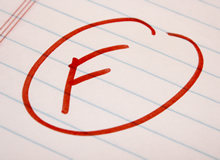
 I remember very clearly giving a test I thought was pretty “easy” to my students, after teaching the heck out of European Exploration of the Americas.
I remember sitting on my really ugly-at-the-time couch and grading paper after paper with growing dismay.
54%; 60%; 52%; 46%, 58%
Woo-hoo! A 68%!
The grades stayed steady, somewhere between 45% and 60%.
I was crushed. The grades were horrible! The kids were going to revolt! Their parents were going to revolt! My administrator was not going to back me up with an entire class failing.
But I taught it!
Was my test awful? Well, it wasn’t anything that would stand up to current 2015 assessment-writing standards, but for the time it was ok. My answer key was right. My questions weren’t too bad, not too vague, no tricks. They measured what I wanted to measure, although mostly low level.
I even had a long-answer portion to assess higher-order thinking! The kids BOMBED those, too!!!
 Well, it couldn’t be my test. It couldn’t possibly be my teaching.
It must be the kids. They’re obviously dumb, right?
But even in my frustration, I had to double-think that.
Really? ALL my kids were dumb? Even that one who usually made an A on everything? Even the super-study-queen? Even the one who asked a million questions to tell me that he knew more than I did?
Not ONE of those kids got higher than a D?
I had to take a hit to my pride and admit it. I hadn’t taught it as well as I thought.
As a matter of fact, I had to admit that not ONLY had I missed the boat somewhere in my teaching, but I had gone three weeks without knowing that my kids were lost.
Three. Flippin’. Weeks.
What happened?
Well, I neglected to monitor.
I didn’t know how to check if my kids were “getting it”. I only knew how to check if they were doing their work and getting the right answer.
Boy, there’s a huge difference between getting the right answer on some classwork or homework (which often happens through cheating, copying, Googling, hunt-and-find-in-the-reading, or just plain guessing) -- and actually LEARNING the material.
 I should know. I am now embarrassed to admit that I copied homework off friends in high school and then made poor grades on assessments. And my grades were fine due to category-weighting (i.e. homework counting more than tests).
So, I didn’t monitor my kids and I taught for three weeks without knowing that they were lost.
What could I have done instead? The answer is formative assessment.
Formative assessment takes a million different forms. Basically, it means that I know how my students are learning DURING the lesson, instead of waiting until after I’m done teaching it.
Formative assessment is meant to monitor student learning and provide ongoing feedback for teachers to improve their teaching and for students to improve their learning.
How do I do it?
Read what they write WHEN they write it: It’s so easy to monitor for behavior and completion and to miss opportunities to monitor for learning. Read what the kids are writing and give immediate, helpful feedback. “Owen, you didn’t quite get this point that Jefferson made here. Let’s look at it again...”
- Exit Slips: Have the students answer your essential question, define your overarching concept, or explain today’s concept in their own words. One caveat -- you have to read their exit slips immediately (or at least that day). You can’t put them in a stack to read next week or you lose the power of doing them. THEN -- use what you learn and adjust your teaching.
Plickers: Create (or better yet, use one already created) a multiple choice question or two about what you’re teaching that day. Then, give each kid a Plicker (a paper-clicker). Simply scan the class with your smartphone or tablet and boom! You have formative assessment, easily used and easily graphed.
- Scale Reflections: At the end of every class, have your students reflect, in writing, about where they are on the scale -- AND WHY. Ask them to give evidence as to why they’re level 1s or level 2s or level 3s. Again, read what they write that day so you can use that info to inform your teaching tomorrow.
There are a million ways to use formative assessment in your class, but I don’t want it to be a burden. I don’t want it to be one-more-thing-you-are-supposed-to-do. I want it to be something you-the-teacher-want-to-do because it’s valuable to your teaching and to your students’ learning.
Here’s how to make it really, really worthwhile.
- Read it that day. Read it that period, if possible. Don’t wait, or your formative assessment goes “stale” pretty quickly. Like, by tomorrow.
- Find some way to record it that isn’t a burden on your time. That’s why I love Plickers -- I-the-teacher don’t have to record anything. It’s recorded for me. But be able to reference it later or else it’s not very useful
Use it to help you plan and adjust your teaching. Did your kids ALL bomb because you could have taught it better? Did only some of your kids bomb? Did the kids who were off-task all period bomb? (Maybe you can use this immediate data to show them how their off-task behavior directly impacts their learning) Did the kids who were out last Tuesday bomb it? Did your Level One readers bomb it? Did your ELL students bomb it? Who do you need to help the most?
- Use it to reteach and to group students. So 17 kids really “got it” and 5 kids didn’t? Let’s do something in groups and put those 5 kids in a group with you-the-teacher so you can remediate. Put the other 17 in groups for enrichment. That way, you get to target the kids who need that particular piece the most!
Don’t wait until it’s too late. Don’t wait, like I did, until a unit test three weeks later. Check up on your kids NOW! And adjust your teaching based on your check-ups.
What do you think? How do you do formative assessment? More importantly, what do you do with your formative assessment knowledge? Have you ever assumed all your kids were dumb only to crush your own pride and find out that you could have taught something better?
As always, I love to hear from you! Email me at newmantr@pcsb.org


