Showing posts with label Political Cartoons. Show all posts

Tuesday, September 26, 2017

Keep Looking


We live in a fast world. We have the answer to most factual questions in our pocket, in the form of smart phones. We text each other and expect quick replies. We love Twitter, with its fast, 140 character limit and we adore Snapchat, where our pictures disappear just as quickly.

With the missed hurricane days, we are all trying to move at warp speed, too.

But sometimes, a slowdown can be a speed-up at the same time.

Like this strategy, called, “Looking 10x2” from Harvard Project Zero: Artful Thinking.

If you do it well, you actually get farther by slowing down.

You will use this strategy with an image -- a painting, a photograph, a political cartoon, a picture of an artifact. If you’re not sure where to start, try your textbook or curriculum materials.

Here’s how the strategy works. It’s pretty simple.

  1. Instruct the students to look at the image quietly for at least 30 seconds. Have them let their eyes wander.
  2. Ask them to list 10 words or phrases about any aspect of the image.
  3. Repeat steps 1 & 2. Have the students look at the same image again and try to list ten more words or phrases to your list.

This thinking routine encourages students to slow down and make careful, detailed observations by encouraging them to push beyond first impressions and obvious features.

How often do we (AND our students) look at a visual for 3 seconds or less before moving on? Before looking at our phones? Before assuming that we’ve “got it” and speeding along?


But there are a billion powerful images to use to teach content in our classes. Try it yourself with images like this ...
.

Or this...

Or this ...

Think about the time involved. If you put up the image in front of your students and then explain it TO them, it will take you several minutes.

I’m long winded. I could easily spend 5 whole minutes on one of these images.

But if you put it up, ask them to look for 30 seconds, jot down ten things they notice, look again, and jot down ten MORE things -- then you have four clear benefits.
  1. The kids are doing the thinking (and you have proof!)
  2. It takes 2-3 minutes (as opposed to my five minutes of talking and another minute or two to answer the question from that one kid who always has a question.
  3. The kids “own” their learning and it will therefore “stick” better in their brains.
  4. The kids are examining the image more carefully and more deeply and therefore will have deeper understanding of the image and the topic.

You can also use it with non-art images or objects as well, although I would start with art to teach the strategy.

I think you can slow down with “Looking 10x2” and cover images more thoroughly, which means you actually speed up.

Practice it yourself, so you can experience the struggle of finding a SECOND set of observations before you ask your kids to try it.


Have you used this before? Are you going to try it? As always, I love to hear about it! Email me at newmantr@pcsb.org

Wednesday, August 27, 2014

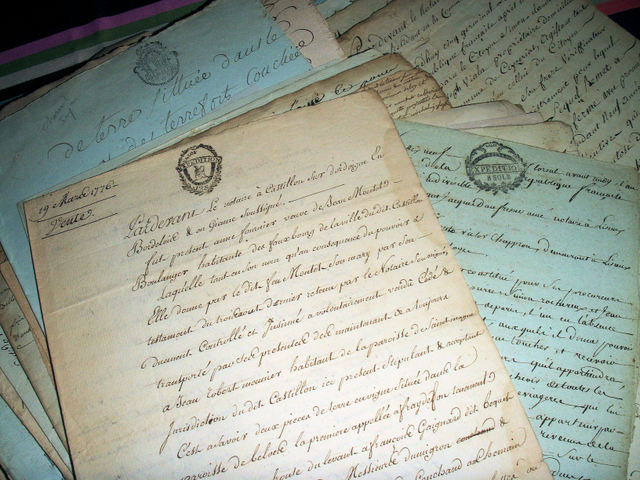
The Final Countdown: Ranking the Docs

You may know that I love a good countdown. Or the Final Countdown song. (Is it playing in your head now? You’re welcome...) Who wore the best dresses at the Emmys? Count me in! What were the best hip-hop songs of the 90s? Heck, yeah! What are the top novels of the 2014? I’ll read a good handful! What are fifteen fun facts about Amelia Earhart? I’ll click on that!

Our world (particularly our digital media) is full of lists and rankings. Kids spend a lot of time online and are constantly seeing the best songs of the week, the top celebrity news stories of the day, or the coolest apps this month. They know how to debate and argue and rank items in their personal lives. It’s time to use that skill-set for Social Studies

You may have noticed from our discussions about assessment at DWT  that there are a lot of documents on the EOCs, both state EOCs (7th & HS US) and many of the district assessments (everything else).

A. Lot. Of documents.

Our EOCs (and many of our district-assessments) are supposed to be 65%-75% stimulus-based. That means 2/3 - 3/4 of EOCs and district assessments will have a document, an image, a cartoon, a map, a graph, a chart, an artwork, or something on which a question will be based.

Which means that this is NOT a trivia test. Kids need more than just facts and content to be successful.

It’s a skill test. Often, it’s a reading test.

One great strategy for helping kids practice analyzing and thinking critically about documents is Primary Source Stations.

Hear me out if you already do something like this -- I hope I’m putting a new spin on the way you do it.:)

I borrowed the format of the lesson from the super-great Glenn Wiebe from History Tech http://historytech.wordpress.com/ and his C4 Strategy Cards

Primary Source Stations

  1. Choose a good Essential Question for the lesson.
    1. Such as -- “What was the impact of the Triangular Trade in Europe, Africa, and the Americas?” or “What internal and external factors led to the fall of the empires of Ghana, Mali, and Songhai?” or “What effects did Social Darwinism and the Gospel of Wealth have on society?”
  2. Collect several documents that support your Essential Question -- images, letters, court documents, infographics, obituaries, paintings, editorials, ads,whatever.
  3. Place those documents around the room. If you’re feeling fancy, you can post them on construction paper or posterboard. If you’re not feeling fancy, just stick them on various desks around the room. The number and length of these documents will vary depending on your Essential Question, your time frame, your kids,and your resources.
  4. Give kids a common document analysis tool to use for each document. Here are a few suggestions. Use your favorite --
    1. The DBQ Doc Analysis sheet (this might make them easier to do when you get to your DBQ) http://moodle.pcsb.org/mod/resource/view.php?inpopup=true&id=502282
    2. Keep it short -- try “I See/I Think/I Wonder”  http://tinyurl.com/seethinkwonder
  5. Divide your kids into groups of two and three and have them rotate through the stations, using the same document analysis tool for each document.
  6. THEN, after the kids have analyzed all the documents (here’s my favorite part -- the “top ten” style listing!) have them rank those documents in order in which they best helped answer the question and give them to you as a countdown..  For example -- a document that shows a large impact of the Triangular Trade would rank higher than one that shows a small impact of the Triangular Trade. A document that that is better evidence of Social Darwinism would rank higher than a document that shows so-so evidence of Social Darwinism.
  7. Lead a whole-class discussion that tries to have the class come to a consensus about the value of the documents. This makes them use that evidence (Hello? Common Core/Literacy Standards?) to support their positions.
  8. Finally, have your kids close out the lesson with a short response to the question, using the documents to support their answers.

BAM! You just helped your kids analyze documents, prioritize those documents, and look at their value. They just rocked the practice of stimulus analysis for the EOC and/or district assessment. They looked at the value of various pieces of evidence. They answered the Essential Question in a real-world way, used our literacy standards (formerly known as the Common Core), and thought critically.

Woo-hoo! Great lesson! Super-adaptable!  All you need to prepare is a great essential question (check your curriculum guide) and some good documents (check your favorite social studies websites). Maybe some tape, if you’re feeling fancy.

Do you love a good countdown or ranking? Will you try this in your class? As always, I love to hear how it goes! Email me
-Tracy

Wednesday, April 9, 2014

TACOS and Political Cartoons

4/2/2014 Wednesday Words Tip “TACOS and Political Cartoons”


My three year old is pretty observant. Even though she can’t read yet, she can already recognize symbols. She knows what the Target store symbol means. She knows which door leads to the men’s restroom and which leads to the women’s. She has learned that the red circle with the slash through it is a symbol for “no” and likes to ask me things like “why trucks can’t go there” (a no-trucks sign). She recognizes that the person with the crown in a storybook is a king, queen, prince or (most likely, sigh) a princess.

Visuals are powerful. Even the new baby has learned that when he sees a bottle it means food.

Our students tend to have a love-hate relationship with visuals, particularly political cartoons in Social Studies classes. On one hand, kids tend to think images are easier to read because they don’t have any (or many) words. On the other hand, kids sometimes think they need to be in a Dan Brown novel to understand all the obscure symbols in some cartoons.

Understanding political cartoons is an essential social studies skill. It is an indisputable literacy skill that belongs to us, not to English/Language Arts or science or math. We know that political cartoons will appear on our EOCs and AP exams. Our kids need to get better at interpreting them and feel confident in using them. It’s a skill needed for civic engagement. It’s something informed adults do.

And it’s challenging!
If you’re looking for a new tool to use with political cartoons, try TACOS. It’s an acronym, of course, from an AP Institute. Teach your students to look for the following things in a political cartoon:
·         Time -- When was this cartoon created? Are there any context clues to help me figure out the time? Are there any actual dates referenced? What do I know about that time?
·         Action -- What actions are happening in the cartoon? What are people doing or saying?
·         Caption(s) – What captions are included? Students need to write down all of the words or text in the cartoon, including captions, speech bubbles, labels, text boxes, etc.
·         Objects -- What THINGS or objects do we see in the cartoon? Are any exaggerated in size or action?
·         Summary or So-what -- What’s the point? What does this have to do with real life or with what we are learning about in class? Why is this important?

If you find your kids are struggling with the very English/Language Arts skills of symbolism, irony, analogy, and exaggeration, the Library of Congress Classroom Materials have a wonderful lesson you can use to directly, explicitly teach the skills needed to interpret cartoons.

Check out the lesson at goo.gl/63VcS4 (copy and paste if this link doesn't work correctly)

It includes practice cartoons, identifying parts of a cartoon, teacher resources, and a pdf explaining symbolism, irony, etc. It’s very basic, but sometimes going back to basics is just what our kids need to learn or relearn this skill. It looks easy to implement as a mini-lesson in the classroom. I love the ability to digitally match the cartoon concept (like exaggeration) to the part of the cartoon it explains (like a giant door or huge Uncle Sam or Jay Leno’s chin). It would be a fun whole-class activity on a Smartboard or projector or more fun individually on laptops or ipads.

What do you think about teaching political cartoons? Do you have any favorite, tried-and-true, successful methods? Are you looking to update your teaching or reviewing of this skill? If any of you try TACOS or the LOC lesson will you drop me a line and tell me how it goes?
As always, I love to hear from you! Email me at newmantr521@gmail.com

-Tracy