Wednesday, November 2, 2016

HOT4Ham


Misconceptions  about Hamilton: An American Musical
  1. It’s stuffy (Nope! It’s actually fun hip-hop!)
  2. You have to see it (Nope! You can listen to the audio like the rest of us poor Floridians)
  3. It’s not useful in a middle classroom (Nope! I think it can honestly teach benchmarks with higher-order thinking)

But seriously -- I don’t think I’ve geeked out this bad since New Kids on The Block.

I know, I know -- you haven’t seen it. NEITHER HAVE I (sigh). The only people who have seen it have lived in or visited NYC in the past year AND happened to have tons of cash to spend OR won a $10 ticket in a lottery.

I live in Florida. I’m a teacher, so I don’t have tons  of cash to spend.

So instead of seeing the biggest musical of this century so far -- I listen to it. Free on Amazon Prime Music. Free on Youtube. Or pay for the album, digitally or in the store. Whatevs.

I listen to it. And I watch clips on PBS.

But, if you teach 6th, 7th, or 8th grade in Pinellas -- NOW is the time to use Hamilton in your class! It hits benchmarks in ALL middle school classes this month (or next month).

And if you teach something else -- see if you can use it?

And it can give you a great jumping-off point for higher order thinking.I like to abbrieviate Higher-Order Thinking as “HOT”. It’s  more fun that way.

I think everyone should get HOT4HAM!

Here are my FOUR favorite ideas of HOT4HAM (HOT= “Higher Order Thinking” for “Ham”, Hamilton)


  1. If you’re teaching causes of the revolution...  Use “Farmer Refuted” but make sure you have the lyrics, either on paper or on the screen.
    1. Teaching Idea: Have the kids listen, the first time, to “Samuel Seabury’s” side and then write a one-sentence summary of his (the Loyalists’ side). Then, have them listen  again, this time paying more attention to Hamilton’s (the Patriots’ side) and write a one-sentence summary of the Patriots’ side.
    2. HOT Higher-Order Thinking: Have the kids connect other historical figures from class to the side in the song they would identify with (Seabury’s Loyalist and Hamilton’s Patriot)
Addresses benchmarks (US Hist) SS.8.A.3.2; SS.8.A.3.3; (Civics) SS.7.C.1.3)

  1. If you’re teaching the American Revolution ... Use “Right Hand Man” (first two minutes) and use “Guns and Ships”. Again -- print or project the lyrics (especially because they are rapped so fast in this song). You might annotate the lyrics, too, to help with some of the tough vocab here.  
  1. Teaching idea: Then, ask students to turn and talk about how the individuals in the songs (Washington, Hamilton, Lafayette) contributed to the American War effort.
  2. HOT Higher Order Thinking: Specifically, ask them to tell us how those men helped America win the war.  Have them rap their answer for bonus points.
Addresses benchmarks (US Hist) SS.8.A.3.3; SS.8.A.3.4, SS.8.A.3.6

3. If you’re teaching the Early Republic ... Use “One Last Time” (which is available as an actual video -- with actors singing!! At a Washington Prize Award ceremony).  This number teaches Washington’s Farewell Address -- both the reasons behind establishing the two-term presidency and the actual words of the document itself.
  1. Teaching idea: Ask students to read excerpts from Washington’s Farewell Address to determine a few of the main ideas.
  2. HOT Higher Order Thinking: I would ask students to use historical cause and effect skills and to write a few sentences about what would be different in our country if Washington hadn’t self-limited the presidency to two terms.
Addresses benchmarks (US Hist) SS.8.A.3.12 (Civics - it’s a stretch, but maybe  SS.7.C.3.8)

4.  If you’re teaching the Constitutional Convention & Federalist Papers ... Use “Non-Stop” and choose the excerpts that best help (there’s some extraneous verses here). Then,
    1. Teaching idea: Focus on the verse about the Constitutional Convention.  Have students examine Hamilton’s contributions to the Constitutional Convention. http://www.pbs.org/wgbh/amex/duel/sfeature/hamiltonusconstituion.html
    2. HOT Higher Order Thinking: Have students pull out two or three ways (from the song or the PBS Article that PROVE that Hamilton was a Federalist.
    3. Teaching Idea: Focus on the verse about the Federalist papers. Have students discuss why Hamilton may have been motivated to write 51 essays about the Constitution.
    4. HOT Higher Order Thinking: Have students explain how the quote below connects to the Federalists :
Why has government been instituted at all? Because the passions of men will not conform to the dictates of reason and justice, without constraint.
-Alexander Hamilton, Federalist No. 15
Addresses Benchmarks: US Hist SS.8.A.3.10, SS.8.A.3.11. Civics SS.7.A.1.8

You don’t have to use Hamilton: An American Musical in your class. But you do have to use HOT (Higher-Order Thinking) -- and use them frequently.

Image result for hamilton musical memeIf you’ve seen Hamilton: An American Musical -- tell me. Wait, don’t tell me. I’ll be too jealous.

I encourage you to catch a listen to Hamilton (links to audio above). Can you use Hamilton to teach middle school Civics or US History -- or something else? How can you use it to have kids practice higher order thinking skills(HOTs)? As always, I love to hear from you (especially if you have an extra plane ticket AND an extra Broadway ticket) :D Email me (about the HOT, not actually about your ticket) newmantr@pcsb.org
-Tracy

Wednesday, October 26, 2016

How About A Big, Warm Cup of "Nope"?

Sometimes, it turns out that I’m not as brilliant as I wish I was. (I know. Big shocker.) Sometimes, it takes me more than once to learn something.

I think I’m not the only one.

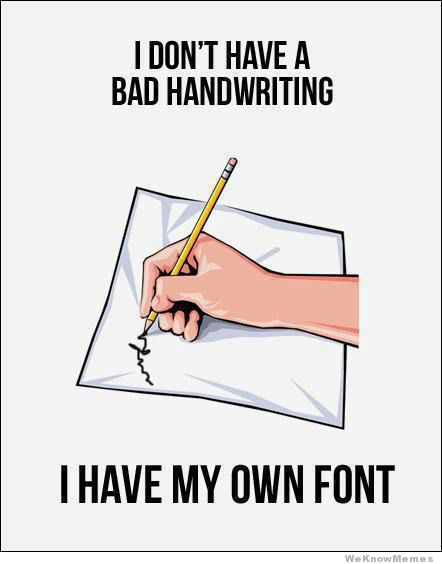
My daughter helped remind me of this. She’s in first grade now and she has terrible handwriting. It’s pretty illegible. Her teacher even commented on it last week. (Not that mine is ALL that much better...)

So what do I do? Well, I’m a teacher! And I try to be a good parent! I’d like to help her with this. Not knowing much about teaching first grade or about teaching handwriting, I go to the internet and find some worksheets.


Here’s how I envisioned helping my daughter work on her handwriting.
Step One: Give her the worksheet and time to work on it.
Step Two: Check on the worksheet.
Step Three: Handwriting improves due to practice. She is rewarded with a little extra TV time.

Uh, nope.

Here’s how it actually went down:
Step One: Give her worksheet
Step Two: Check on Worksheet. Handwriting is still illegible. But there’s more of the illegible writing there on the page now. More illegible writing.
Step Three: Handwriting doesn’t improve at all. She wants extra TV time anyway, since she put in her time and effort.

Out of frustration, I email her teacher,
“Dear Mrs. Teacher. We have been working on handwriting at home but it doesn't seem to be improving. Any suggestions?”

Her teacher emails me back, “It’s great that you’re helping! Here is the first grade handwriting curriculum that we use. Maybe that will help!”

Great! A better worksheet!

And then, I click on the email and open the attachment.

Uhhhhh....
Hmmmm......
Uh oh. This is not going to go the way I had envisioned.

Image result for teaching real teaching is messyIt sure looks like ... REAL TEACHING

Because I can see that, instead of a worksheet where we just do MORE of the same not-helping activity, instead the curriculum is
  1. Gradual Release-based
  2. Requires teacher (or parent in this case) to do the gradual releasing.
  3. Way, way better than getting a worksheet off the internet.

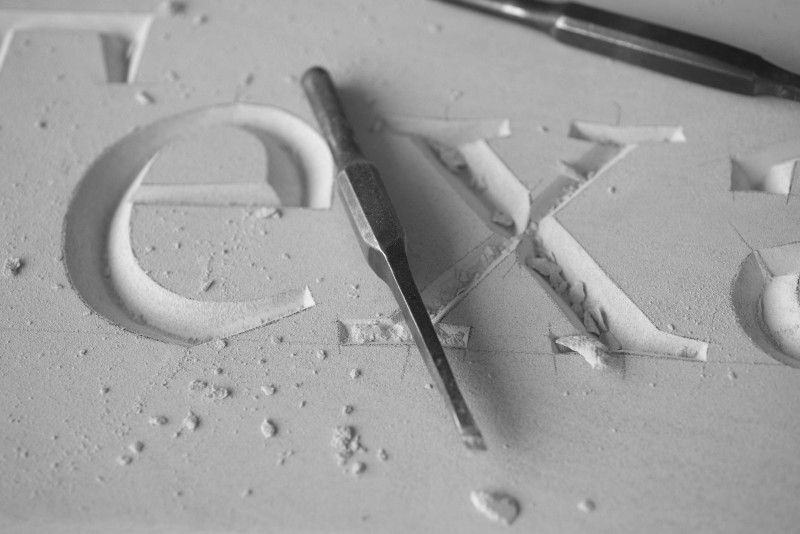
So we tried it. We sat down and I showed her how to form each letter. I read the script (did you know that there is a particular way to describe the formation of each letter? Me neither!)  We talked  through where on the line each letter begins. I modeled how to form each letter. She wrote it in the air with her finger and then wrote each letter on the line while I talked her through the process. THEN, we went back and evaluated the all letter “e”s we had written and re-did a few that weren’t up to par.

It was hard work, for both of us.

But, slowly, sooooo slowly, it started to pay off. Her letters are better formed. They aren’t up “in the air” or all over the page. They rest on the line like they’re supposed to.

So here’s what I learned.

  1. Sometimes, a kid doesn’t need MORE of the SAME to get better. Sometimes, they need it re-taught, probably a little differently.
  2. Worksheets rarely help kids actually learn, as independent work.
  3. Gradual release really does work amazingly well for skills.

When was the last time you DIDN’T get something on the first try? (It’s ok. It doesn’t mean anything bad. Just that you’re human and not perfect.) Was it using “Unify”? Was it a new lesson plan template? A piece of technology? A dinner recipe? A type of exercise?  A home improvement task? (I know it takes me three tries and four trips to Home Depot every time I try a new home improvement task...)

Horatio Caine - How do you know what to reteach? Use formative assessmentHow do you decide when to reteach? Is it ... the result of (whipping off my sunglasses) FORMATIVE ASSESSMENT? (Bam! Flashbacks to September’s Formative Assessment Month! Eeeooowwww!!) How DO you reteach concepts and benchmarks where your kids struggled?

We’ll get more into the nitty gritty next week.

As always, I love to hear from you! Email me newmantr@pcsb.org and talk about reteaching.

Tuesday, October 11, 2016

What Comes Next?

Happy month-after-formative-assessment-month

So we spent a month looking at types of formative assessment. So now what?

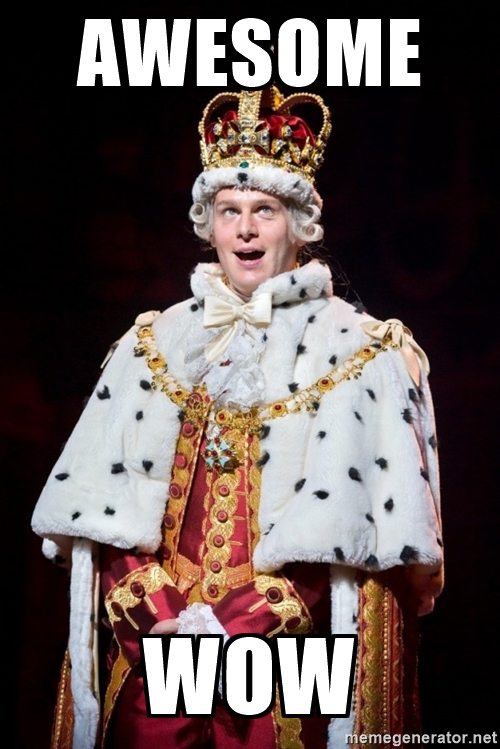
In the Best Musical Ever*, Hamilton, after the colonists win the American Revolution, the King of England, King George III sings gleefully,

What comes next?
You’ve been freed
Do you know how hard it is to lead?
You’re on your own
Awesome. Wow.
Do you have a clue what happens now?

*As rated unscientifically by me

I’d like to follow up to our thinking about formative assessment with King George’s first question (not his third question, which iis kind of snotty and jerky. His second question isn’t really related to this post.)

What comes next?

Meaning, what comes next, after you formatively assess your students? What comes next, after you see if they know the content or not -- in real time, once or even twice a class period?

What comes next?

The answer is  -- adapt.

Lesson plans are written (and often posted or emailed or shared...) but they’re not in stone. Despite the impression others may try to give you, your lesson plans should be living documents. In addition to the benchmarks, strategies, vocabulary terms, objectives, and whatever else your administration asks for ... you should include one thing FOR YOURSELF, not because someone asks for it.

You should include a contingency plan, based on your formative assessment.

Image result for heavy dLike Whitney Houston, your formative assessment asks “how will I know”?
Like Heavy D and the Boyz, you should be able to answer “now that we’ve found out, what are we going to do with it?”

Meaning, what do I do IF such-and-such happens....

What do I do ...
  • If my kids get my lesson more quickly than I thought?
  • If SOME of my kids get my lesson more quickly?
  • If SOME of my kids get the lesson quickly and SOME are lost?
  • If my lesson bombs and NONE of my kids get it?
  • If the kids get part of the lesson but not another part?

If you don’t want to put this stuff in your written turn-it-in lesson plans, that not my business. I’m not your boss or anyone’s supervisor.

BUT -- I would think it out, at least, for my lessons.

Two-steps:
  1. Formatively assess students
  2. Adapt lesson based on what the formative assessment tells you.

Some ideas on your adaptation --
  • How might you reteach to the whole class?
  • Are you ready to move on to the next part if they get it really quickly?
  • How might you use strategic grouping of students to help kids who struggle with different parts of the lesson?
  • How can you differentiate for ELL students, ESE students, gifted students, other groups?


There are a million ways to do this. More than I can fit in this email, at least!

What comes next? How do you adapt your lessons based on what you learn in your formative assessments? What’s working? What’s not?

I’d love to hear about your responses to formative assessment! As always, email me newmantr@pcsb.org

Thursday, October 6, 2016

Digital DBQ Might Change Your Life

Digital DBQ might change your life

Y’all know I LOVE a top-ten list, right?

I got to attend the Digital DBQ training (twice!) this week and I am DYING to try it with actual kids! If you didn’t get to go yet (or if you need a cheerleader for Digital DBQ anyway), please see my list below!

Top Ten Things I Love-Love-Love about Digital DBQ

10. You can blow up all the in-color images, huge, and dig into them. No more squinting at blurry copies of copies of copies or illegally scanning them into your computer. Everything is in color (except, you know, stuff that was photographed in black and white). Hooray for analyzing maps, photographs, artworks, and graphs!!!

9. You don’t have to teach the WHOLE thing digitally. If you can’t get a computer lab for a whole week, you can teach it blended -- do SOME digitally and SOME paper-and-pencil. I can even do some digitally as a whole-class, on the projector!

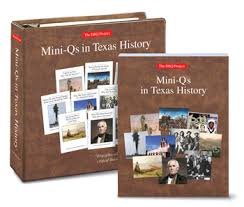
8. It gives me access to DBQs I may not have in my building. Like the Texas Mini-Qs. Or Salem Witch trial (which isn’t in older versions of the US Vol 1 Binder). High school teachers -- you just won the DBQ PRoject Lottery! Check it out....

7. It READS STUFF ALOUD to kids. With REAL ACTORS (not a Siri-sounding computer voice). I love that it reads the background essay and documents out loud to kids. I might even do that with the whole-class, in my projector!

6. It lets me differentiate easily. I can choose which kid gets which supports/accommodations. I can give my ELL learners a more-scaffolded Doc Analysis sheet and my regular kids a regular doc analysis sheet. I can decide that Student A, whose 504 says she reads a lot slower than her peers, should get  one less document. I can decide that Student B, who struggles with writing, gets the Guided Essay while other students work with the traditional outline. AND I DON’T HAVE TO DO ANY EXTRA PREP BUT SOME CLICKS! Woo-hoo!!

5. It mimics the FSA test. Kids take the FSA via computer and have tools like the ones available in Digital DBQ -- like highlighting, underlining, and note-taking. Kids can even click the boldface words and get definitions! It’s web-based so you don’t have to download anything. It even saves all the kids’ work every 3-5 seconds, so their work won’t disappear.


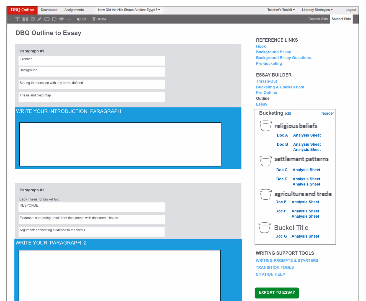
4. More writing support! The “Essay Builder” feature will let kids take their buckets and chickenfoot and helps them to construct their essay one chunk at a time. It gives them more prompts and more structure. Hooray for better writing!

3. More writing flexibility! Students can add or remove “buckets” -- and their chickenfoot will automatically add or remove chicken “toes” accordingly. This lets them have more flexibility over their essay structure so it’s not so rigid

2. You don’t have to input all your students into the system. All you have to do is give your kids a link (write it, put it in Portal, text it, project it) and have them login with their R2.D2 logins. No name-entering!!!


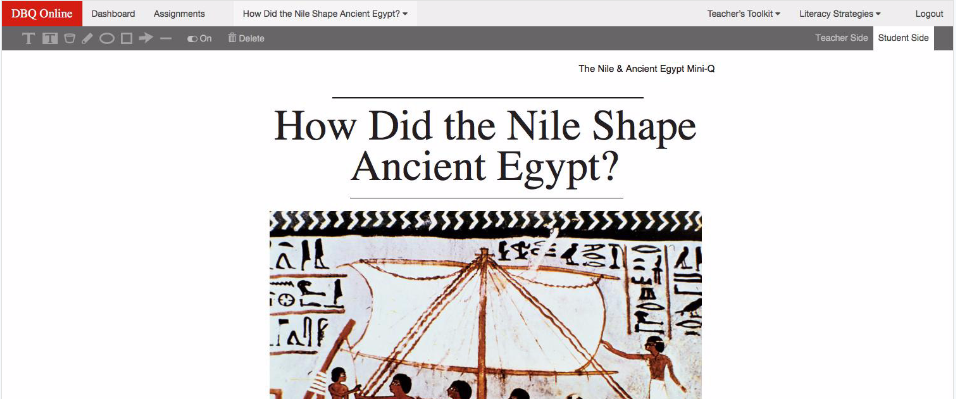
1. It’s JUST like the regular DBQs -- it looks the same, the documents and hook exercises and everything are the same -- it’s even the same font.  You still have the “student pages” and “teacher pages”. It’s not “one more new thing”. It’s the same, comfortable, familiar thing -- but on a computer!

A few quick notes... Our district has a one-year subscription to Digital DBQ. We need to try it out -- with our kids --- to decide if it’s worth paying for next year. AND if we DO decide that it’s worth paying for -- we have to show it by having our kids actually use it.

We are having Digital DBQ training this upcoming Wednesday, Oct 12 during the PD day for elementary and middle school teachers. This training will be offered both north county and south county, both morning and afternoon. If your principal will give you permission, we’d love to see you there! We hope to offer another evening training on this, too. We will let you know when it is scheduled!


Digital DBQ looks like an awesome tool! I hope it is as awesome for you as I think it will be. The only way to know is to try it out with your kids!

As always, I love to hear from you! Email me at newmantr@pcsb.org