Tuesday, October 16, 2018

Cut. It. Out.

Doc Strips.

No, this blog hasn’t gone “blue”. This is not about a person named “Doc” who does anything NSFW (not suitable for work). Instead, this is a strategy for digging into a document. It’s not like Chicken Strips.

So, there are a lot of ways to get kids to dig into a historical document. We can use Doc Analysis Sheets, we can use PERSIA, we can do “I See I Think I Wonder”, we can use “Looking 10x2”, and on and on.
Well, here’s another tool for your tool box and it’s great for struggling readers or high achieving readers.

It’s called Document Strips.  And it’s fairly simple to prep for.

Just Cut. It. Out.
The papers, I mean. Cut out the papers.

Strategy: Doc Strips
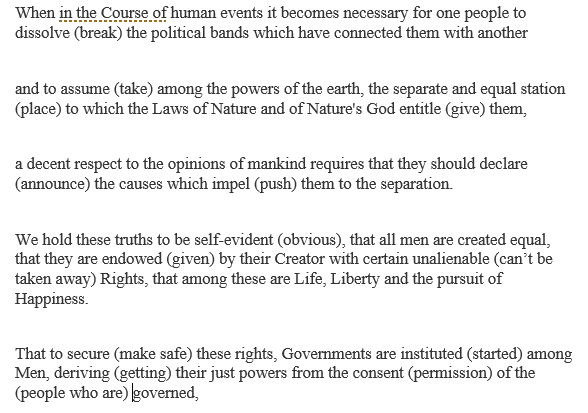
Why? To get kids to dig further into a text, to pique student curiosity, to help them read more closely.
What? Simply cut your documents into sentence (or phrase) strips. Then, have the kids use context clues to assemble the document back together!

How?  

1.      Choose a document that the kids can tackle (mostly) by themselves. Be sure to define or pre-teach any terms that might give the kids too much struggle. We don’t want them to give up because they come across an indecipherable word.
2.      Then, split the document into sentences (or phrases), one per line. Cut the strips and put each set in an envelope. Try not to give them clues!
3.      Give each group of students (partners work best, but 3s or 4s are ok) an envelope and instruct the groups to try to read the sentences and put them in order.
4.      Go around to the groups and check to see if they got the sentence (or phrase) strips in the correct order. If not, ask them WHY they put the sentences in that order. Often, they will either find their mistakes or they will have compelling evidence that shows solid thinking.
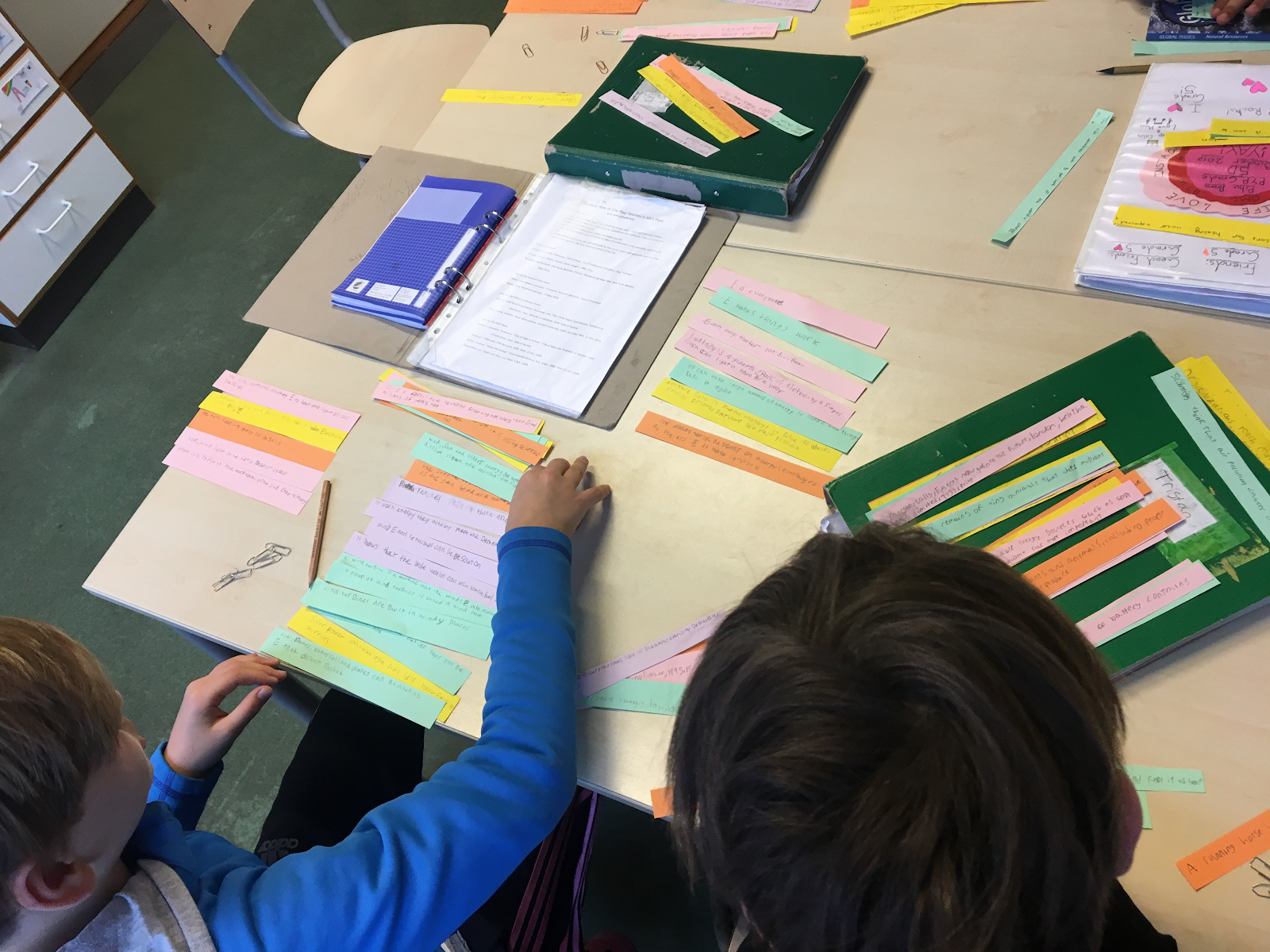
Why would this help? Well, it helps struggling readers to have to dig into the text and work to make sense of what they’re reading. It also helps to slow down your speed readers and keep them really understanding the text (as opposed to the strategy of scanning for answers that many readers have mastered). It also is a little more fun than reading without Doc Strips or than writing. It “looks” easy (even if it isn’t).


Pro Tip:  Keep an “answer key” uncut for yourself  to quickly check answers as you walk around the room.

How do I know if they got it? Have them do a quick formative assessment to check whether they understood the document. Ask them to tweet the doc, hashtag it, summarize it, illustrate it, etc. Let them put what they learned in a different format to show you that they “got it”.

All you have to do is Cut. It. Out.

This is an oldie but a goodie! Do you use it? Will you try it? As always, I love to hear from you! Email me at newmantr@pcsb.org

Tuesday, October 9, 2018

Oh, Crop!


Do you ever show your kids an image, political cartoon, map, chart graph, etc., and find that kids focus on the One Thing in the image and then miss all the “small stuff” and the details?

Oooorrrrr .....

Do you ever find a great image (or map or graph or chart or painting or photo or ....) in your book or somewhere and ask your kids, “Can you look at the small bottom left corner”, “do you see the thing near the top”? “Look at the third column on the graph” ...


And then take 10 minutes trying to get everyone to see what you’re trying to show them?

Oooorrrrrr ....
Do you ever struggle with fitting in multiple perspectives into some lessons?

I like to say,”Oh Crop!” when that happens.
(not really. But it sounds funny)

If you’d like to use more visuals in your class (paintings, sculptures, photographs, maps, charts, graphs, political cartoons, etc.), but you find it annoying and frustrating, check out this “Crop It” strategy!

Here it goes!

What is it? “Crop It” is a hands-on learning routine where teachers pose questions and students use paper cropping tools to deeply explore a visual primary source.

Why Use it?  Life moves pretty fast. We see thousands of images a day and we don’t give many of them more than a second or two of our attention. “Crop It” slows us down to provide time for students to think  and to examine the details that they might otherwise miss. It also helps them “get into the head” of the artist (or creator) of the visual.

Prep:
  1. Choose multiple images for your kids to dig into. Consider some such as:
    1. Various sources like cartoons, propaganda, advertisements, newspaper articles, etc.
    2. Sources that represent multiple perspectives on a topic
    3. Sources depicting the different people, places, events within a unit.
    4. Sources representing perspectives missing from the textbook.
  2. Print enough so that every kid (or pair of kids) have an image and a set of Crop It Tools. Multiple kids can have the same image. You don’t need thirty different images. You can have 5 or 6.
  3. Prepare some higher order thinking questions to accompany the images on the board or screen.

Step One:  Ask kids to choose an image that either:
  1. Connects to an experience they have had
  2. Relates to something they know about
  3. Leaves them with questions
  4. Evokes their curiosity
Step Two: Explore the Image
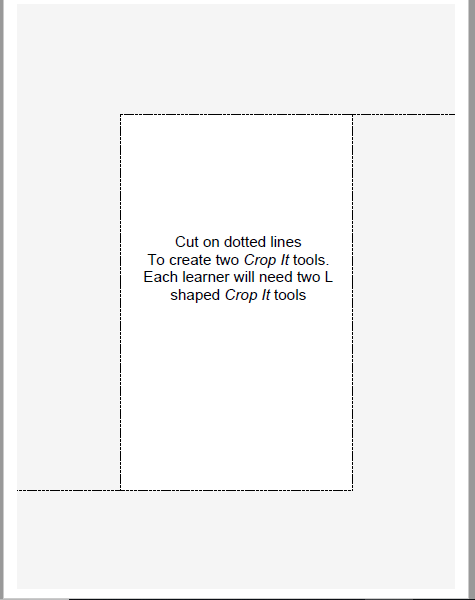
  1. Pass out two “Crop It” tools to each student.
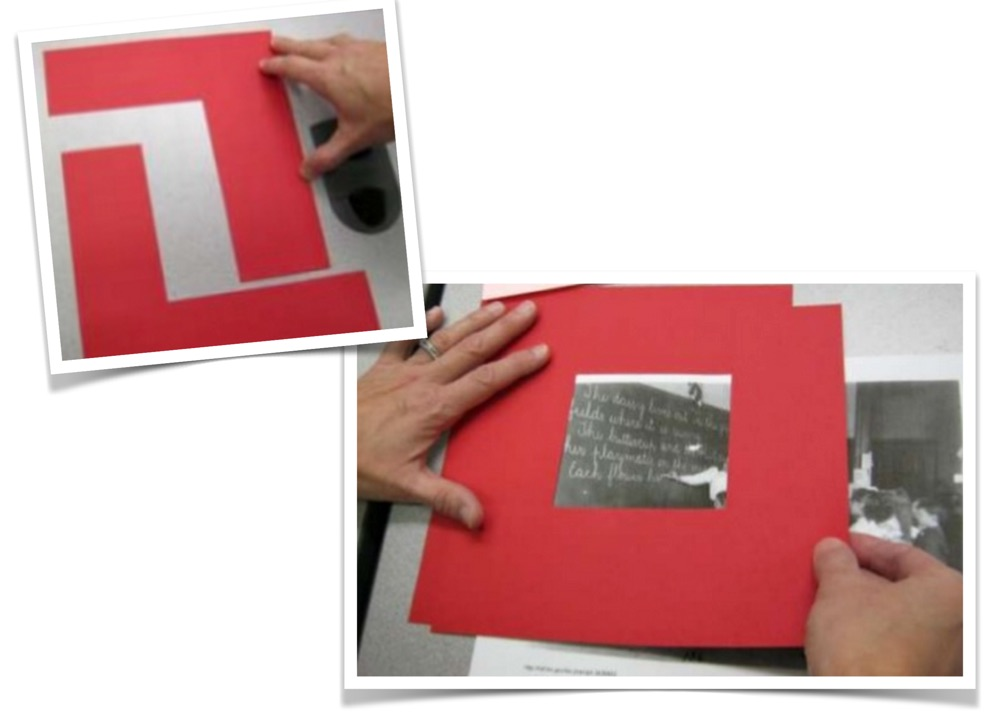
  2. Demonstrate how to use the “Crop It” tools to focus on a particular piece of a source. Students can make various sizes of triangles, rectangles, and lines of “crop” to focus attention on an important part of the source.
  3. Invite students to carefully explore their image by using the tools. Pose a question and ask students to look carefully and “crop” to show an answer.  Some example questions might include:
    1. Crop to show what first caught your eye. Think: Why did you notice this part?
    2. Crop to show who or what this image is mainly about. Think: Why is this person or thing important?
    3. Crop to a clue where this takes place. Think: What has happened at this place?
    4. Invite kids to use divergent thinking. Where ELSE could you crop to answer the question?
4. Let kids look at other students’ crops, to see what their images showed and what they focused on.


Step Three: Collect evidence.
  1. Collect evidence that students cropped on the board or on chart paper by asking them recall the details they cropped and list that evidence. These charts encourage students to notice details that can be used later.
  2. Relate the evidence back to your Learning Goal (benchmark) or LEarning targets or Essential Questions.

Be careful of ...
  • Asking too many questions during Step Two, Keep it moving quickly so kids don’t get off  task and so they stay focused on their primary source.

What do you think? Is it worth a try?  Do you have enough copies left this month to make a class set of “crop it” tools? Remember -- download them from here and make copies https://www.teachinghistory.org/sites/default/files/2018-08/crop_it_tools.pdf


Wednesday, October 3, 2018

The Candy Is About To Kick In

Happy October! It’s time for (some other people in some other states) to bust out their pumpkin spice lattes, sweaters, and halloween candy!

Don’t worry, y’all. I’m still sweatin’ right here in FL with you.

But I’ve seen the Halloween candy, too. It’s calling to me. I’m trying to behave  -- but it’s only Oct 3!! Only 28 more days until Halloween (when it’s socially acceptable to eat all the candy).

Here as we begin October together, I have been seeing a BUNCH of  classrooms where teacher-student relationships are amazing. I have been seeing some places where the kids who are unwilling to work in Class A are doing the hard work of thinking, growing, and learning in Class B. I have been seeing students who will yell and cuss at one teacher now settle in and practice self-correcting their language for another teacher. Kids who refuse to participate in one class actively leading a group in another class.

But I have also seen the Halloween Candy and I know where it’s going. Straight into those kids’ bloodstreams, ready to pump them up and give them a reason/excuse to act up.

Here is your friendly Public Service Announcement to remind all teachers out there that our students .... are not adults

They’re kids. Adolescents. Tweens & Teens.
Even sugared up, they’re still not adults (especially?)

And they’re still learning. They’re each a “work in progress”.

And they mess up. A Lot.

To be fair, I mess up a lot, too. Here are some examples of the many manifestations of my own imperfection:
  • My house is a mess right now.
  • I literally can’t remember when I last cleaned the inside of my fridge.
  • I haven’t worked out in 46 days in a row.
  • I ate cake three times last week.
  • I sent my kids to school with the wrong lunch boxes (each other’s)
  • I can’t get my kid to eat vegetables.  
  • I check my phone at stoplights.
  • I forgot to pay a weird walk-in-clinic bill in a reasonable amount of time because I thought insurance covered it and now it’s on my credit report.
  • I didn’t go to the dentist for a whole year.
  • I was snarky and checked my email a lot during a training last spring.
  • I had side conversations through a meeting recently.

I’m not perfect with responsibility and organization and timeliness either. Thank goodness that my boss (Hi, Michelle!) doesn’t dock points (or worse, dollars!) off me every time I do something less-than-perfectly.

My bosses, colleagues, and friends have always let me know where I need to improve. And honestly, natural consequences do that, too (Don’t clean? Have dirty house. Don’t turn in bill? Have to pay late fee.)

But they have never punished me because of the once-a-year day that I leave my laptop at home or because I forgot to fill out a form correctly (thanks, Kim!) or because sometimes a Wednesday email goes out on a Thursday (uh, life happens). When I mess up, those people in my life help me figure out what went wrong and how to fix it.

So -- how can we do more of that for kids? Kids have a LOT LESS experience with these things than we adults do. Kids are still learning and need support.

If we can forgive ourselves and the other adults in our lives -- why can’t we do that for our students? If the adults in their lives don’t have it all together perfectly yet (and some of the adults in their lives are really struggling!), why do we expect the kids to have responsibility and self-control and social skills and prioritization mastered?

I know that we know that kids aren’t “finished” people. They’re “still cooking”, still growing. So how can we assume goodwill and assume that a kid isn’t being an intentional jerk -- that he or she is instead feeling frustrated, confused, forgetful, unvalued, or like a failure.

When a kid acts out or doesn’t do what we ask or gives up or turns things in late (or not at all), or checks his phone, how can we help the kid do better next time?

How can we remember to approach student behavior from our relationship with the kids and from a point of helping the student actually learn from his or her mistakes?

What do you do to help you remember that they’re kids and that they’re still learning? How can we do more corrective help and keep up those relationships (even in candy season)?

I always love to hear from you! Email me at newmantr@pcsb.org
And have a piece of candy for me! I struggle with impulse control sometimes, too, just like the kids.

Wednesday, September 26, 2018

Teaching Hacks, The Look, and Monitoring


Teaching Hacks, The Look, and Monitoring
Image result for teaching hacks

Y’all know that I love Teaching Hacks! You know what I mean? Those Pinterest-y ideas for quick fixes in the classroom?

Here are a few of my faves ...
  1. Turn and Talks. All day, every day. Makes kids process learning and therefore RETAIN learning
  2. Having kids use Whiteboard markers to write ON the desks. And then baby wipes to remove. (so much more fun than paper!)
  3. Using Plickers to formatively assess in under 2 minutes. Because time is EVERYTHING to teachers. (except today they introduced a pay system?)
  4. Bathroom pass on a lanyard (because, ewww, where does the pass go when they’re using the facilities?)
  5. Written directions for everythingeverythingeverything. Every activity, assignment, everything with written directions on the board or screen. Helps ESE kids, ESOL kids, kids who have auditory processing issues, kids who just weren’t listening, kids who are flakey, and kids who are all over the place. If you write the directions down, half your management improves!

Ok, I’d like to add a new Teaching Hack to your list.

It’s so simple, but so rarely used.

It’s called “Read student work WHILE they’re working”

No, really. Stay with me!

Kids will trick you all the time. They can’t help it. They’re kids.  One favorite trick of most students is The Look.

This is different from the Teacher Look, the Mom Look or  The Administrator Look.

The Student Look is an “I’m innocent look”, maybe an “I’m thinking deeply look”, or even an “I am on task” look.

They use it all the time

Kids are great at looking busy. I used to happily walk around my classroom and monitor my students. I loved to walk around and do what  I THOUGHT was monitoring.

“Thanks for being on task, Destiny!”
“Let’s start our work, Carlos!”
“Brittany, you don’t have any work done! What have you been doing?”
“You’re almost done, Austin! Great job!”

What was wrong with those? I was monitoring for compliance, not for comprehension.

What’s the difference? I used to monitor to see if my kids were DOING their work, not if they were LEARNING what I wanted them to learn!

A kid can write stuff on paper all day but have no idea what we’re learning. They can be compliant by copying their friends’ words, they can be compliant by copying some things out of the book/packet, or they can be compliant just staying quiet and making wild guesses.

Kids can be tricksy. They can definitely LOOK busy but be missing the point.

I was constantly surprised AFTER students turned in their work and it was waaayyyy off, super wrong, or missed the point of the assignment/question entirely!

So how can we monitor for LEARNING? What’s the Teaching Hack here?

It’s so easy. Just read what they write WHILE they’re writing it.

I know we think we’re all already doing it. And maybe it was just me. But I see and hear lots of teachers monitoring around the room talking to kids about DOING work, not about WHAT they’re writing.

As you walk around the classroom, read what they write WHILE they are writing. Are they on point? Are their answers aligned to your question or are they off in left field? Do their answers read EXACTLY like the answers of the kid next to them? Are they wildly making stuff up? Are they copying some sort of answer out of the book without actually understanding it? Are they jotting down “IDK” for every third question?

And then -- when you see them on task but OFF-TRACK (not understanding), STOP and help them right then.

Don’t wait until kids turn in their work. Help them fix it right away, in the moment.

This takes EXACTLY as much effort as your monitoring for compliance does. You DO have to get up and walk around, just the same amount of steps. But it pays out waaayyyy more in student learning.

Totally worth it. Do mostly the same thing you are already doing but make it work better for you and your kids. Don’t get fooled by “The Student Look”. Monitor for LEARNING not for compliance.

Now that’s a Teaching Hack!!

Thoughts? Questions? Email me at newmantr@pcsb.org