Wednesday, May 9, 2018

Beach Ball Docs

Where are we in the summer countdown? Eleven student-days of school left, right? It sure is hard to get kids to review for exams when it feels like beach weather outside!!

Lets see if we can throw a bone (or a ball) to the beachy wanna-bes (um, me included!). Let’s play our next review game with a beach ball, to combine the two. And for fun. And learning.

So, for me, one of the hardest parts of review is getting past the lower-level thinking. Getting past the review guide or review packet or review game that involves a list of terms or concepts.

So, here’s a way to do review with DOCUMENTS!!!

Because, depending on your exam, the EOC/FSA/district final will include roughly about 50% stimulus-based questions (and most of those stimuli are documents).

So how can we review using primary and secondary source documents? Here goes...


Higher Order Review: Beach Ball Docs
Prep:
1.      Select a series of documents such as quotes, passages, images, political cartoons, maps, charts or graphs within a unit or across multiple units.
2.      Print out one set of documents for each group OR prepare a slideshow to project the documents for the students.
3.      In clear writing, write one of the following questions on each colored section of the beach ball (adapt as necessary). Pro tip: deflate the beach ball a little AFTER you write on it, so it lands with less bounce.
a.   When and/or Where?
b.   Causes and/or effects?
c.    Why was it written?
d.   What is the main idea?
e.   Make a connection to another topic in this course.
f.        What perspective does this document represent?
4.   Break students into small groups and give each group a beach ball and a printed set of documents OR project the documents whole class one-by-one.
Play:
5.      Explain to student that they will examine documents based on a variety of document analysis questions/prompts on their beach ball.
6.      Use a timer and select an appropriate amount of time students have to discuss each document.
7.      Instruct groups to roll the beach ball and analyze the document based on the question/prompt rolled. Student should discuss and come up with a group answer.
8.      Groups will record their answer and points on the tracking sheet based on a point system.
                    1 point- When?, Why?                                                                    
                    2 points- Cause(s)?, Effects(s)?                                                      
                    3 points- connection, main idea, perspective
9.      Students will repeat steps for each document.      
10.  The group with the most points based on accurate answers at the end of the allotted time wins!
Benefits of Beach Ball Docs:
  • Student collaboration and discussion.  
  • Students practice document analysis skills and higher order thinking.
  • Students examine documents with a different purpose each time.
  • Students have to connect documents with related concepts and terms.
Watch out for:
  • Kids getting off task. Circulate and “play” along to keep them on task.
  • Kids don’t discuss answers as a group. Encourage teams to come to a consensus before writing their answer on the tracking sheet.
  • There isn’t just one right answer. Tell students that it’s OK to have varying answers to each question/prompt on the beach ball for the same document. The idea is to get kids TALKING about the documents!

BTW, I have found beach balls at Walmart, Target, and Party City, and the dollar store. Generally for a dollar per beach ball, so you can buy one and play whole class, or you can buy several and have the kids play in smaller groups.

What do you think? Can you organize kids and documents and a beach ball or two and create meaningful, higher-order review? As always, I love to hear from you! Email me at newmantr@pcsb.org

Wednesday, May 2, 2018

Taboo Review

So, my absolutely favorite board game is Taboo. There was a period of time when I was in college that my roommate and I played it.  All. The Time. At one point, one of us could give the clue “green” and the other would know that the answer was “Indiana Jones”.

If you’re not familiar with the board game Taboo, you play it in teams. One member of each team gets a card that his or her teammates cannot see. That person tries to give clues to get the members of his or her team to say the top word on the card -- but the clue-giver cannot say the top word OR any of the words listed below on the card. Those words are “taboo”. You can’t say them.

So we recently adapted this game for use as a Higher Order Review game... and discovered that half the internet has made versions for their content areas. Particularly, biology teachers seem to have made a bunch of cards, but I have seen some SS ones. Or, you can make your own.


But if you want to adapt this for your classroom, here you go!

Higher Order Review: Taboo
Prep:
1.      Create/compile a list of vocab terms – AND the words most associated with those terms. (ex. Enlightenment: Locke, Montesquieu, social contract). Make a card for each with the MAIN word at the top and the hints below. You can even have that one class that you have for three hours today make the cards for the other classes.
2.      Print and cut  several decks of those cards so you can have several Taboo games going at once.
3.      Divide your class into 2 or 3 main groups and divide each group into two teams.

Play:
4.   Explain that each team will get one minute on the clock/watch/phone timer. During that minute, one member of the team will be the “Delegate” and will try to get his team to say the TOP term, WITHOUT using any of the hint terms below it. If he or she uses the word, a variation of the word, or one of the hint words, that card must pass and no one can get the point.  The Delegate must try to get his own teammates to guess the top word.
5.   When his team guesses one word, he may move on to the next card and continue until time is up.
6.   A member of the opposite team will be the “Checker and Balancer” and will look over the delegate’s shoulder to make sure he or she does not use the word, the hint words, or any variations. If the Checker and Balancer catches the Delegate using a “Taboo” word, that card is discarded
7.   Teams take one-minute turns until one team reaches a specified goal (10 points, for example)
8.   Discarded cards may be used again or not, depending on teacher preference.
Benefits of Taboo Game:
  • Students examine multiple facets of a concept or vocab term.
  • Students are listening to usage and application of their vocab terms and practicing using and applying those terms.
  • Active and engaging activity.
Watch Out For:
  • Kids struggling to remember terms. Maybe let them use their notes? Or a Word Wall?
  • Kids cheating. That’s why we have a Checker and Balancer.
  • Kids off task. Be sure to circulate and monitor both behavior and understanding.
  • Kids arguing over “you said the word/no I didn’t”. Please be a careful monitor to make sure kids are playing fairly. You might strategically group kids so kids who tend to NOT get along are not playing directly against each other.

So, are you up for it? Or is it too taboo for you? (Pun points!) Can you play Taboo with your students to help them use higher order thinking for review?

Let me know how it goes! As always, I love to hear from you!

-Tracy

Monday, April 23, 2018

SWAT Team

So, It’s that time of year...  Time for review games!

A reminder -- none of our kids (NOT A SINGLE ONE!!) are going to take a low-level, facts-only, memorization EOC or exam. I can only speak for Social Studies, but I suspect we are not alone on this...

Our EOC and final exams are written on the rough guidelines of 20-60-20. Meaning, ROUGHLY 20% of the test is Level 1 thinking, 60% of the test is Level 2 thinking, and 20% of the test is Level 3 thinking.


Which means 80% (!!) of the test is NOT recall-level content.

So, if most of the test is higher order thinking, how can I use review games -- WITHOUT dumbing the review games down to lower level?

Well, I have a couple for you. Let’s start with the rowdiest one, just for fun.

And, ummmm, you’re going to need two flyswatters and some masking tape.

Higher Order Review: Swat Teams
Prep:
1.      Create/compile a list of vocab terms – and examples or non-examples of each. These examples could be much like the stimuli on their assessment, quotes, excerpts, images, etc. (I wouldn’t use straight definitions because students will memorize them and it won’t be higher order thinking and it won’t help them much on their EOC or final)
2.      Post the words on a wall/bulletin board that kids can access.  (not your SMARTBOARD!). A hallway might be a good option if your room is too small.
3.      Put a tape line on your floor that The Swatters need to be behind, a foot or two away from the wall.
4.      Divide class into two equal groups and line them up behind each other and sit or stand in order.
Play:
5.   Explain to the class that each team will have the first student in line “play” at a time. When they have completed their turn, out of the two teams, the first student to “swat” the correct answer gets the point for his or her team. When the student is done with his or her turn, that student goes to the end of the line.  
6.   All students in line need to listen to the example since they might get a different example for the same word. They will listen better if they know they’re hearing “clues” about a word they might get.
7.   Read the example or non-example to the group. (Be clear if it is a NOT example). The two students with the fly swatters listen to the example.
8.   The first student to swat the correct term gets the point for his or her team.
9.   The team with the most points wins.
Benefits of Swatter Game:
  • Students examine multiple facets of a concept or vocab term.
  • Students are listening to usage and application of their vocab terms and practicing using and applying those terms.
  • Active and engaging activity.
  • Fun can increase serotonin, which can improve memory, pride in work well done, and confidence.
Watch Out For:
  • Kids struggling to remember terms. Maybe let them use their notes?  
  • Kids acting up in line.  Maybe take away points for teams not listening? Or remind students that if the Swatter can’t hear the hint he or she can’t get the point.
  • Kids swatting each other.  The child who uses a flyswatter on another child is instantly removed from the game, his team loses points, and you use the discipline consequence for that kid that you would normally use. Please DO NOT punish the entire class for one kid who acts like a fool.


If it were me, I think I might use Civics 3.1 & 3.2 and post the various forms and systems of government and then give examples, descriptions, or connections for the kids to swat.

Are you brave enough to give two kids fly swatters -- and let LEARNING and REVIEW happen? Can you write a few examples and descriptions that use higher-order thinking? Are you BRAVE enough to try this game?

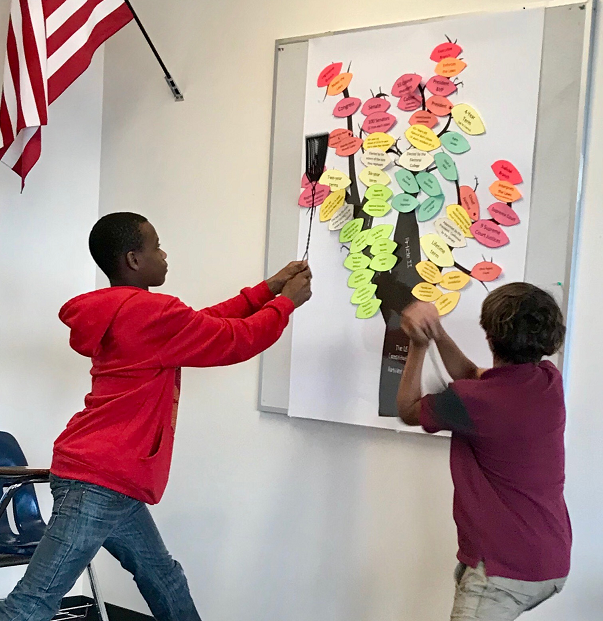
If so, email me and let me know how it goes. You’re welcome to send pix of  the game if it’s as hilarious as it was at a PCSB middle school this week with the Three Branches Tree.... Email me at newmantr@pcsb.org

-Tracy

Thursday, April 19, 2018

Multiple Perspectives

Do your kids look at history like, well, um, ... kids? Do they assume that everything in history  was inevitable? Do they assume that everything in history happened for a “logical, purposeful” reason?

Your kids aren’t alone. Plenty of adults also struggle with the idea that things in history were “meant to be”.

But not everything HAD to turn out the way it did and it’s useful for kids to put on their “Multiple Perspective Glasses” and see things through someone else’s eyes.

Here’s a strategy called “PMI” which is a way of looking at an issue from multiple viewpoints. It’s easy for us-in-2018 to look at history and see inevitability in how things turned out and think “of course things turned out that way! Was there ever a question?”


Yes.

There were hundreds of questions in history that had many very real possibilities of turning out differently.

Instead of students believing in the inevitability of history, it’s important to look at history through the eyes of  people at the time period and examining it the way they might have.

A great strategy for this is called “PMI”.

P= Plus (or positives)
M= Minus (or negatives)
I = Interesting

Pose an interesting question from history -- a “what if” or a “what would you do?” question like ...
  • Should Truman drop the atomic bomb?
  • What if Radical Republicans kept reconstruction going strong for another decade or two?
  • What if Texas had remained an independent nation?
  • What if the Founders had left slavery out of the Constitution entirely?
  • Should the Cold War get “hot” and the US and USSR fight directly?
  • What if Kenya had invested in infrastructure during decolonization?
  • Should LBJ sign the Civil Rights Act of 1968?
  • Should Lincoln free ALL the slaves with an Emancipation Proclamation?
  • Should the Supreme Court be the best place to decide the 2000 presidential election?

Once you have a good, debatable, multiple perspective question, then you can ask the kids to  tell you the positives of the situation, the negatives, and interesting points.

As with any new skill, I would model this the first time. Then, I would have students practice using it in groups. Finally, I would let them try it out on their own.

Download one from here https://lo.unisa.edu.au/mod/book/view.php?id=611321&chapterid=100451 and let me know how it goes!

Multiple perspectives isn’t just a “nice to know”. It’s crucial for our students as future voters, as internet users, and as participants in civic dialogue about everything from building new roads to gun control to race relations to balancing the budget. Every topic in the news requires the skill of multiple perspectives -- and so do our EOCs and Final Exams!

As always, try it and let me know how it goes!
-Tracy